Yes, they’ve been here for the taking for over 70 years!
Landlocked Atlantic salmon first got stocked in New Jersey during the 1950s, according to online sources. New Wawayanda Lake’s 119 acres, now named Lake Aeroflex, and the 255 acres of Wawayanda Lake proper, amounted to salmon in privately owned waters. Wawayanda was stocked privately, but by what I’ve gathered, the state was involved in stocking New Wawayanda. Salmon also got stocked by the state into Warren County’s Mountain Lake, privately owned then by a homeowner’s community.
In 1951, an 8-pound landlocked salmon got caught in New Wawayanda Lake, occupying the state record for 68 years. Because of the date of that record, it seems safe to say stockings originated in the 1940s, despite the lack of records to support that assumption. If large salmon got stocked in 1950, a situation of rapid growth, with herring forage having been transplanted from Lake Hopatcong, might account for that record. But the salmon would have been very large when stocked; not likely.
In recent times, I believe we enjoy a better situation. All three lakes I’ve mentioned are public now, and lakes Wawayanda and Aeroflex have been stocked by the state since 2006. Tilcon Lake’s 88 acres began receiving stockings in 2016, and when stocking began at 650-acre Merrill Creek Reservoir in 2018, that amounted to 325 salmon. The reservoir has been stocked annually ever since – 680 salmon in 2024, for example. More salmon per acre getting stocked into the three lakes is due, at least in part, to their earlier inclusion in the stocking program.
I believe the stage is set for another state record. Runelvy Rodriguez broke one at Lake Aeroflex on June 2, 2019, when she caught an 8-pound, 5-ounce landlocked on a deeply trolled spoon. Two years later, and just 3 years after the first salmon got stocked there, Merrill Creek Reservoir came through for Joe Satkowski. He caught the present 8-pound, 10-ounce state record on a homemade jig on September 30, 2021. You can just imagine how big some of the salmon in that reservoir—210 feet deep—might be by now. It holds a healthy herring population and is loaded with shrimp-like Gammarus or scuds. After all, the world record landlocked salmon weighed 26 pounds, 12 ounces, caught in Michigan’s Torch Lake in 2010.
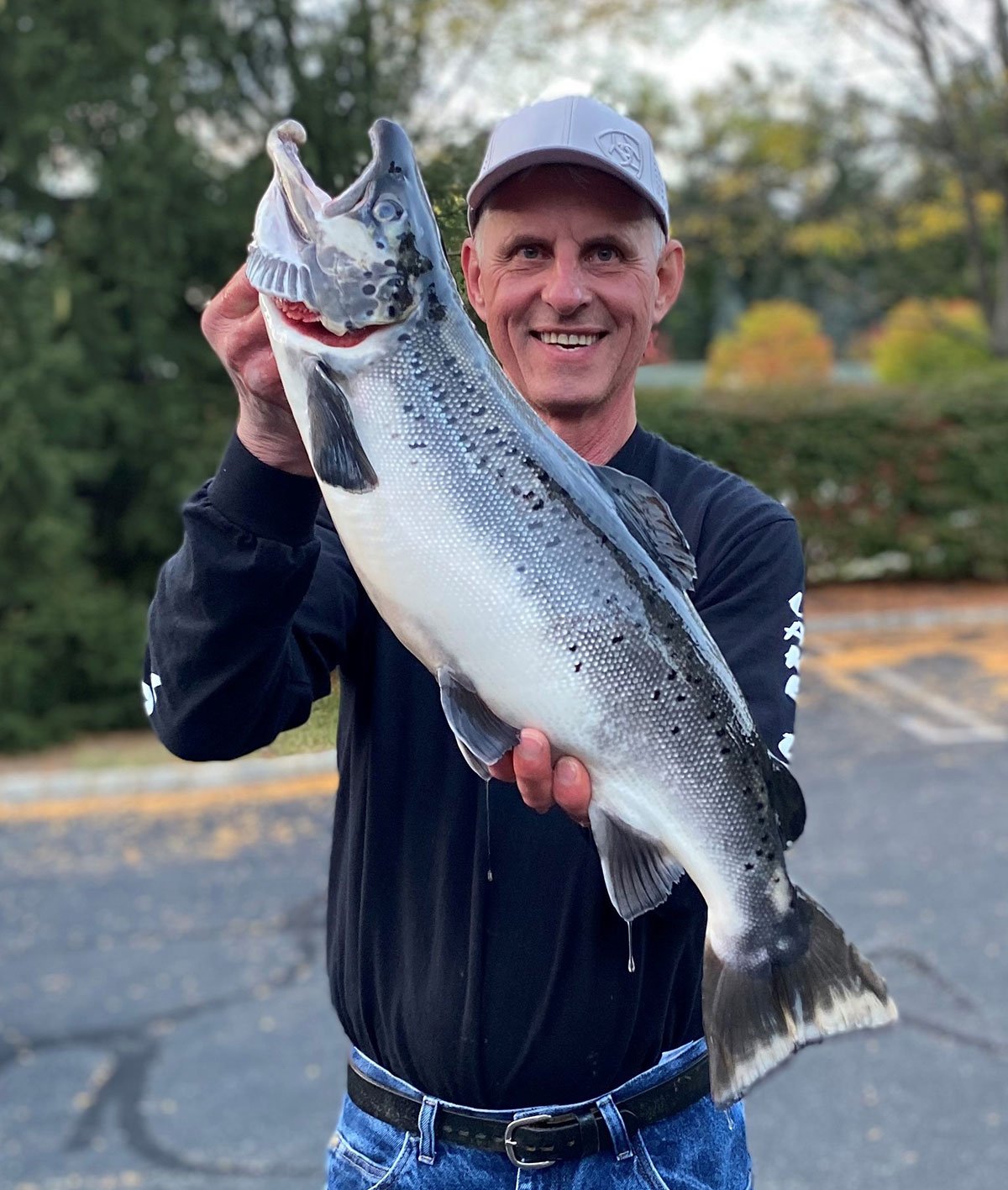
Fall Salmon
Salmon are stocked in October and November after surface temps fall below 60 degrees. They average 14 to 15 inches long. I’ve never noticed anglers flocking for them like they do for trout freshly planted in streams. Just as well, because the salmon are a holdover fishery. They get caught every season.
During the fall, fishing from shore is popular because it produces. Spoons, spinners, and jerkbaits on light line. They all work. Light line involves risk, however, because pickerel hit the same offerings, and when any does, it might cut that line. All the lakes and the reservoir stocked with salmon have pickerel populations. Regardless, 4-pound test fluorocarbon—to be sure the salmon don’t see or feel the line—is a good idea in these clear waters. Most of the time, you’re casting open water, not running the lure too close to the weeds occupied by pickerel.
The water you’ll access from shore probably gets deep fast, but salmon will be anywhere from the bottom to the surface. Retrieve your offerings here and there. Spoons, spinners, and jerkbaits are usually better on the small side. Given the choice between a quarter-ounce and a 1/8-ounce Phoebe spoon, I reach for the smaller, because I’ve caught salmon on that size. None on the larger, though I’ve tried.
And yet a larger lure will allow you to reach water you can’t reach with smaller. If you’re not catching salmon, it may make sense to size up. Casting closer to where you stand may be all too limiting. Larger lures will also allow you to cast further along shorelines you can’t access by foot.

Winter Hardwater
We enjoyed a serious ice season early this year, and I got to witness stunning salmon action on Lake Aeroflex. Someone in a party next to mine hooked a nice one on a shiner suspended 4 feet under the spool of a tip-up. The salmon weighed about 3 pounds. Minutes later another got caught by a jigger from the same party, so I believed a pod had moved through. The party catching the fish stood over water about 35 feet deep. That day I caught an 18-inch largemouth bass; my friend Oliver Round caught a 22-inch pickerel, and Brian Cronk wasn’t with us the whole time, but we tried for salmon with half our tip-ups, getting a few flags. We wanted salmon most.
One tactic is to use tiny treble hooks; size 18 is worth its weight in gold. Carefully impale little fathead minnows and use 2-pound test fluorocarbon leaders. Suspend the baits 2 feet under tip-up spools. The example of the Aeroflex 3-pounder, however, suggests that shiners and heavier leader might do as well, but make sure the leader is fluorocarbon, because fluorocarbon is almost invisible and resists ice abrasion.
You can try a variety of approaches. Place some shiners a little deeper under tip-ups. Fatheads near the ice under other tip-ups. And after all, the second salmon we witnessed on Aeroflex got jigged up from the bottom—the nick in my supposition of a pod having moved through. Did a pod spread that far apart? Who knows, really?
Many of the salmon caught through the ice do succumb to jigging. Some of them about 2 feet down. Others at the bottom. Still others midway. To locate salmon anywhere in the water column, a lot of ice anglers use sonar to give them a clear picture. A screen can enable the witnessing of a salmon approaching a jig and slamming it. I’ve seen sonar used with intense mental focus and concentration. It pays off, though the units can be very expensive. Speaking for myself, I haven’t tried it yet, though there’s no reason why I can’t bring along my portable unit and put the transducer in a hole.
Jiggers use 1/16-ounce jigs tipped with fatheads. Or they use little Kastmasters or other silvery spoons that resemble small herring. Both approaches produce. (Herring aren’t for sale during the winter.)
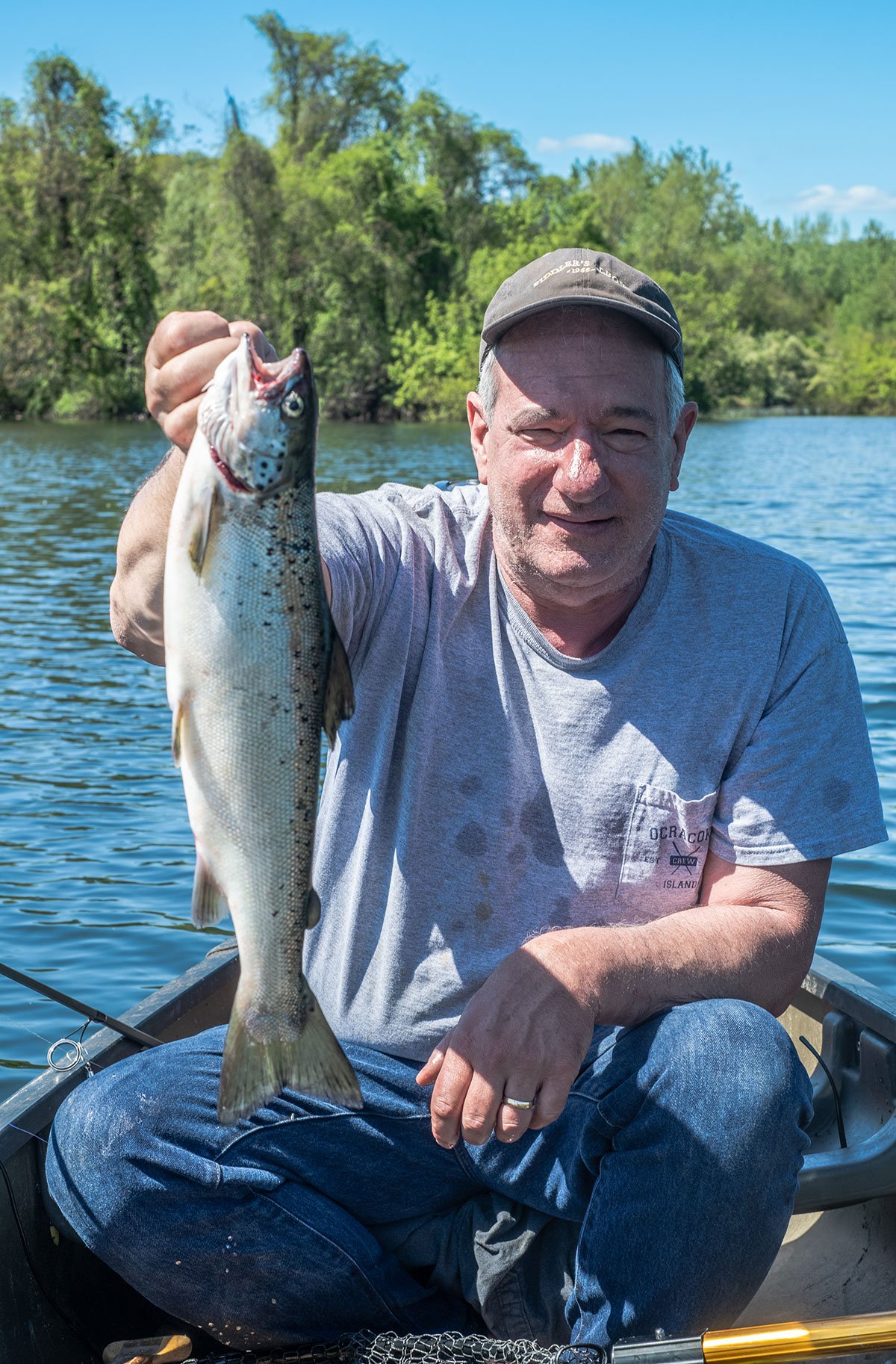
After The Ice
Spring comes on gradually, beginning at ice out. People complain of summer beginning with the first day in the 80s, but it often seems as if winter is dragging on through April. Both the months of March and April, however, offer anglers the possibility of hooking salmon from the bank. The same lures that work in the fall will work now. Some anglers slip shiners under bobbers.
By the first weeks of May, water temperatures at Tilcon typically climb into the mid-60s to about 70, aquatic vegetation filling out. The deeper lakes and reservoirs are warming, too, but not quite as quickly. Herring, if not spawning yet, are getting ready to among weeds. “Bait balls” can sometimes be observed not only with bass and pickerel on them. Salmon shoot into weedy shallows of 7 feet or shallower, picking off some of those herring. They’ll hit spoons or topwater plugs, although using light line test is absurdly risky, given the pickerel. Among such weeds, I caught a salmon on a jerkbait 4-1/2 inches long. At the surface. That plug was tied to 20-pound-test fluorocarbon, so go figure.
In general, salmon are shallow in May. Brenden Kuprel and I have hooked them using little 2-1/2-inch paddletails on 1/16-ounce jigs. Right at the side of the canoe when we positioned only yards from shore. Another tactic is to cast spinners or Phoebe spoons not too near the outside edges of weeds where pickerel are less likely to strike. There you can use light line test with some safety. You can also troll.
In June, salmon generally suspend in the depths. Most of Tilcon Lake is about 35 feet deep, where especially late in the day, salmon rise to bust herring schooling at the surface. The crashing sounds and sight of splashes is dramatic. Some of the salmon are good-sized and you can see they are. By approaching the mayhem quietly, get into position to cast the area with a spinner or a Phoebe. As a last resort, repeatedly troll. I’ve seen herring get busted over deeper Lake Aeroflex water, and at Lake Wawayanda, anglers drift live herring 15 feet down in 60 and 70 feet of water.
You don’t necessarily have to troll a spoon deep in June, although that does catch salmon. I’ve hooked them on a Phoebe trolled at the surface nearly into July. I think Phoebes are especially effective when the sun’s out, as the reflected light makes them especially visible from deeper down in clear water. Salmon are very swift swimmers and will shoot upward to take something shiny. That’s not the only time Phoebes work at the surface, though. I once caught a May salmon on a trolled Phoebe at dusk. I also caught a nice largemouth that way during daylit hours over mid-lake, 35-foot depths, but I knew the salmon because it streaked left to right and right to left at high speed.
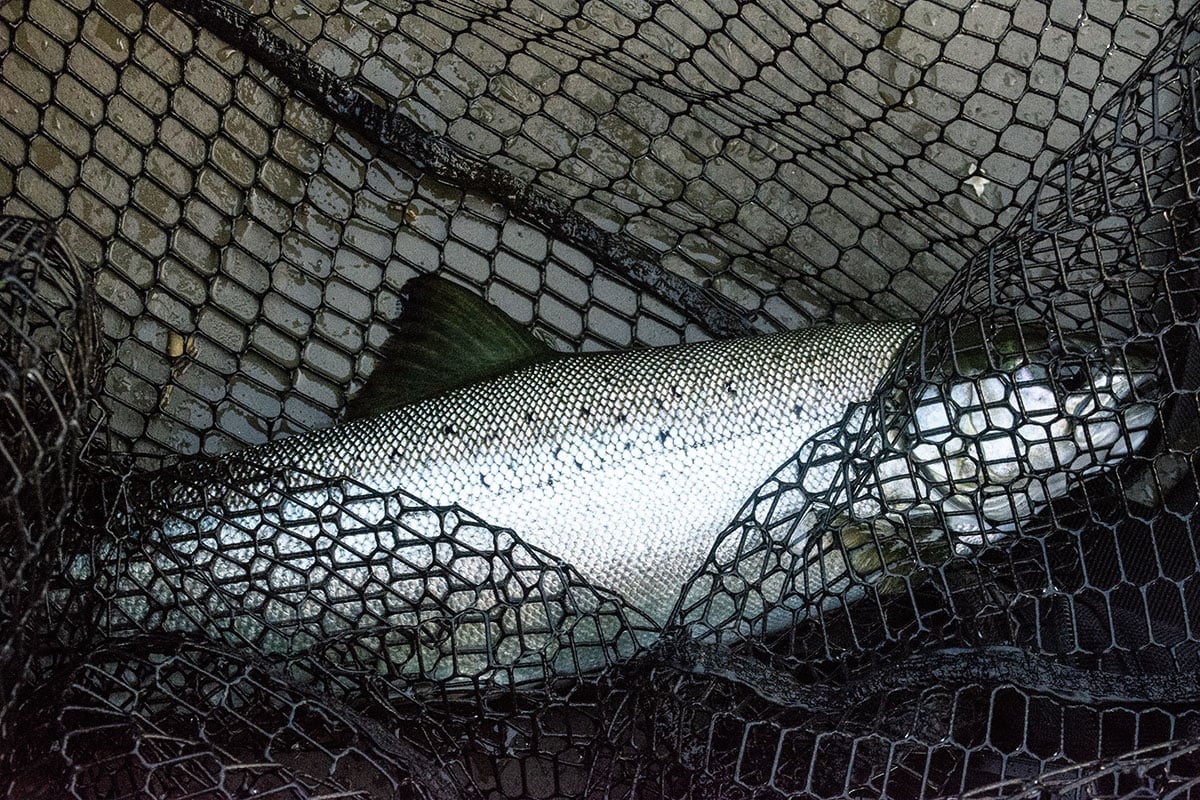
Dog Days Are Tough
It’s not impossible to catch salmon during the summer, but I don’t believe you’ll see any evidence of them, besides on the graph. By July, they stop busting herring at the surface and feed on herring gone deep. Weeds fill out, and you don’t see herring associated with them, nor will you likely see them near the surface, as they prefer cooler temperatures, too.
All the salmon-stocked lakes and the reservoir have oxygen-rich depths greater than 50 feet. Wikipedia lists Merrill Creek Reservoir’s mean depth at 75 feet. Lake Aeroflex has a mean depth of 40 and is 110 feet at most. Lake Wawayanda reaches depths of 90 feet and Tilcon Lake 55 feet.
Once during August, my son and I trolled Tilcon, paying attention to the graph and marking very few fish. Until we motored over the deepest water—where fish marked all over near bottom. Naturally, I reached for small Kastmasters. We jigged and jigged, right on the noses of those fish. Nothing happened until Matt reeled in at high speed, a salmon leaping out of the water behind the metal and almost into the squareback canoe!
We tried more speed jigging, for nothing. That doesn’t mean it won’t work another time. On another occasion during the summer on Lake Wawayanda, Matt and I had a bucket of shiners in the boat. A big fish marked on the graph, suspended 57 feet down. Using a large split shot, he lowered a shiner to it, got hit, and set the hook on a good fish. I saw the rod doubled over, but then I saw it straighten out, the fish gone.