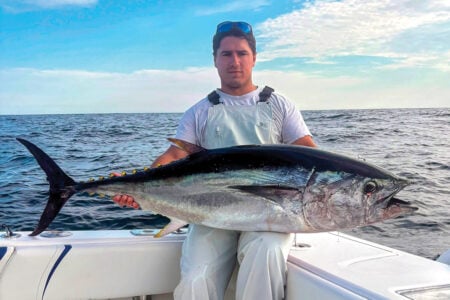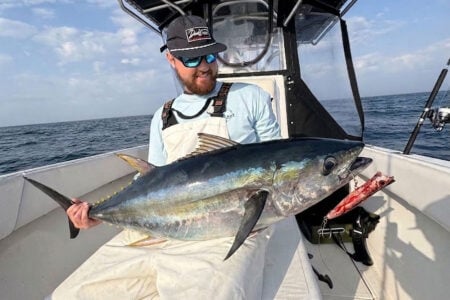
A deep dive into a method getting more popular with each passing season
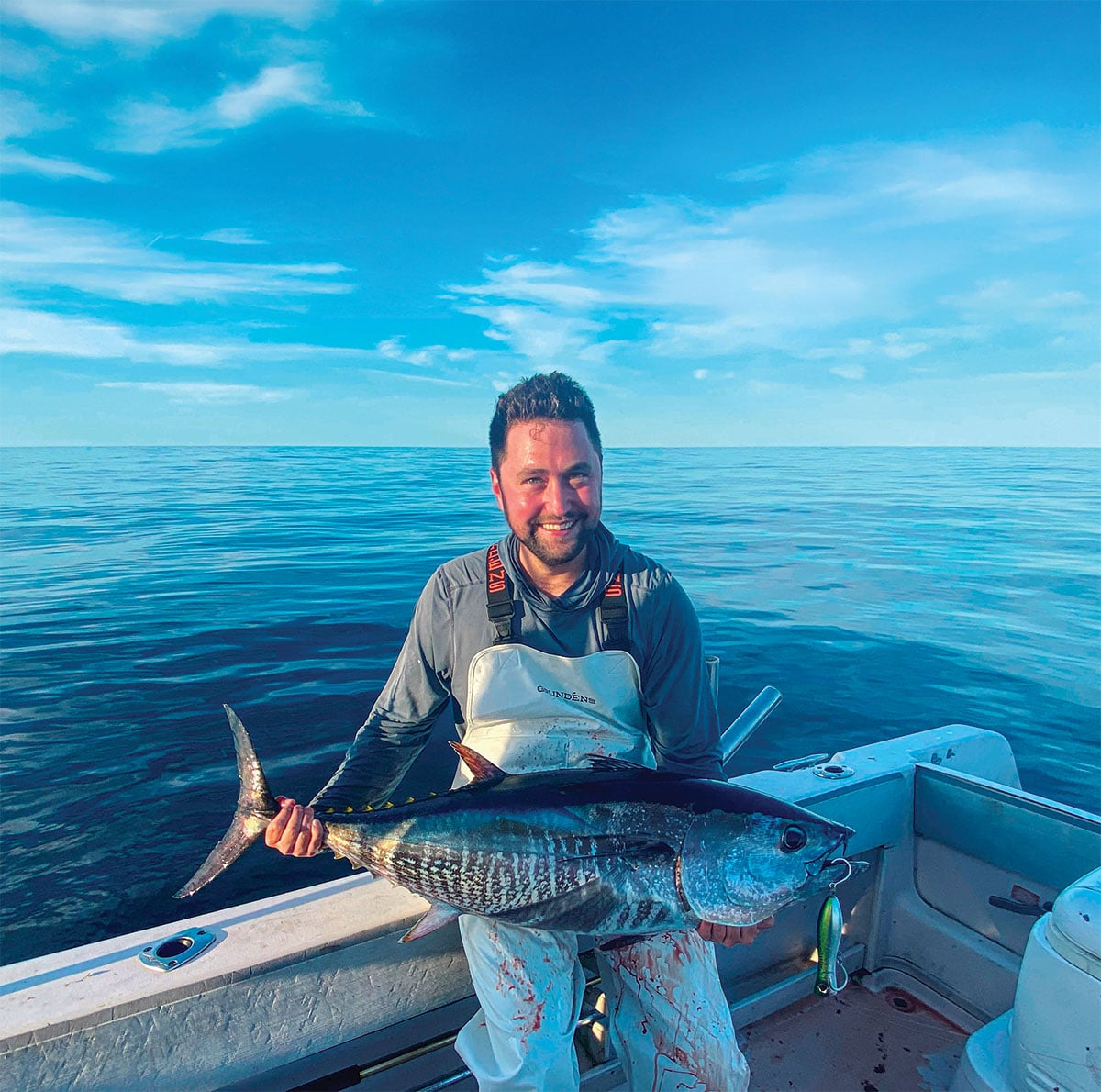
There are a number of ways to catch tuna—trolling, jigging, live bait, dead bait, even dragger hopping using multiple techniques. Where any of these methods can work at the right moment, none, in my experience, can equate to the absolute adrenaline rush of taking a tuna on or near the surface.
To set some realistic parameters, we’ll define “topwater tuna” as being anywhere from sea level down to about 10 feet under the surface.
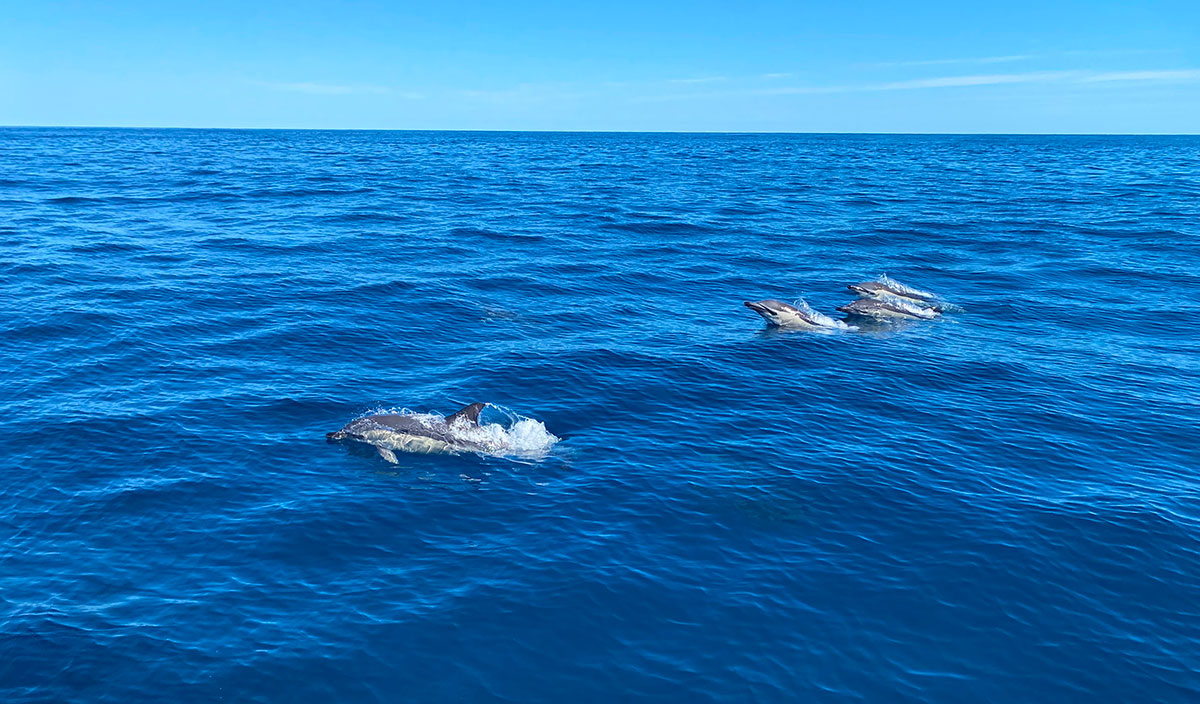
Unlike blind trolling or chunking, trolling/chunking near sea life, or trolling/chunking specific submarine structure like wrecks and canyon ledges, embracing the concept of casting to topwater tuna requires specific rules of engagement. Sure, blind fan-casting into a flock of birds sitting quietly on the surface might lead to a stray fish every so often, but targeted, accurate casts to foamers (tuna whacking bait on the surface), birds diving in the water on terrified baitfish schools, bubble feeds, or terrified skippies and bonito, or leading the front of a traveling porpoise pod, might get you a lot more action and consistent results.
This is the epitome of “run-and-gun” tuna fishing. Find some life, get over to the spot, make a few casts, and repeat if you don’t get a strike.
Walk The Walk
Depending on the size of your boat, and the amount of cockpit or deck space forward, anywhere from one to three anglers can walk the walk, casting into a potential spot and then sliding down the side of the boat during the retrieve to allow the next angler a chance. Having a good set of binoculars (especially the stabilized variety) can go a long way to put you at the top of the food chain, since you will now expand your vision in your efforts to spot the telltale signs before anyone else in the fleet gets wind of your whereabouts.
When practicing the proven run-and-gun dance steps, I try to get upwind of the melee on the surface, cut my engine, and drift down into the chaos. This tactic also gets my anglers some added distance on the downwind casts, allowing me a few more yards of separation from my boat to the surface activity. The one wild card in this equation is any other boat or boats that try to crash the party. Not everyone with a large, expensive, quad-outboard boat is considerate or respectful of topwater tuna protocol.
I have been practicing a variation of this theme over the past few seasons that has its moments. I’ll work an area that has potential, reduce my trolling spread from seven outfits to five, while actively seeking out the aforementioned bird, whale, or porpoise pod life. If we get an unplanned casting opportunity anywhere in a 180-degree arc in front of my console, I’ll momentarily chop my throttle to idle speed in forward gear and signal the angler to cast a popping plug or twitchbait into the melee that has suddenly appeared on the surface.
There has to be excellent communication between operator and angler to deploy this specific approach, but it has paid off for me in the past. You will get one or two quick casts max using this approach, and if there are no takers, bring the trolling baits back up to speed (typically 6 to 6.5 knots), make sure there are no tangles, and start the process all over again.
Hardware & Adjustments
When looking through the potential array of possibilities for tuna-grade surface and sub-surface lures, the choices are almost endless. But there are some basic requirements that should be met. To get a manufacturer’s perspective on the topic, I reached out to Capt. Mike Hogan of Massachusetts-based Hogy Lures. “We believe catch-and-release should be standard practice in topwater fishing, and single inline hooks dramatically reduce injury and foul-hooking, especially in the face and gills,” said Capt. Hogan, adding, “We’ve tested this system extensively and found no major drop-off in landing rates compared to standard trebles. It’s just a faster, cleaner release and healthier fish.”
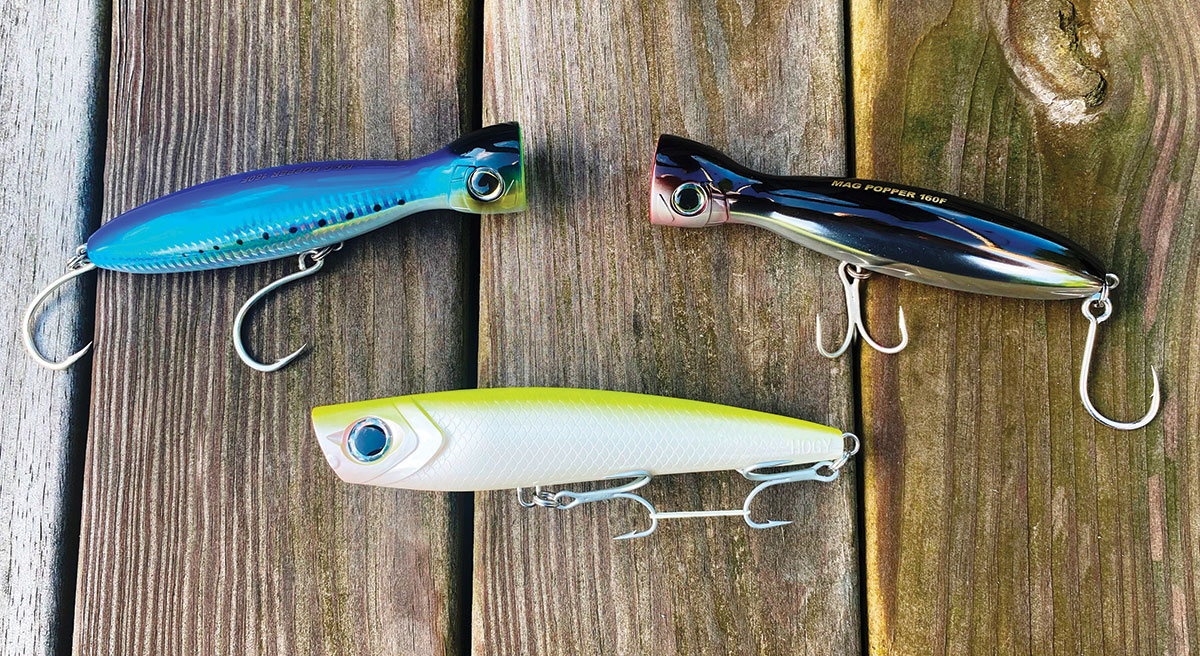
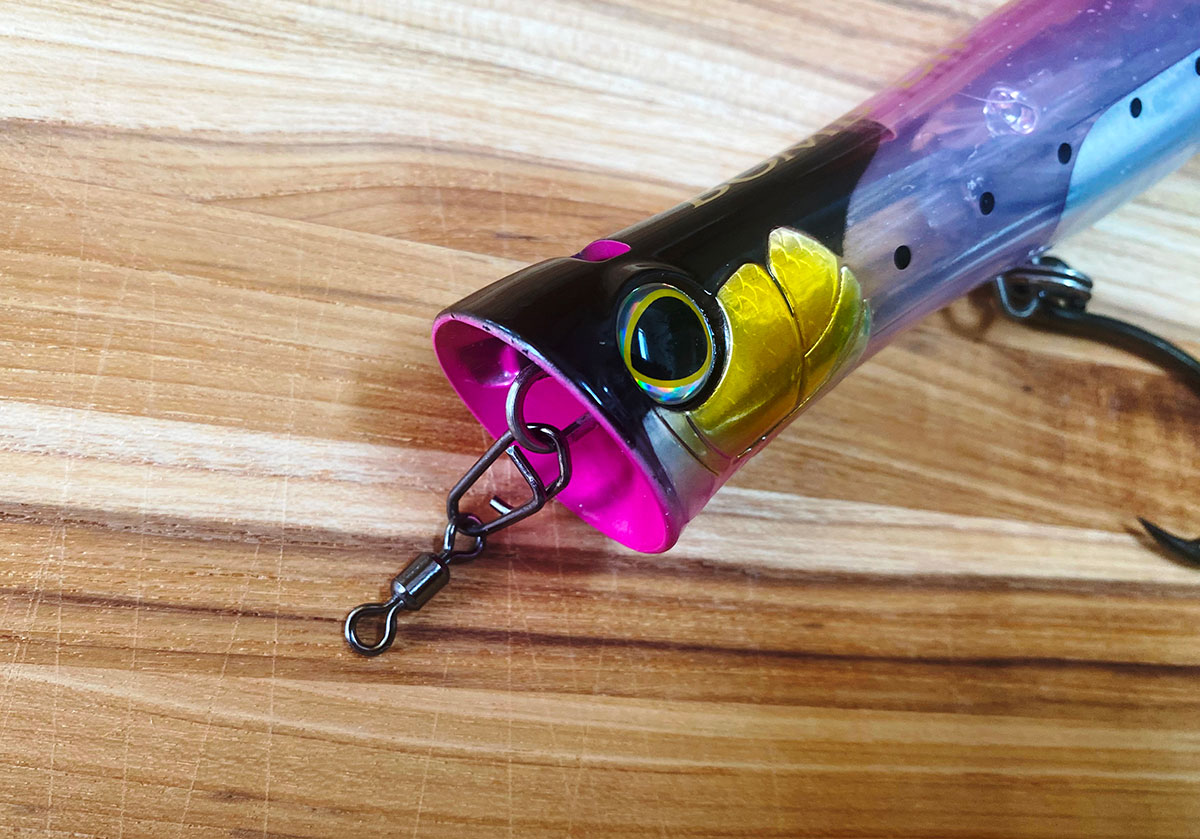
I have used both the Hogy standard Charter Grade Popper and the next-gen Charter Grade Chug Popper with good results. The Charter Grade Popper has been carefully tuned to present the perfect pop-and-sputter action with minimal effort. Available in multiple sizes and weights, it’s through-wired for offshore applications and features multiple rattle chambers for extra sound and vibration. They are aft-weighted for maximum casting distance, even in windy conditions, and hit the water tail-first for minimum foul-hooking and a more natural presentation when it’s time to retrieve them back to the boat. The next-gen Charter Grade Chug Popper features a large, oval-shaped cupped face, maximizing water displacement and creating an attention-grabbing splash. When worked correctly, the popper throws a significant amount of water ahead, amplifying splash and noise to serve as powerful attractants. This chugging-style retrieve makes this lure irresistible to tuna, especially in calm waters with scattered fish, often calling them up to the surface from the depths.
I’ve also had favorable results with both Yo-Zuri’s Bull Popper and the 160-size Mag Popper. The Mag Popper is one of my go-to favorites and measures 6.25 inches long (160mm) and weighs 2.75 ounces. It features tough through-wire construction, a rattle chamber to telegraph a distress sound into the depths, plus it features a patented magnet bullet weight transfer system that allows anglers to get super-long casts downrange, even into the wind. The weight ball unit moves like a bullet aft when you load up and send the plug towards its target. This enhances its momentum and develops extreme casting power and added range. When you start to retrieve the plug after the cast, the ball-bearing housing returns to its center position, giving the lure excellent balance and great popping action.
Other tuna producers for me have been the Shimano Pop Orca and the Bomb Dip Flashboost poppers, which are offered in an array of strike-producing colors. For twitchbaits and sliders, I’ve also had good luck with the Hogy Charter Grade Slider, Yo-Zuri’s Hydro Twitchbait 150S, Yo-Zuri Orca Flashboost, Bomber Pogy, Rapala Slidin’ Rap, and the Daiwa Cuddler. Other popular tuna poppers include the Nomad Design Chug Norris, Halco Roosta, Rapala X-Rap Magnum Xplode, Daiwa Saltiga Dorado Popper, the Tsunami Surface Blaster, and Madd Mantis.
Believe it or not, blade jigs, soft sand eel jigs, and Cali-type surface iron jigs can also be effective on topwater tuna; you just need to speed up the retrieve on these to keep them in the upper water levels.
Retrieve Techniques
Once you’ve made your cast, now what? There are myriad ways to work that lure back to the boat. Whatever retrieve you employ, it’s important that you keep the plug in the water for maximum effectiveness, and this is where not all tuna lures are created equal. It’s a trial-and-error approach.
One proven technique is the pop-and-pause method, where you give the lure an energetic jerk to splash water and make some noise, then let it sit for anywhere from three to five seconds and repeat. Yet another approach is to employ a fast crank and then pause. A third method is the proven long-sweep-and-pause, where the angler moves the rod tip in a horizontal 180-degree arc, a motion that can move the lure anywhere from 6 to 8 feet in one motion. Once the lure has been dragged violently across the ocean’s surface trailing a long bubble stream, let it sit for three to five seconds and repeat back to the boat.
The “Walk the Dog” approach works for both twitchbaits and poppers, where you retrieve the lure in short bursts while sweeping the tip of the rod from side to side during the retrieve, making it change directions. Yet another technique is the “Constant Move” retrieve that brings the popper, slider, or twitchbait back to the boat after the cast in 6- to 12-inch increments.
Whatever method you prefer at the moment, keep retrieving with the reel handle to make sure the line is tight, and when you get a strike, set that hook hard, multiple times.
Gearing Up
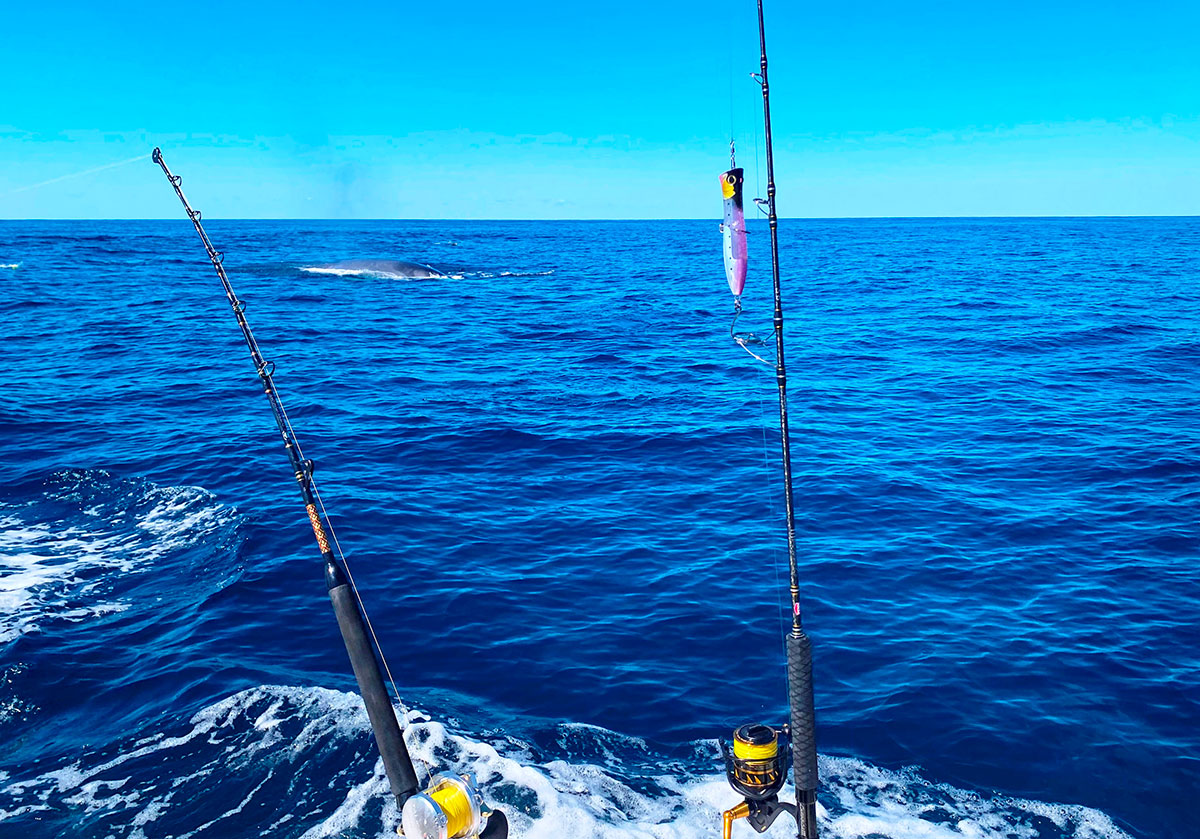
My 2006 EdgeWater 228 CC, MarCeeJay, has caught significantly in excess of its weight in tuna over the 10 years I’ve owned her, and my spin casting rods are limited to a max length of 7 feet. With an extended T-top, two antennas, and rocket launchers on both the T-top and the back of the leaning post, it’s a veritable minefield that has snapped the tip off many an unsuspecting angler’s extended-length rod. To prevent conflict when in the middle of a hot bite, I’ve settled in on “casting” rods that vary in length from 6 feet, 4 inches on up to the stated 7-foot max. With many specialized tuna popping rods being offered from a variety of manufacturers that can range anywhere from 7.25 to 8.25 feet long, my self-imposed limitation comes with a slight decrease in casting distance, a trade-off that I have consciously made.
I’ve seen that most of my peers employ spinners 95% of the time when slinging surface lures to tuna. Why spinners? For starters, it’s a lot easier for the average angler to cast and retrieve without getting a huge “bird’s nest” backlash, a problem that plagues most folks when using conventional tackle. There’s no switching hands from cast to retrieve with a spinner, plus no need to meter the line back and forth when retrieving a lure or fighting a fish. Spinning outfits are just easy and can get the job done with the latest generation of high-quality, high-tech gear on the marketplace.
Whatever rod-and-reel combo you select for working topwater tuna, make sure that it can cast a 2- to 4-ounce popping plug a minimum distance of 40 to 50 yards away from the boat. This is the safe distance where, if you idle up on a school of foraging tuna or porpoise pods that might include tuna shadowing the air-breathing mammals down under, you shouldn’t sound any alarm bells.
Your choice of gear will depend on the type of tuna you seek, the size of your boat, and the size of your budget. Sure, getting a half-dozen top-of-the-line Stellas, Saltigas, Van Staals, etc., with the matching rods and adding 400 yards of eight-carrier braid will make you look like a big man on campus dockside. But it will also set you back five figures, and let me tell you from firsthand experience, you don’t need to drop that amount of serious coin to consistently catch tuna. Each of the major spinning reel manufacturers like Daiwa, Shimano, Penn, Okuma, Tsunami, etc., make a moderately priced big-game spin reel that can get the job done. Saragosa, Twin Power, Battle IV, Azores, and SaltX spinners have been and continue to catch many coastal tuna with some impressive line capacity and drag-stopping power.
Coming clean with full disclosure, I currently own a pair of Stella 14000 reels that are my personal gear when jigging and popping tuna, matched up to the appropriate Shimano Grappler Type-J jigging and casting rods. I also own a few Penn Slammer IV DX (dealer exclusive) 6500 and 7500 reels, mated to Penn Carnage III jigging and casting rods. All are set up for my 6-foot, 3-inch height and preference for a specific casting and fighting ability. When passing rods out among the crew, I share my Shimano Twin Power and Penn standard Slammer IV setups, which have caught a lot of tuna and leave nothing to be desired regarding durability, castability, and the ability to bring a 100-pound tuna boatside.
| SWAPPING TREBLES |
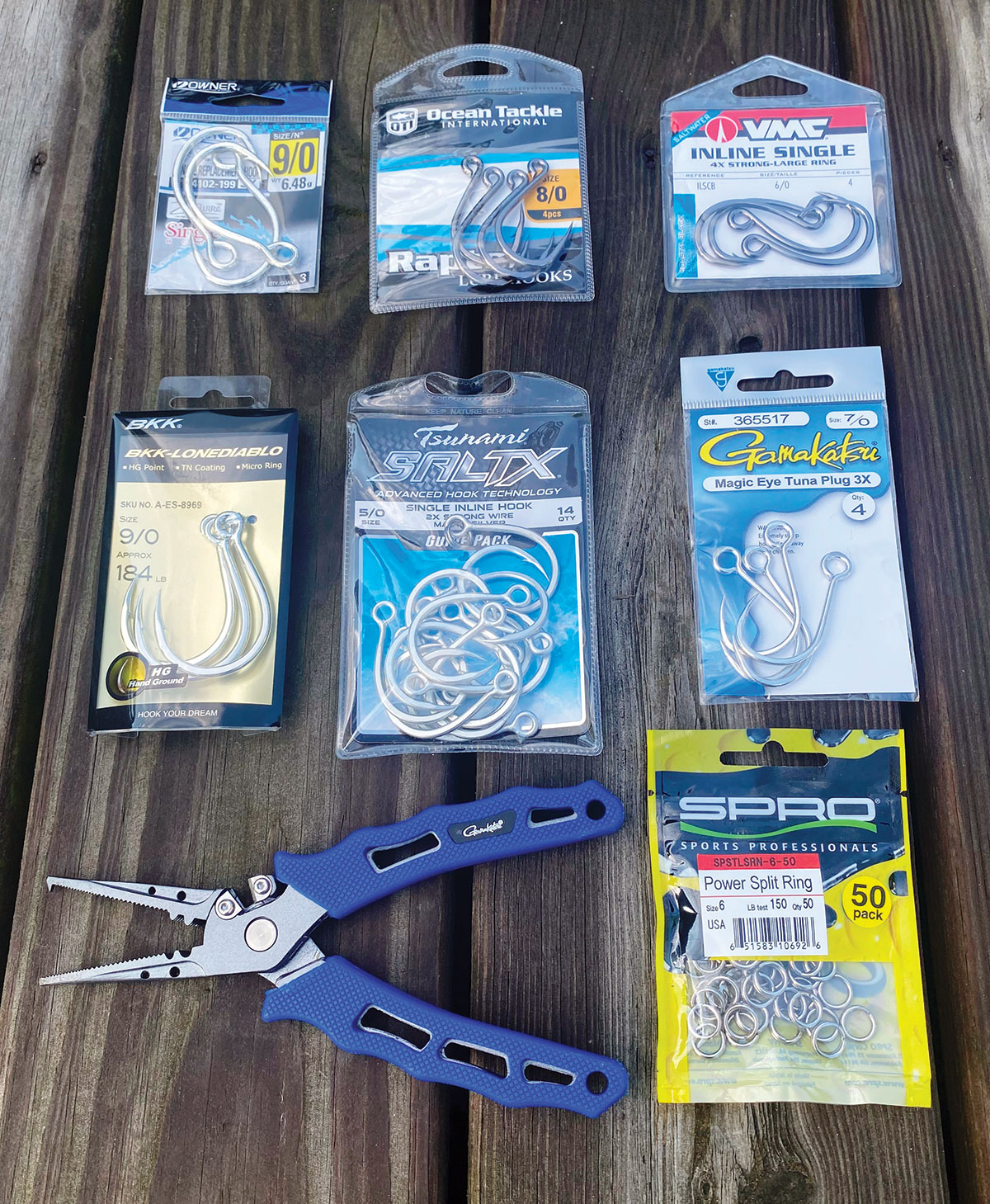
| When purchasing any popping, slider or twitchbait lure for tuna, the first thing I do is to remove those nasty treble hooks and replace them with special purpose single inline versions that feature an eye that is upturned 90 degrees compared to a standard fishhook and is attached to the lure with a heavy duty split ring. I typically use a SPRO 150- or 185-pound rings to make these swap-overs and haven’t lost one yet due to a pulled split ring. Inline hooks distributed by Gamakatsu, Owner, VMC, Ocean Tackle International, BKK and Tsunami will all do the job; just match the size of the hook to the length and depth of the plug and you are in business. |
As for connections, ask a half-dozen anglers how they connect their running line to their lures, and you might get an equal number of different responses. Most of the tuna popper sharpies I know go with the swivel-and-split-ring attachment method. With this approach, a 150- to 185-pound split ring is attached to the lure, which is in turn connected to a micro-sized swivel like the SPRO 1, 1/0, or 2/0. Every time you want to change a lure, you need to locate a pair of split ring pliers, disconnect the current lure from the split ring connection, and then reconnect the next candidate via the reverse method. I have tried this, and to me, it’s a real PITA and takes too much time. My alternate approach has been to employ that same micro SPRO swivel to the main line, but instead of a split ring, I use a 75-pound SPRO snap clip instead. Lure changes are much faster using this method, and the integrity of the connection is good to go.
I typically use a topshot wind-on leader with all of my spinning reels to connect to the superbraid running line that will vary anywhere from 50-, 60-, to 80-pound test. Some of my fellow anglers will replace that mono topshot with a pink or clear fluorocarbon leader, but I’ve seen too many connection knots explode, even FGs, due to the stiffness of the fluoro and the difficulty in tying consistently secure braid-to-fluoro knots. SPRO makes a really soft pink fluoro leader material, and I have had better luck tying lasting knots using this product.
Mono, of course, is a bit softer, and the braid has a tendency to dig into the line and hold tight under stress; hence, that gets the nod for my outfits. If the tuna are really finicky, I’ll tie on a short 24- to 30-inch section of fluoro to a swivel, cover the swivel with a small squid skirt to hide it from the wary-eyed predators, and see how it goes.
The time for tuna popping is now. Get out there and give it a shot.