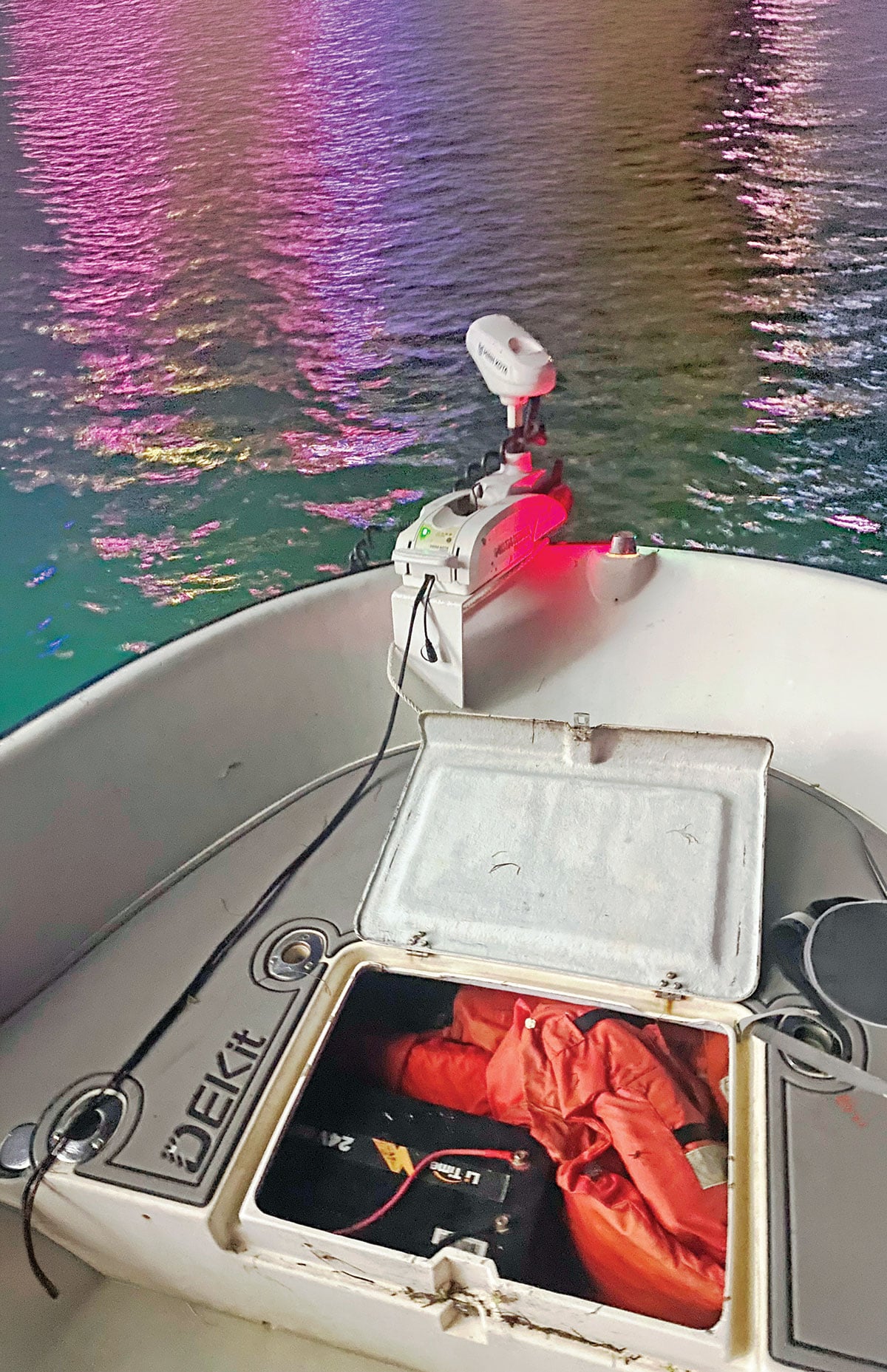
From lead acid to lithium, we break down the marine batteries that keep trolling motors running all day.
After last issue’s electric trolling motor roundup, this month let’s focus on what’s needed to keep them running all day. Let’s take a deep dive into the world of 12v, 24v and 36v deep-cycle marine batteries.
There are currently five commercially viable chemistries that are candidates for powering electric trolling motors and they are flooded lead acid (FLA); absorbed glass mat (AGM); Gel; Lithium Iron Phosphate (LiFePO4) and Solid State (SS). Some general pros and cons for each type are listed as follows:
Flooded Cell Lead Acid
The flooded lead acid (FLA) battery has been the top marine choice for decades, although that tide is slowly turning to some of the next-gen types. Lead acid batteries are dependable and inexpensive on a cost-per-watt base. There are few other batteries that deliver bulk power as cheaply as lead acid and this makes the battery cost-effective for marine use.
The grid structure of the lead acid battery is made from a lead alloy. Lead acid is heavy and is less durable than lithium-based systems when deep cycled. A full discharge causes strain and each discharge/charge cycle permanently robs the battery of a small amount of capacity. This loss is minimal while the battery is in good operating condition, but the fading increases once the performance drops to half the nominal capacity.
This characteristic applies to all batteries in various degrees. Depending on the depth of discharge, lead acid for deep-cycle applications provides 200 to 300 discharge/charge cycles. The primary reasons for its relatively short cycle life are grid corrosion, depletion of the active material and expansion of the positive plates. This aging phenomenon is accelerated at elevated operating temperatures and when drawing high discharge currents.
AGM
Absorbed Glass Mat (AGM) technology batteries are a type of Valve Regulated Lead Acid (VRLA) battery that use a material manufactured from very fine glass fibers. The AGM material acts as both a separator between the positive and negative plates and as a sponge to hold the sulfuric acid electrolyte. The plates are compressed for superior electrical performance compared to conventional flooded lead technology.
According to the engineers that manufacture Deka Marine Batteries, the advantages of AGM types versus FLA batteries include up to twice the effective life cycle; significantly more vibration resistance for wave-pounding protection; safer installations with a sealed no-spill design; higher freeze-resistance for improved cold weather performance, plus a lower discharge rate/loss of capacity during periods of infrequent use.
Flat plate AGM batteries have six sets of plates with glass mat separators containing the electrolyte are arranged in a straight line inside the battery (like sliced bread). Because the plates are compressed in rows, the battery has more capacity, i.e. it uses all of the surface area inside the container to provide more energy when needed. Plate compression enables longer life or more total energy usage over time.
Yet another spin on the AGM battery is spiral technology, like those found in Optima blue top batteries, which offer more plate surface, closer plate spacing and the use of high-purity lead. The results offer you more power in a smaller box, the ability to recharge much faster and higher/cleaner voltage characteristics during discharge. The immobilized plates are under compression and locked in place, improving vibration resistance, reducing shedding of active paste material and gives you a battery that lasts longer and performs better throughout its life. AGM batteries are typically good for 300 to 500 cycles if used properly.
Gel
According to the engineers at Optima, a gel battery design is typically a modification of the standard lead-acid marine battery. A thickening agent is added to the electrolyte to reduce movement and flow inside the battery case, creating a thixotropic gel that permanently locks in the electrolyte into this matrix. Many gel batteries also use one-way valves (valve regulated lead acid, or VRLA) in place of open vents, which help the normal internal gasses to recombine back into water in the battery, reducing gassing.
Gel batteries are typically spill-proof and maintenance-free, delivering dependable performance cycle after cycle, providing longer battery life. Because it uses gelled electrolyte, there is no need to check fluid levels, plus the gel acts as a cushion between the lead plates to minimize vibration damage to the battery’s internals during rough weather service. Gel marine batteries also hold onto their internal charge better than most of the other lead-acid types with a self-discharge rate that’s typically only 2% to 3% per month, so if it’s been a long time between fishing trips, the gel marine battery gives you additional peace of mind. Generally, gel batteries are less tolerant of high heat and are charged at lower power than traditional or AGM batteries.
Lithium Iron Phosphate (LiFePO4)
Whenever I’m talking marine batteries either on the docks or at a Fisherman seminar, many of my readers ask, “what are the basic operating principles for a LiFePO4 battery compared to lead acid types and how are they different?” The short answer is that LiFePO4 batteries operate via an ion-shuttling mechanism, where lithium ions move between a cathode and anode through an electrolyte, offering over 3,000 cycles at 80-85% depth of discharge over their useful lifespans. Conversely, lead-acid batteries rely on a chemical reaction between lead plates and sulfuric acid, which is more volatile, less efficient and limits usable capacity to 50% or less of stated capacity and typically 200 to 500 cycles, depending on battery type.
Lithium Iron Phosphate batteries offer a number of advantages compared to FLA, AGM and Gel lead cell marine power cells, they…
– Deliver higher power during cranking and hold a higher voltage during discharge than a comparably sized lead acid battery. This translates to a hotter ignition, faster starts and more power for your accessories.
– Produce more pound-per-pound power than lead-acid, meaning less physical materials are needed, making for a lighter battery. Some 24-series deep-cycle AGM or Gel batteries weigh over 50 pounds; while a 24-series lithium battery weighs less than half.
– Accept charge current up to five times faster than lead-acid batteries.
– Are up to 96% efficient at converting input energy into stored energy, versus approximately 75% for lead acid. Lithium-ion batteries also do not contain highly-toxic materials or emit harmful gases like standard wet cell lead-acid batteries and no maintenance is required.
– Hold a higher amp rating longer compared to lead acid batteries, which is a great feature for electric trolling motors. Better yet, you can swap a trio of 70-pound 12v deep cycle AGM batteries that weigh 210 pounds for a single 36v lithium at only 45 pounds…that’s a 165-pound reduction, which is significant, especially on smaller boats.
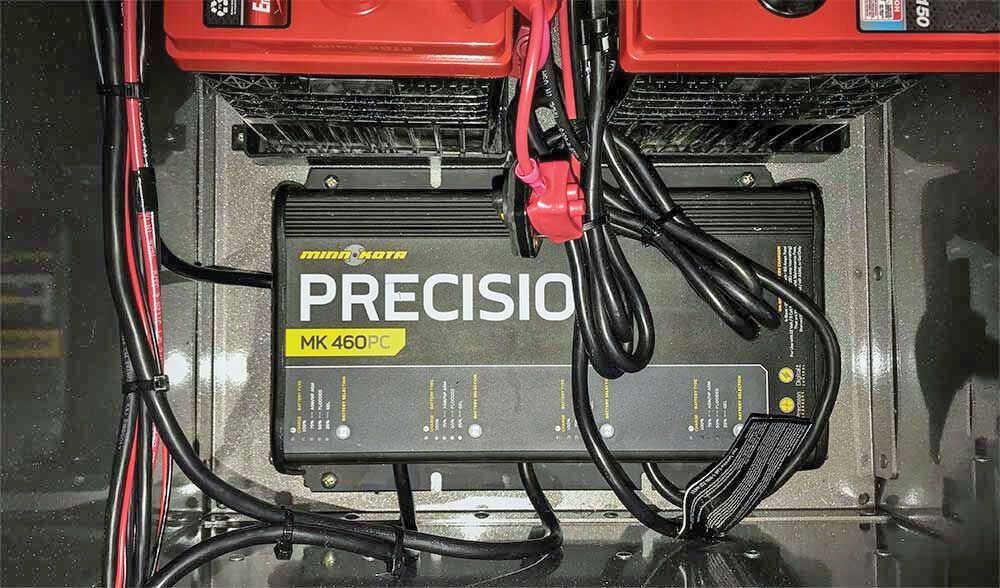
Solid State
Solid state batteries are typically used in the aerospace and defense industries, they are prohibitively expensive and not typically available through the usual commercial distribution channels. Solid State Marine located in Pawtucket, RI is one of the first manufacturers to incorporate solid state technology into a commercially-viable and affordable marine battery. Unlike many LiFePO4 power cells, their batteries are made in the USA.
According to Alex Petti, the Sales Manager of Solid State Marine, “What separates us from the rest of the pack is the chemistry of our cells. A standard lithium cell has a gel electrolyte between the anode and cathode. At the heart of every Solid State Marine battery is a revolutionary solid electrolyte that replaces the flammable liquid found in traditional lithium iron phosphate and lead-acid power packs. By eliminating the liquid, we shrink the distance ions travel between anode and cathode. The result is dramatically higher energy density, ultra-fast charging, extremely low risk of thermal runaway and a lifespan that outlasts conventional batteries by years.” The only potential downside to Solid State batteries is their cost and they are the most expensive type of the bunch.
The Pros Talk
To understand how battery technology is reshaping the water, I reached out to Adam Knowles, Brand Manager at Minn Kota, and the technical team at Navico. Minn Kota notes that while traditional flooded lead-acid batteries remain the most affordable and accessible, LiFePO4 options provide a significant edge in weight and size. For the best experience, Knowles recommends an amp-hour rating of 95–125 Ah. Navico adds that most “serious anglers” are migrating toward lithium to increase top-end speed and runtime, though the final choice ultimately balances budget against performance goals.
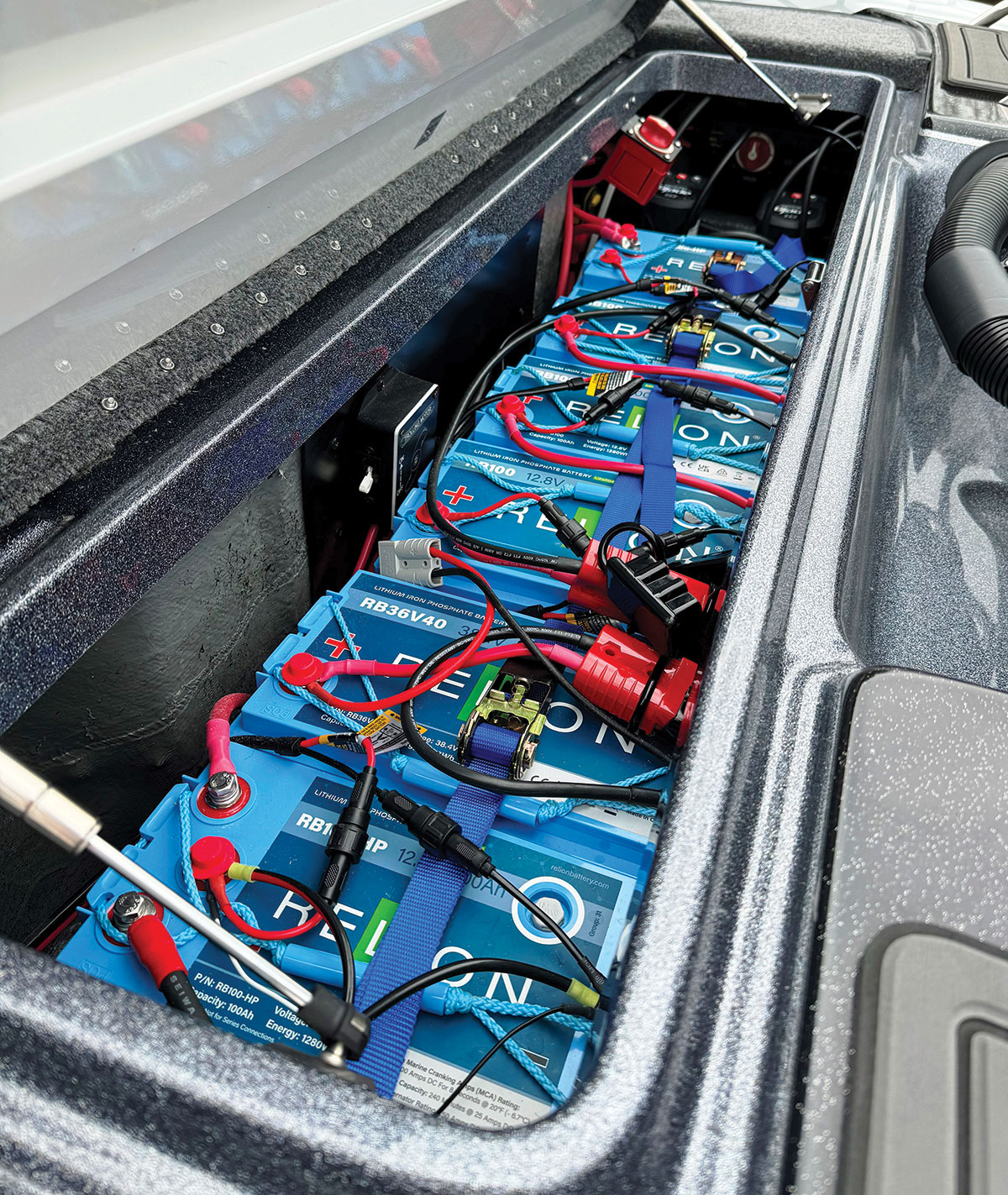
The rise of 24V and 36V lithium batteries has introduced a new dilemma: a single-cell unit versus multiple 12V batteries wired in series. Both manufacturers emphasize redundancy. If one battery fails in a 36V series, anglers using dual-voltage brushless motors (like the Minn Kota QUEST or Lowrance Ghost X) can rewire the remaining two batteries to 24V and keep fishing. Navico also points out that 12V banks are currently easier to support with standard on-board charging systems.
A single 24V or 36V battery is the ultimate space-saver, offering a straightforward rigging solution for crowded bilge areas or smaller vessels. However, both experts warn that if a single high-voltage battery fails, the day is over, as it cannot be rewired to a lower voltage. Proper rigging remains paramount. Minn Kota stresses the necessity of overcurrent protection, such as the MKR-27 fuse, to protect the motor’s electronics. Whether you choose the reliability of a traditional series bank or the sleek efficiency of a single lithium unit, following ABYC standards or consulting a certified technician is the best way to ensure your power system is as rugged as your trolling motor.
Battery Math
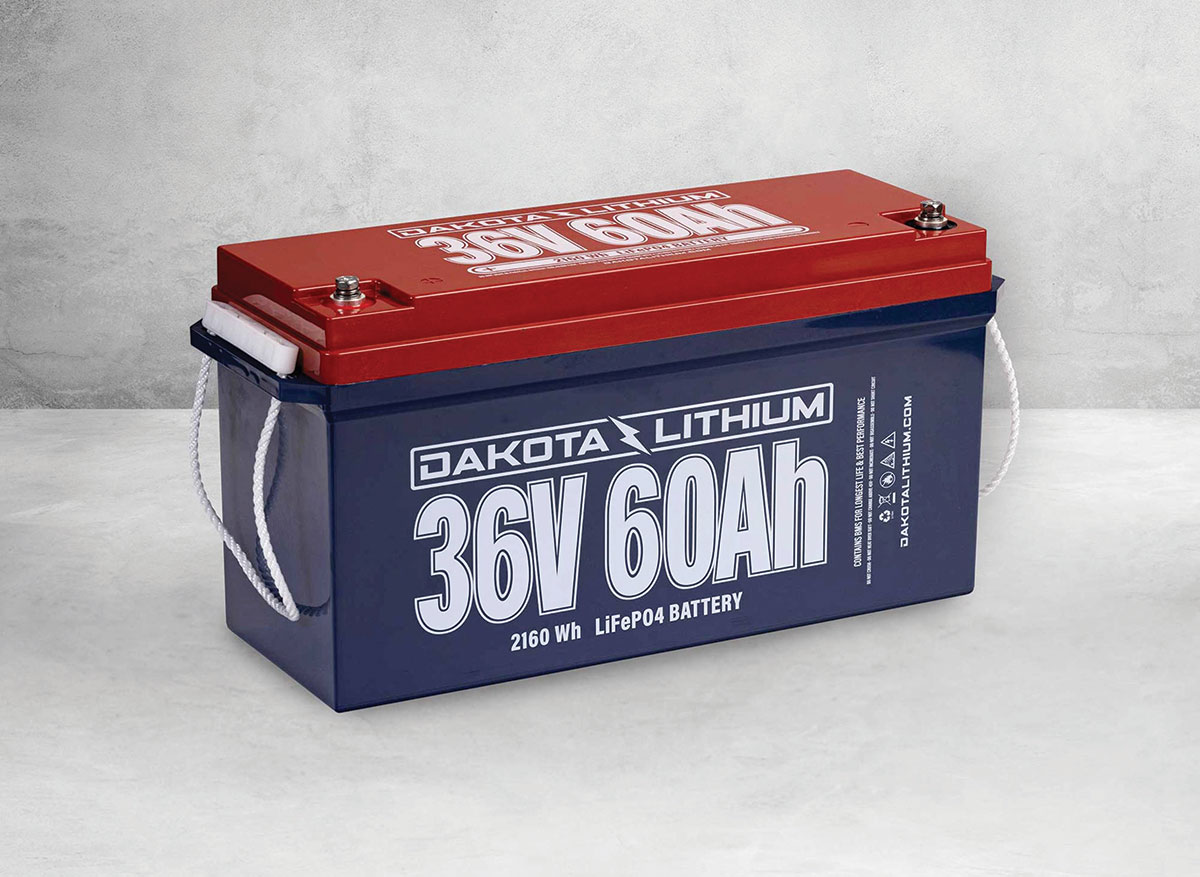
When anglers ask me to explain why a single 36v 60 Ah LiFePO4 deep cycle battery can offer potentially more consistent run time than a trio of 12v 100Ah AGM batteries, here’s the basic battery math. At a 20-amp draw, three 100Ah AGM or FLA batteries that are wired for 36v will provide roughly 2.5 hours of runtime, while a single 60Ah 36v lithium battery provides about 2.5 to 2.7 hours. AGMs offer higher capacity (Ah), but lithium batteries (LiFePO4) maintain higher voltage, providing consistent power throughout the entire discharge range.
Three 100Ah 12v AGM Batteries Wired in Series (36v System)
Total Capacity: 100Ah at 36v
Usable Capacity: 50% depth of discharge for AGMs = 50Ah.
Weight: 3 x 70 pounds = 210 pounds
Runtime: Although the total “theoretical potential” of these three 100Ah AGMs wired in series to produce 36v is 5-hours (100Ah/20A = 5), this is not recommended for AGM battery longevity. Using an industry standard practical benchmark of 50% depth of discharge, this translates to 50Ah/20A = 2.5-hours of run time at 20 amps. If you push those AGMs to 80% DoD, you might get 4-hours of run time on paper (80Ah/20A = 4), but it will usually be less in the real world, since these AGMs will typically drop below 12v when pushed passed 50% DoD, so the motor and battery will be working harder to develop expected thrust.
One 60Ah 36v Lithium Battery
Total Capacity: 60Ah at 36V.
Usable Capacity: 85-90% depth of discharge = 51Ah-54Ah
Weight: 42 to 45 pounds
Runtime: 51Ah/20A = 2.55-hours of run-time; 54Ah/20A = 2.7-hours of operation. Unlike AGM or FLA battery types, LiFePO4 power cells will hold a steady 12V of output power through the 0-to-90% depth of discharge range. Once they get too far past 90% DoD, the BMS (battery management system) will typically go into shutdown mode to prevent any damage to the cells. Having a battery meter onboard that indicates “how much gas is left in the tank” will enable operators to better judge how to manage their day out on the fishing grounds.
Final Calculations…Cost per Use
As a final thought relative to the price/value relationship of battery chemistry math, the cost of three Interstate 100Ah Group 27 AGMs is $460 per unit x 3 = $1,380. Add battery cables to make the series connections at another $70 and the bottom line for this setup is roughly $1,450. Let’s assume we get 500 duty cycles out of these before they expire, so the average cost per use is $1,450/500 = $2.90.
In contrast, a single 60Ah 36v LiFePO4 battery like a Dakota Lithium costs about $1,700. Since this is a solo battery setup, no additional connection cables are required. Let’s rate this power cell at the industry norm of 3,000 cycles and the average cost per use is $1,700/3,000 = $0.57. That’s a huge difference, plus it weighs less and has a much smaller footprint for easier stowing. Which choice makes more sense to you?