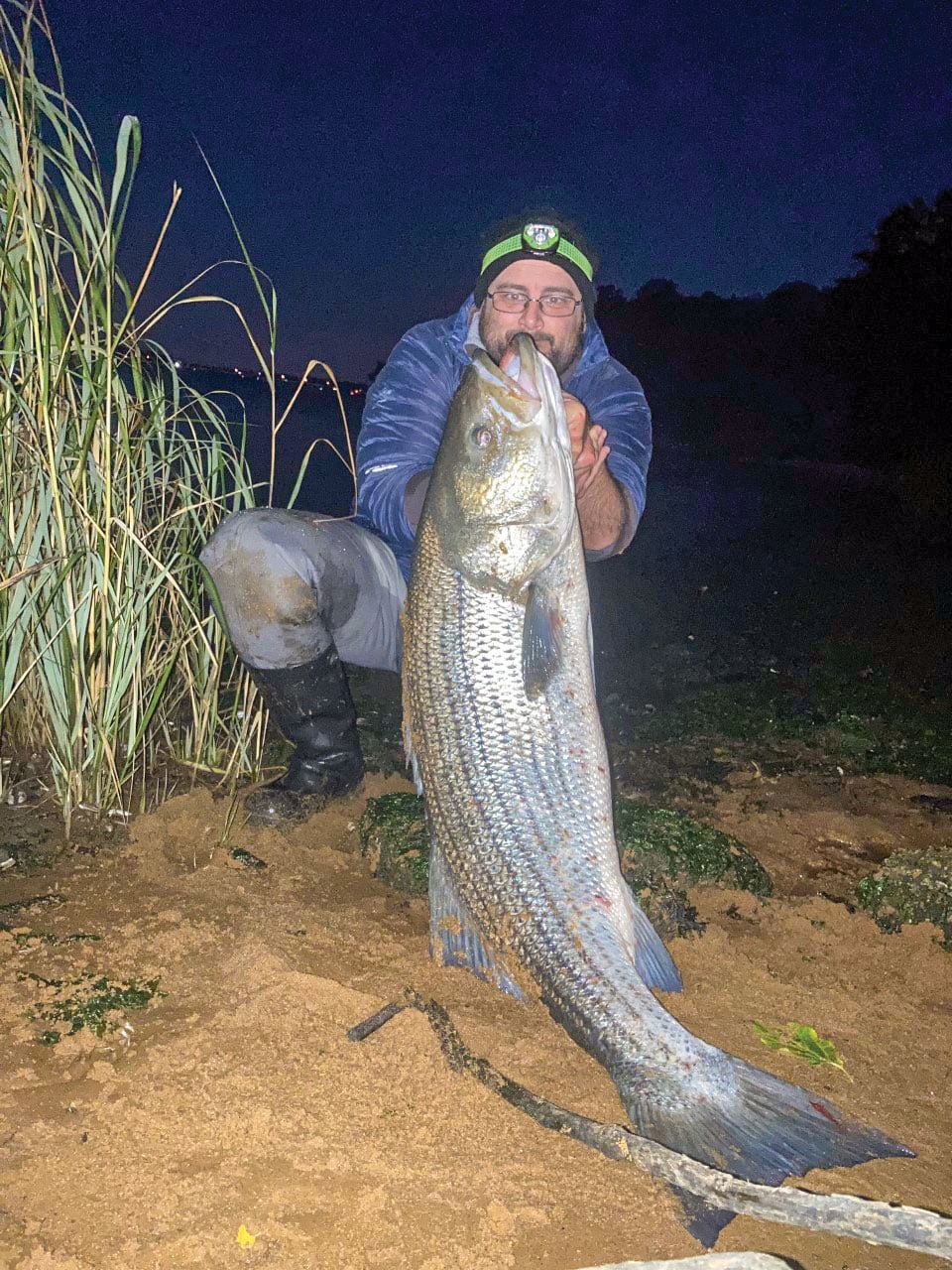
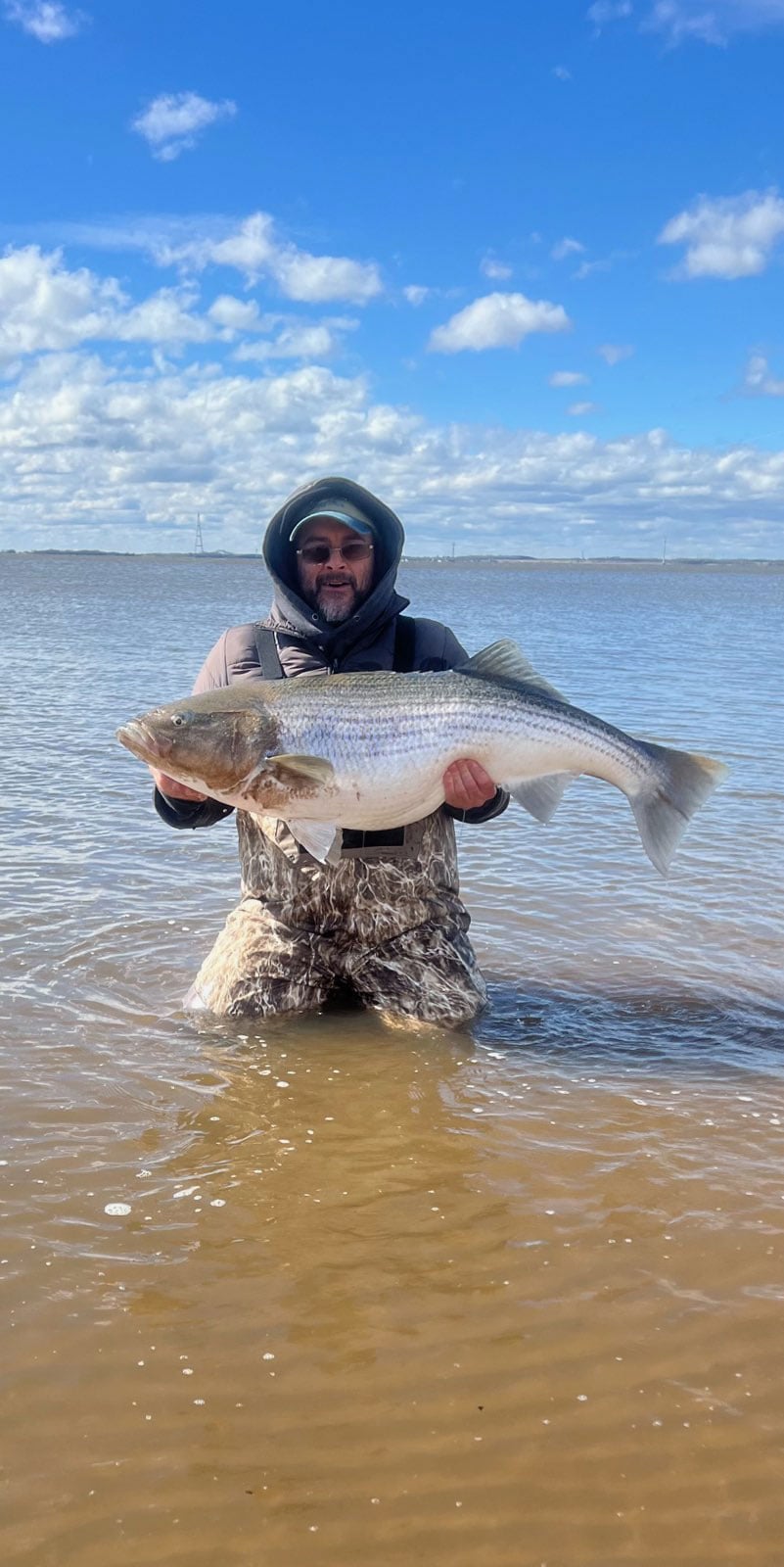
What are you willing to give up in the quest for a 50?
Striped bass are beautiful fish, with a bit of a mystique that surrounds them. Fishing in a quiet environment, that’s seemingly devoid of life, can be relaxing, but also lonely and isolating… even melancholy at times. Hooking up with a giant bass here can shatter the emotional negatives through the realization that you were never alone there in the first place.
Subconsciously, I’d argue, it reinforces general principles like hope/faith and gratification after sacrifice. It’s no wonder these scenarios have a divine flavor as the angler feels like they’re manifesting life, seemingly from nowhere. I once read a piece in The Fisherman about “The Perfect Day” where I described my most idyllic setting. The passages written above are akin to mine and I’d assume many other trophy striped bass anglers would feel the same way.
There are many things that influence the importance of a catch. For example, the company one is keeping at the time, or perhaps the sentiment of a specific location/time and unforeseen challenges in landing the fish. However, I’d propose that the two main factors that influence the value of a catch are the fish’s rarity and intrinsic difficulty to land. So it’s not just the trial in fighting the fish, but the test in finding them, too.
The species, location, and age of the individual fish (better inferred by length, not weight) influence its rarity. The difficulty in landing is appropriately influenced by the species, location, and its size (better inferred by weight, not length). The seemingly small distinction on the last factor, length vs. weight, has made big waves on how anglers chase, handle, and even set their goals for striped bass. It’s also been at the core of some controversies and disagreements.
My opinion firmly sits on one side of that fence. However, below I make an argument that because weight and length are informationally related, it should not be as tough in adjusting one’s trophy standard as some may initially assume.
The Trophy Mark
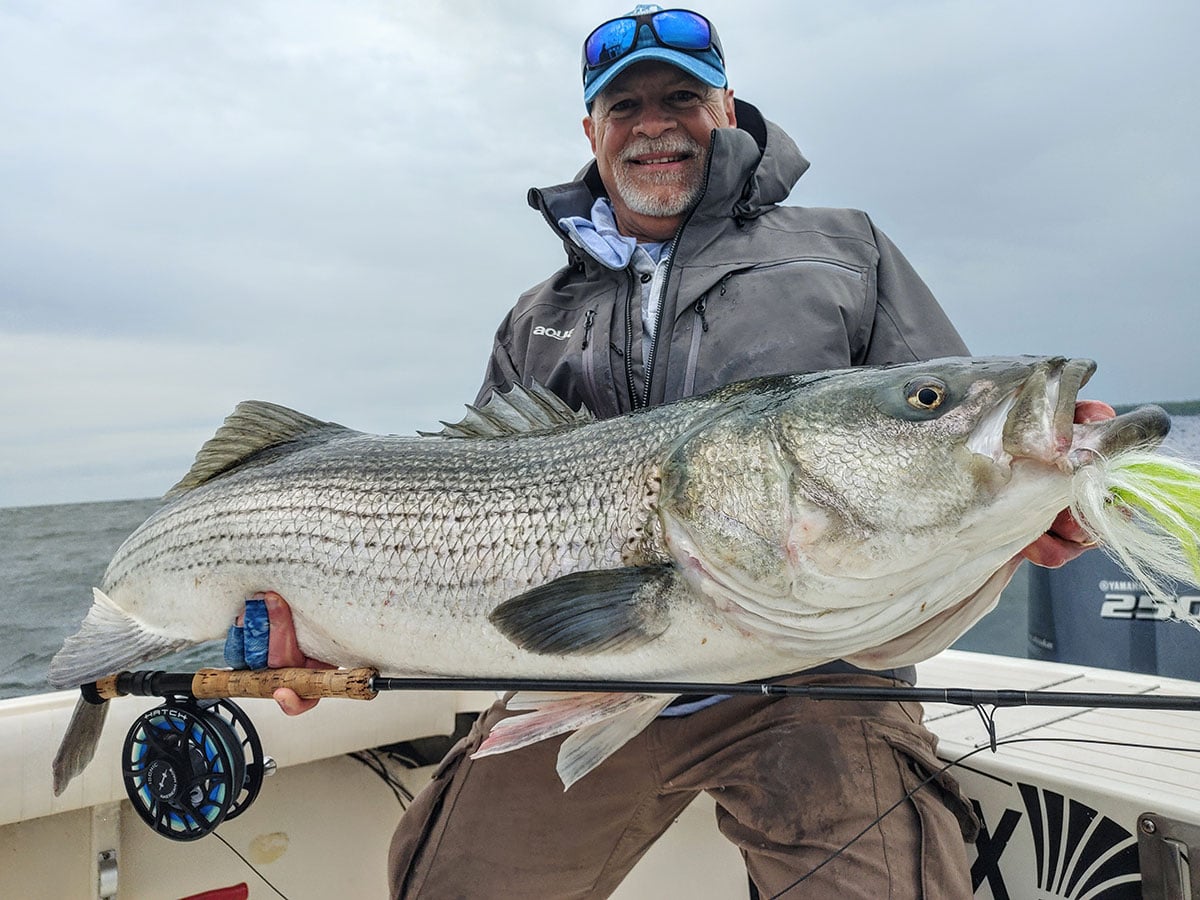
Anglers have different benchmarks for what constitutes a ‘trophy’, likely because of how much time they can or do put into the art. For avid striper anglers however, the 50-pound mark has historically been the gold standard for a trophy striped bass. At least, it was up until about 15 years ago when we saw the transition to 50 inches. This happened because greater numbers of anglers were adopting a conservation-minded approach, and because the regulations eventually changed to outlaw the harvesting of such a fish. This effectively ended the practice of hanging 50s on the scale back at the local tackle shop. For old timers that have had a tough time adjusting to this change, like this author, there is some solace.
On a striped bass length-to-weight graph, the intersection point where the length and weight units are roughly equivalent is serendipitously at 50. Yes, there will be exceptions in particular scenarios, such as before spawn; and like human height vs weight, there will be variation across individual fish. Still, that intersection of values means that the mark of 50 pounds and 50 inches are fortunately in high correlation, insomuch that one variable can be used for inferences on the other. Fully appreciating this could and should help more traditional, weight-obsessed anglers to make an adjustment in their goals and assessing their catches. Remember too, that taking the girth in addition to the length can be used for an even closer estimation of weight via the equation, (length x girth2 ÷ 800).
Regardless of the assessment methods, the rarity and difficulty in landing such a fish combine to validate the challenge. If you’ve just started striper fishing and you’re getting ruffled for that quality fish, you’re in for a miserable time, long-term. Despite the draws to trophy bass, this challenge comes with a grind, notably time-commitment and the personal sacrifices that may get anglers flustered. Big fish come more and more with experiential knowledge, which is only obtained through perseverance, working through that grind just like any other worthwhile life endeavor. And the tougher the challenge, the more rewarding and prestigious the payoff.
For new trophy hunters, your first bunch will come slowly, unless you luck into bunker blitzes or are lucky enough to get put into a hot secret bite, both of which are far less rewarding and defeat the purpose of what you’re really trying to accomplish. All trophy striper fishermen are trying to express/display, to their peers and to themselves that they have the expected level of grit, smarts, and ethics needed to consistently obtain that rare prize. So, don’t wish to cut corners, and don’t ever give up.
Trophy Angling Mindsets
Passions and standards for ‘trophies’ are complex, due partly to the mix of angler types targeting them. There are three main mindsets of surfcasters, two of which leave the art of trophy hunting abruptly. The first group seems to misdiagnose the extent to which they actually love the art and/or the sacrifices needed to catch trophies consistently. They lose interest or perhaps become unable to balance other responsibilities with what is needed for this type of fishing. They eventually fade out of the scene, sacrificing it for permanent career rigidity and even social commitments. To use an astronomical analogy, I think of anglers like these as small stars that shine dimly for a short time and then burn out quickly after just a few years, regardless of the motivation others may try to instill in them.
Anglers of the second mindset also burn out quickly, but for a different reason. They actually love the art, but in a short-sighted way. They sacrifice any and all career responsibilities to fish as hard as possible. This is only sustainable for a few years, until their source of income and resources vanish from neglect. They then abruptly disappear. I relate them to a rapidly burning large star that soon goes supernova. They burn bright for a short time, sometimes landing many fish while in the game, then vanishing from the sport. It is difficult to witness this in friends, as attempted advice for them is almost the inverse of that needed by the first mindset. If they were to tamp down on their obsession a bit, just enough to manage life’s other responsibilities, their passion would be more durable and long-lasting, as opposed to being self-destructive, which can sometimes occur.
I’d make the argument that the third and final of the mindsets is optimal. This is the one that young anglers should strive for if they want the most success over the long-term. Anglers of this third mindset fish as hard as the former group, sacrificing all social commitments, non-job related obligations, and even non-essential job responsibilities, but they have the self-restraint not to sacrifice their important job responsibilities. They also put in place mechanisms by which to push their career path or position into one that allows for increasing time flexibility. Eventually, anglers of this approach will accumulate more catches and experience than the other two groups combined, and it will compound with that increasing flexibility to fish.
I’m a firm believer in what a lot of famous athletes preach: in the long run, consistency, discipline, and honest self-reflection trump inherent skill and talent. After all, as a goofball myself, I know this firsthand. Any lack of talent has been compensated 10 times over with such a mindset, both in trophy striped bass fishing and life’s other endeavors.
So, there are four main takeaways I hope to encourage with this article: perseverance, responsibility, balance, and flexibility. Appreciate the distinction between hard work and perseverance. Hard work can be specifically applied to the short-term and overdone to one’s detriment. Perseverance is a more long-term, enduring quality that incorporates other virtues like responsibility. So fish hard, but not to the point where trophy hunting erodes your responsibility to the non-fishing-related resource-generators (e.g., job, health, etc.) that sustain it.
Awareness and consistent reflection about the first two will help a trophy hunter approach optimal balance for decades to come. That optimal point of balance is not stationary, but instead dynamic from the variety of life changes, many unforeseen, that inevitably occur. So flexibility is essential to adapt. These lessons apply not only to becoming a great trophy striped bass angler, but also to any passion one pursues in life.