A seasoned waterman explains how preparation, safety, and smart rigging make running a 14-foot Livingston offshore a calculated decision rather than reckless adventure.
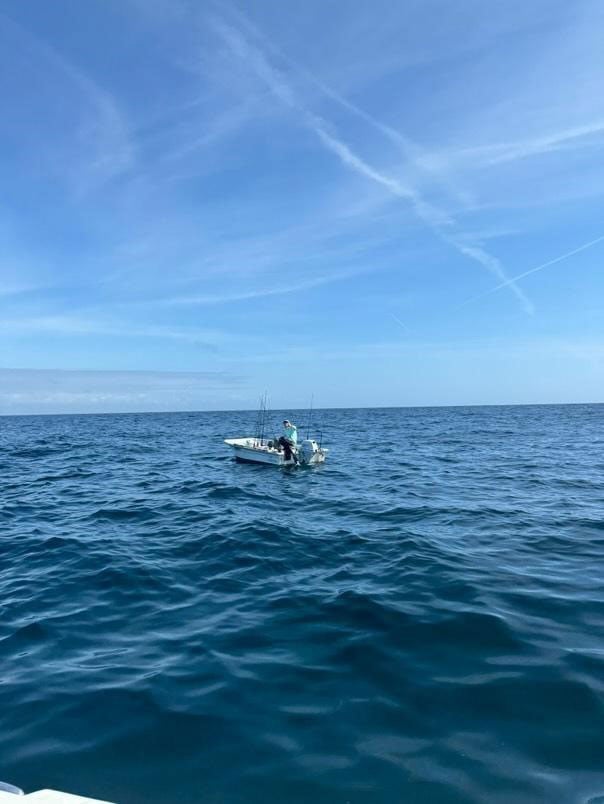
Taking a 14-foot boat with a 20-horsepower tiller 15 miles offshore is wild. I know. It’s usually the first thing people say when they find out what I do with my Livingston. The second question is almost always, “Are you nuts?”
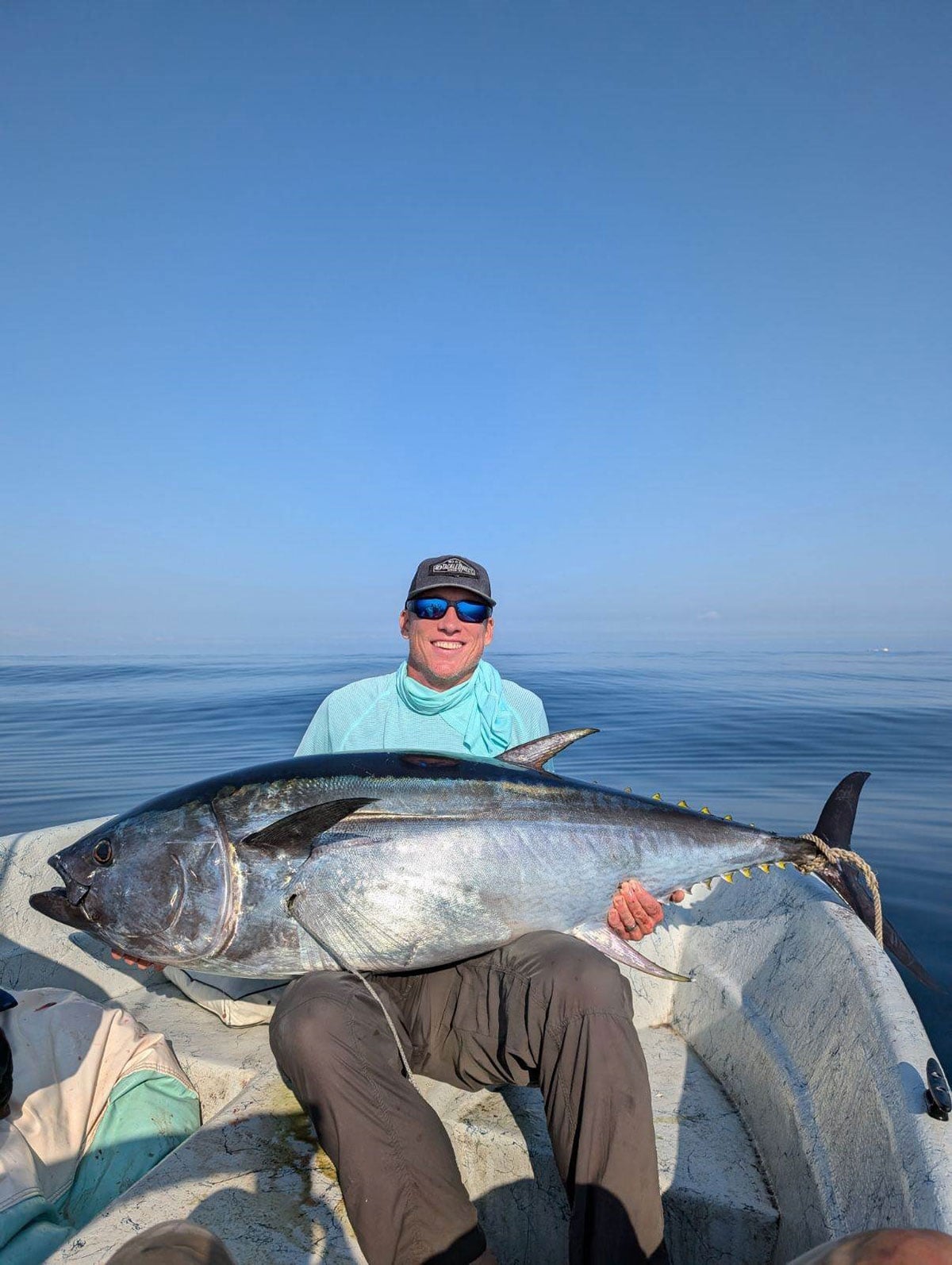
Maybe a little. But the ability to catch bluefin tuna, thresher sharks, and mahi from a boat that most people would barely take outside the inlet didn’t happen by accident, and it certainly didn’t happen overnight. This isn’t a story about recklessness or bravado. It’s about preparation, progression, and learning exactly what a small boat can do—and just as importantly, what it shouldn’t.
My name is Tom, and while this setup might raise eyebrows, I’m not new to being on the water. I’ve been fishing my entire life and spent nine years working aboard a full-day ocean fluke boat out of Captree: Tradewinds, under Capt. Paul Risi. I’ve also been spearfishing and surfing for over two decades—experiences that have taught me how to read conditions, respect the ocean, and make conservative decisions when things didn’t feel right. All of that time shaped how I approach this boat and every mile I run offshore.
Why A 14-Foot Boat?
One of the most common questions, right after, “are you nuts?” is “why not a bigger boat?” The short answer is efficiency. I wanted to maximize time on the water by getting on and off quickly, packing as much capability into the boat as possible while minimizing what went into the truck. Trailerability was non-negotiable. I wanted to be able to tow it anywhere, launch anywhere, and still have the confidence to run offshore when conditions allowed. At the same time, limited storage meant it couldn’t be much larger than a bathtub.
That search eventually led me to a 14-foot Livingston.
The boat measures 13 feet 11 inches long, with a 68-inch beam, roughly 22 inches of freeboard, and a hull weight of just 315 pounds. Power comes from a 20-horsepower Suzuki DF20A long-shaft, backed up by a 3.5-horsepower Tohatsu auxiliary. On paper, it doesn’t sound like much. But paper doesn’t tell the whole story.
Finding The Right Platform
I didn’t wake up one morning convinced this was the boat. Over several months, I built a list of requirements and slowly narrowed things down. Once I landed on the Livingston, the real challenge began: finding one on the East Coast. They’re rare, and when one pops up, you don’t have much time to think. It took three years of searching before one finally appeared, and thankfully it was in Gloucester, Massachusetts. Truth be told, I would have driven just about anywhere on the East Coast to get it, but this one ended up being just a ferry ride and an hour-and-forty-five-minute drive north.
Dialing In Performance
The first year with the boat was spent staying close and learning its personality. That led to the first major change: repowering from a basic Honda 9.9-horsepower motor to a Suzuki DF20A with electric start and power tilt. While the horsepower increase was noticeable, the real improvement was efficiency.
On a calm day, fully loaded with another person aboard, the boat averages about 10 miles per gallon. For offshore runs, I typically carry nine gallons of fuel, providing roughly a 90-mile range. You’ll never see me running that far because I operate using the rule of thirds and never venture beyond one-third of my total range from the ramp. So if you see me near the Empire Wind turbine bases or out at the 12-Mile Reef between Moriches and Shinnecock, don’t worry. I’ve done the math.
Safety Comes First
Before chasing pelagics offshore, several areas needed serious attention: space optimization, trolling capability, landing fish, comfort, and, most importantly, safety.
Safety is something I take extremely seriously, and I likely carry more onboard than many boats twice this size. Beyond U.S. Coast Guard requirements, the boat carries spare props, tools and parts, a first-aid kit with a tourniquet, compass, storm whistle, handheld VHF, multiple modes of propulsion, 600-feet of anchor line, manual and electric bilge pumps, spare drain plugs, Stay Afloat putty, and more. None of it is there by accident. It’s the result of thinking through failure points and planning for situations I hope never happen.
But gear alone doesn’t make you safe. The most important factor is understanding the limits of yourself, the boat, the equipment, and the weather. If it’s not a good day to go, I don’t go. At most, I stay inside. There will always be another window.
Maximizing Space
On a 14-foot boat, optimization and comfort go hand in hand. The more efficiently you use space, the more comfortable the boat becomes. There have been many sleepless nights figuring out how to position gear without creating dead space or compromising safety.
One surprisingly effective addition was a bean-bag chair, which made long runs far more comfortable—at least for a passenger. Another game-changer was building a tiller-handle adapter that connects to the top half of a paddleboard paddle, creating a removable tiller extension that improves balance, comfort, and control. The paddle also doubles as a backup means of propulsion for short moves without the engines.
A Small-Boat Trolling Spread
For trolling, believe it or not, this boat can—and has—pulled six rods, though five is more typical. Custom-built boxes made from scrap wood, PVC, and galvanized clamps make it possible.
A standard spread includes three 18-inch spreader bars, two directional bars, a diving plug, and a shotgun line. It took trial and error to dial in, along with a few tangles that made me briefly regret spooling the same-color braid on every reel.
But nothing compares to the chaos of a bluefin smacking a lure and dumping a reel. When that happens, you’re suddenly trying to keep the boat straight while clearing lines with spreader bars piling onto the deck. There’s no avoiding some level of mayhem. As long as nothing—and nobody—is getting hooked except the fish, it’s a good problem to have.

Landing Big Fish From A Small Boat
Landing fish is where things get serious. Once a bluefin or thresher is next to the boat, the question becomes, “Now what?”
I refuse to put a flying gaff—especially into a shark—anywhere near this hull. The sides have no knees or core, and the rolled rail carries most of the structural load. It wouldn’t take much for a shark to crack the hull and compromise the boat, and I’m certainly not tying anything with fight left in it to a nylon cleat!
The solution was a harpoon. I built a breakdown harpoon that stows inside my DIY console. When assembled, it looks like something straight out of Moby Dick, but it’s effective, controlled, and—most importantly—safe for this platform.
The Next Evolution
As capable as the current setup is, the 20-horsepower tiller is no longer the end goal. The next phase is about expanding capability while maintaining the same core principles.
Plans include converting to remote steering, increasing fuel capacity and range, repowering by roughly 300 percent, installing a flat deck, increasing freeboard, extending the bow, adding a half-cab with a proper console and integrated screens, an actual gunwale with rod holders, and hopefully an arch with a radar mount.
If that sounds like a lot, it is. But every change has a purpose.
Preparation Over Size
So if you see a modified Livingston near the Coimbra, miles off Montauk, or anywhere else along the East Coast, don’t worry. I’ve got fuel, backups for the backups, and—hopefully—fish in the kill bag.
You can follow along on Instagram (@OutToSeaNY) or YouTube (Out to Sea Media). I’m always happy to share what I’ve learned and keep refining what’s possible when preparation matters more than size.