A rundown of general locations around the island with summer surf fishing potential.
Since striped bass is a coastal species, and they are available to us for most of the year, I was able to catch Hudson stock bass in winter at power plants in the 1990s, because many Hudson River fish winter-over in Long Island Sound. That was the “dream world” of the 1990s when sand eels, herring, spearing, squid, anchovies, and winter-over stripers were abundant.
An old saying offers this advice, “Nothing good lasts forever, so when you have it, make sure you enjoy it.” Boy, did I enjoy it. However, winter fishing aside, I also fished hard in the summer for stripers; even though in the 1980s stripers were a rare catch. Bureaucrats and politicians hid behind empty arguments asserting that the population was healthy. Meanwhile, stripers declined through the 1980s until a moratorium saved them. Clearly, we can’t count on either natural reproduction or bureaucrats to maintain great fishing. We continue to do well in spring and fall, but what can we do to improve summer success?
Suggestion #1
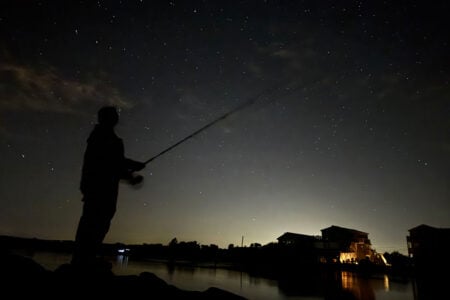
Fish at night. I didn’t catch many stripers in the 80s, but the ones I caught were big, because we keyed to two factors: First, a buddy discovered that recent inlet dredging left Fire Island inlet deeper and irregular. Second, we discovered that some large stripers queued up at that structure in the inlet on July and August full moon outgoing tides. Apparently, summer resident stripers sat quietly behind bottom elevations, and waited for the tide to carry food to them.
Third, we found that a smorgasbord of baits swept down inlet on stronger moon tides. The baits included large sand eels, squid, baby sea bass, small flounder, baby weakfish, and small porgies. Although we also fished between the moons and in spring and fall months, we generally didn’t catch fish. We concluded, although perhaps incorrectly, that at other times of the year more bait was available in the oceans or deep in the bays.
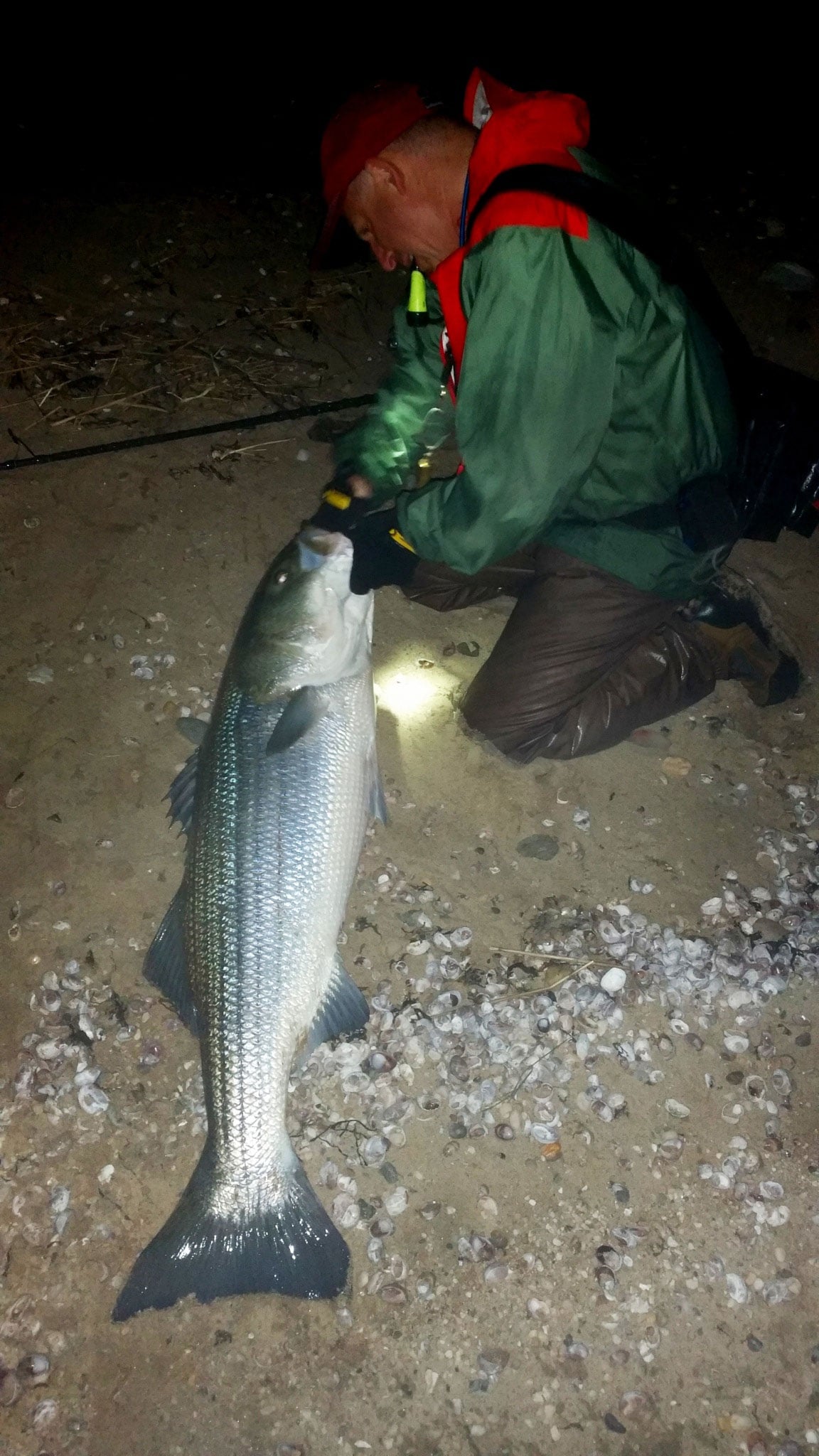
These big stripers were never, and I repeat never, available in daylight. This was a summertime, moon, and night related event married to a stretch of bottom structure. I offer the above example to demonstrate how important it is to fish at night during the summer months if you want to catch big fish. Our fish in those years were typically between 22 and 27 pounds, with some smaller and some larger fish like the 53 that hangs over my fireplace. Save your energy, because this spot doesn’t exist anymore. Over time, sand accumulated and filled in the trenches so that today, the bottom is flat. Bait patterns have also changed over the years. When the “spot” lost its productivity, some of us kept trying until it was clear that the “fat lady had sung,” a well-known Yogism.
Opportunities Persist
However, the disappearance of one piece of bottom structure shouldn’t discourage us because although water flow in the inlets destroys structure, it also creates new structure. My days of night fish are unfortunately over, but opportunities still exist for others. I’ve suggested exploring the areas inside the inlet to fellow anglers, but it hasn’t worked out. First, they didn’t survey by day, made only one trip, didn’t catch a fish, and gave up on the idea. So, let me clarify below, lest anglers get the wrong idea.
There were three and sometimes four of us who fished for these summer stripers, and during a six-day moon period, we averaged five to eight fish: sometimes less and sometimes a few more. We would fish about three hours a night. That’s about nine man-hours a night, and sometimes twelve. Ten hours multiplied by six nights is 60 total hours of casting. Now divide the 60 hours by an average of six fish and we have 10 hours per fish. Now, we are following the tide around the clock (6 nights) and therefore we eventually ran out of darkness. At the end of each tide cycle, we were fatigued and welcomed a break.
Helps To Be Nuts
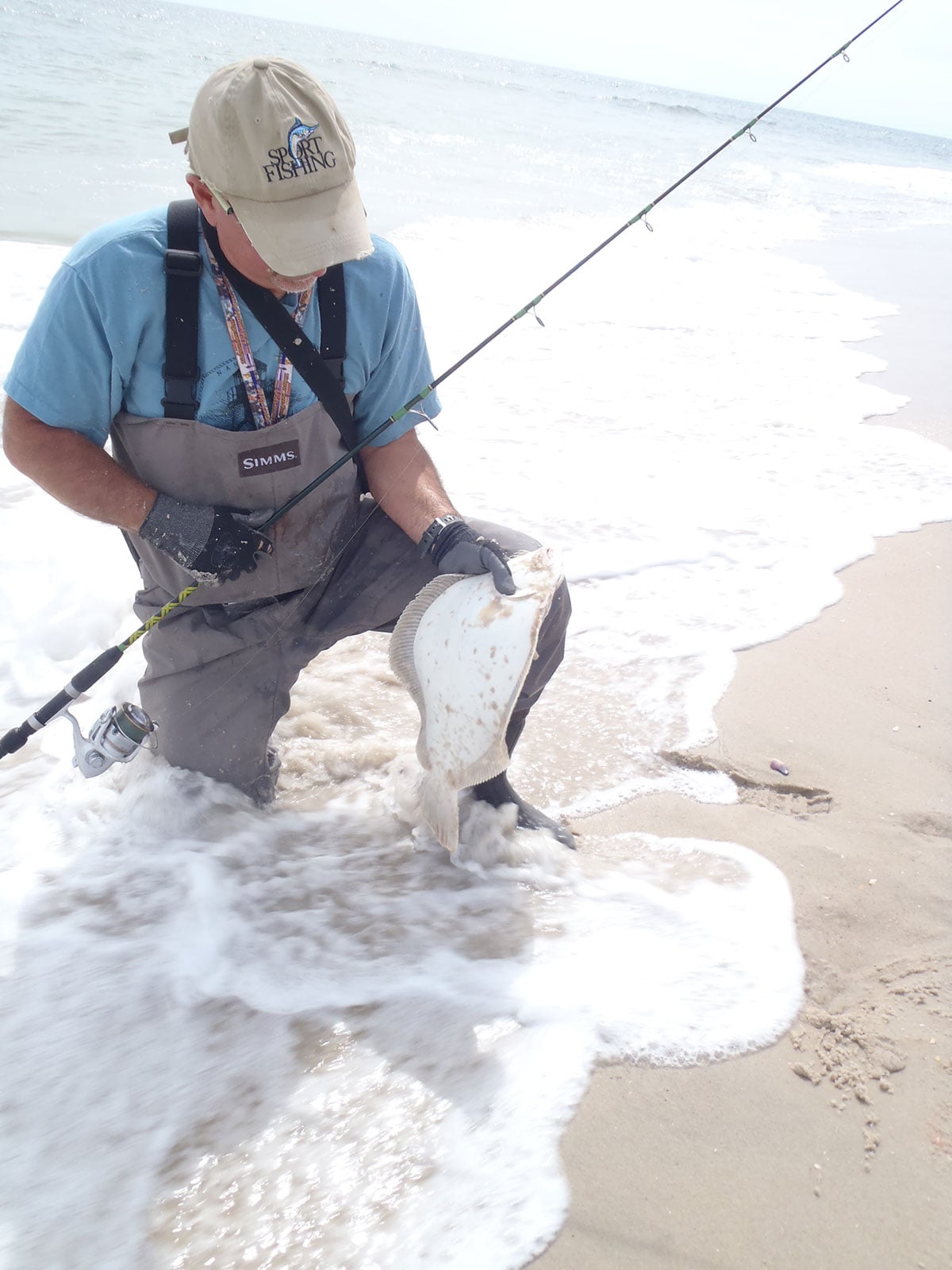
I’m a dedicated surf rat, and I’ve been one since I was eight years old when my father and uncle allowed me to tag along on an early Sunday morning fishing trip to Jones Beach West End II. That was the beginning of striper mania. With that mania in mind, my youth plus the night safaris in the 70s and 80s seemed quite normal. My young adult life blessed me with a much better ability to function without sleep. It helped to have a couple of friends to take turns casting and keep each other company. Although it was nice to have company in the wee hours, I also fished there alone at night many times. The lack of company should never deter a manic surf rat.
Insane surf fishing people seeking big striped bass will stay up night after night with only a slim hope of catching a big fish. Is it normal, a sickness, or an addiction? Can’t say for sure, and frankly I don’t want to know the answer. The moral of the story is you too can join the cuckoo’s nest crowd. Here’s how. Study your favorite inlet by day looking for lighter and darker water areas that suggest structure. Make a note of those areas with the most turbulent water. Next, fish the summer moons at least four nights in a row with deep running lures, and you may find a run of fish like we had.
Jetties Too
I’m not a fan of jetty fishing for a number of reasons. Most of my reasons center around my safety and that of the fish. However, large stripers have a habit of gathering close to the rocks at the tips of inlet jetties in summer; especially at night. It is possible to fish jetties safely if you take proper precautions, including the right outer wear, appropriate tackle, and an eagle eye on wave heights.
Cautions: It’s best to have the following gear before you fish jetties. One, long water-proof pants and a top, but not waders since if you fall off the jetty, waders fill up with water and you’ll sink. It happens every year: don’t let it be you. Second, wear Korkers. These are a version of sandal-like slip-overs with metal spikes on the bottom to grip the slippery rocks. Third, you’ll need a medium-heavy power, medium action 10-foot rod, and 30 to 50-pound-test line in order to lift fish out of the water and dissuade fish from charging into the jetty rocks. Finally, you should befriend an experienced jetty-jockey to fish with in the beginning to learn the ropes. Perhaps now you can understand my reluctance to fish jetties.
Daytime Schoolies
If there are several successful spring spawns of bunker, August can offer daytime action deep in the harbors and bays. In late July or early August, young of the year peanut bunker will leave their hiding places in the weedy areas and rugged shallows deep in the estuaries. Once the first bunker spawn is about 1-1/2 inches, stripers and blues begin to notice them and, if the bait schools are large enough, a run of fish can build from day to day and week to week.
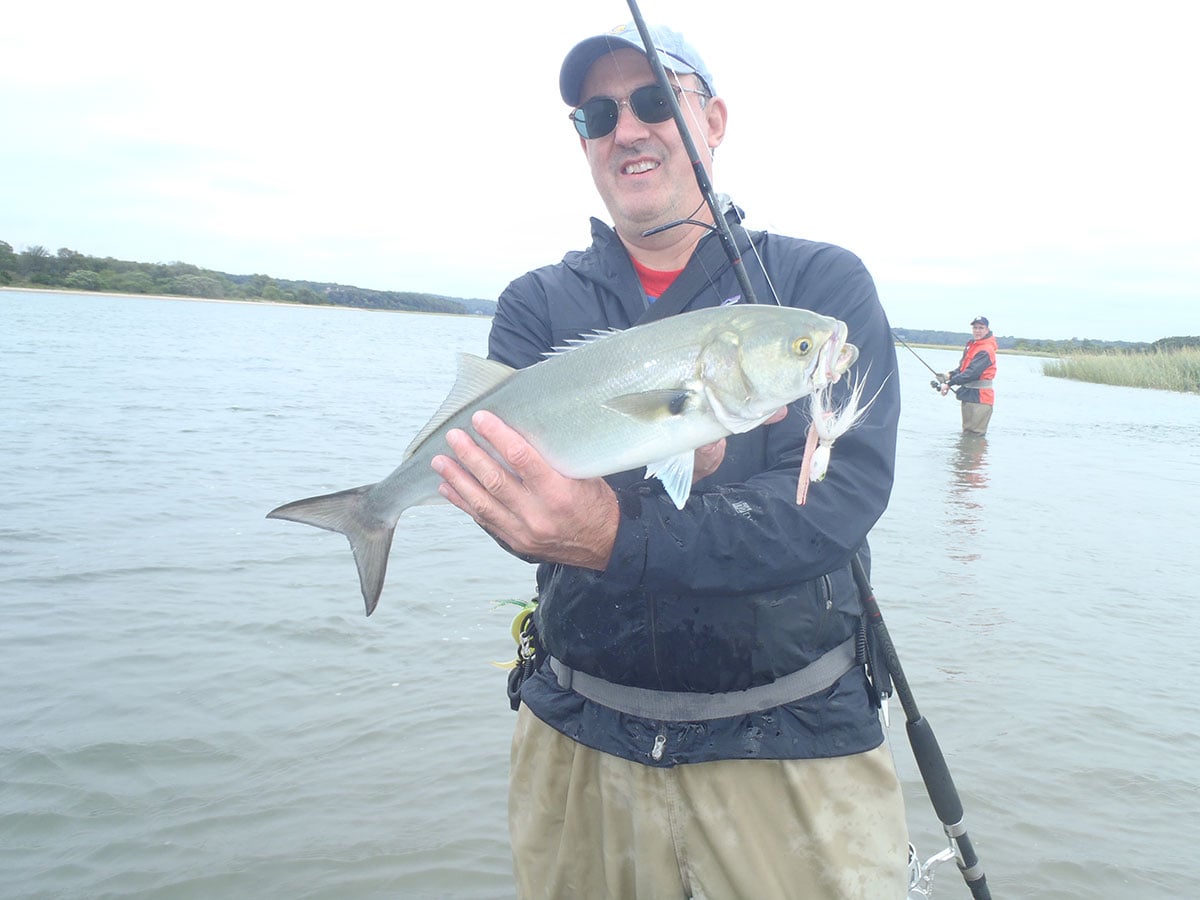
Most of these fish are small, but the action can be intense and once in a while a large fish will show up. I enjoy this summer action enormously, because the bites can be “hot.” One afternoon last summer I bumped into such a bite in a north shore harbor. On the south shore, don’t overlook the mouths of rivers and creeks inside the bays; especially at sunset and sunrise if you can manage to gain some access. In addition, there are canals spread along the north side of the bays where peanuts are sometimes trapped by bass, blues, weakfish, and fluke.
Heavy tackle isn’t needed since the fish are usually small and there are few obstructions. I like a 7-foot medium power fast action rod: lately I’ve been using a Tsunami Tundra model fitted with a VS 150 and 20-pound-test Sufix braid or Diawa J-braid line for all shallow water fishing deep inside estuaries. At times, pencil poppers are effective, but day-in and day-out I like half-ounce and 3/4-ounce bucktails with pork rind trailer or four-inch Z-Man Diesel Minnows on half- and 3/4-ounce VMC Boxer lead heads. This combo allows for easy casting, plenty of feel, and sufficient power to throttle any fish that comes along.
North Shore/South Shore
If bait schools are abundant, both north shore harbors and south shore bays can provide daylight action. There is an access problem in both places, but here and there public beaches provide access for those who live in a particular town. There are also a few state and county parks with both parking and beach access.
In general, north shore or south shore, I often catch more fish in daylight in summer in backwater areas than in the fall, because in fall, bait begins to migrate into the ocean or Sound, and constantly move. That said, night tides offer some larger fish. Night fishing passes provide access to selected areas via the state, county, and towns. If you like fast light tackle action this may be the style for you.
Ocean Beaches
I generally don’t fish the ocean beaches after Memorial Day, but many people who live along the south shore enjoy plying public beaches at night. The New York State Parks Sport Fishing Permit and Fishing Four Wheel Drive permits allows night access at a number of parking fields, as do some town permits. Summer ocean angling is, for the most part, a nighttime activity using natural baits. Although I have done it at times, I don’t relish it, but a steady pick of large stripers is possible.
Lately, however, the bloom has fallen off that rose, to paraphrase, since more and more sharks have invaded the beach zone in summer and ruined the striper fishing. This is especially true on night tides.
The East End
I can’t overlook the east end beaches in the early summer because of the good angling that occurs in daylight. When water from Peconic Bay flows towards the ocean on the outgoing tide, bait is carried beyond Shelter Island and Orient Point into Block Island Sound. As ebb tides carry bait past Orient Point, weakfish, blues, bass and fluke gather, eager to slam small bucktails and paddle tail plastics cast from the shore. Orient Point State Park offers public access, while town beaches offer chances for residents.
| MOON MAGIC |
| For surf fishing around the island during the month of July, the strongest moon-related tides will be around which could result in some of the best opportunities.
July 12–16 (New Moon period) July 27–31 (Full Moon) |
On the south side in June, I’ve enjoyed good action at Shagwong Beach; part of Montauk State Park at night and by day, Goff Point; part of Hither Hills State Park, and Napeague State Park (4WD access). These and other spots frequently produce runs of stripers, weaks, blues, and fluke both at night and during the day as sand eels, peanut bunker, spearing, tinker mackerel, and sometimes squid flow past on the tide.
I prefer fishing to driving so I don’t generally drive long distances to reach fishing “holes.” I prefer to fish locally and learn how and when these spots produce fish. That way, I save gas, time, and have reliable places to fish. Success, in the end, is all about learning local waters, understanding bait behavior, and adapting to changing conditions, regardless of where you live.