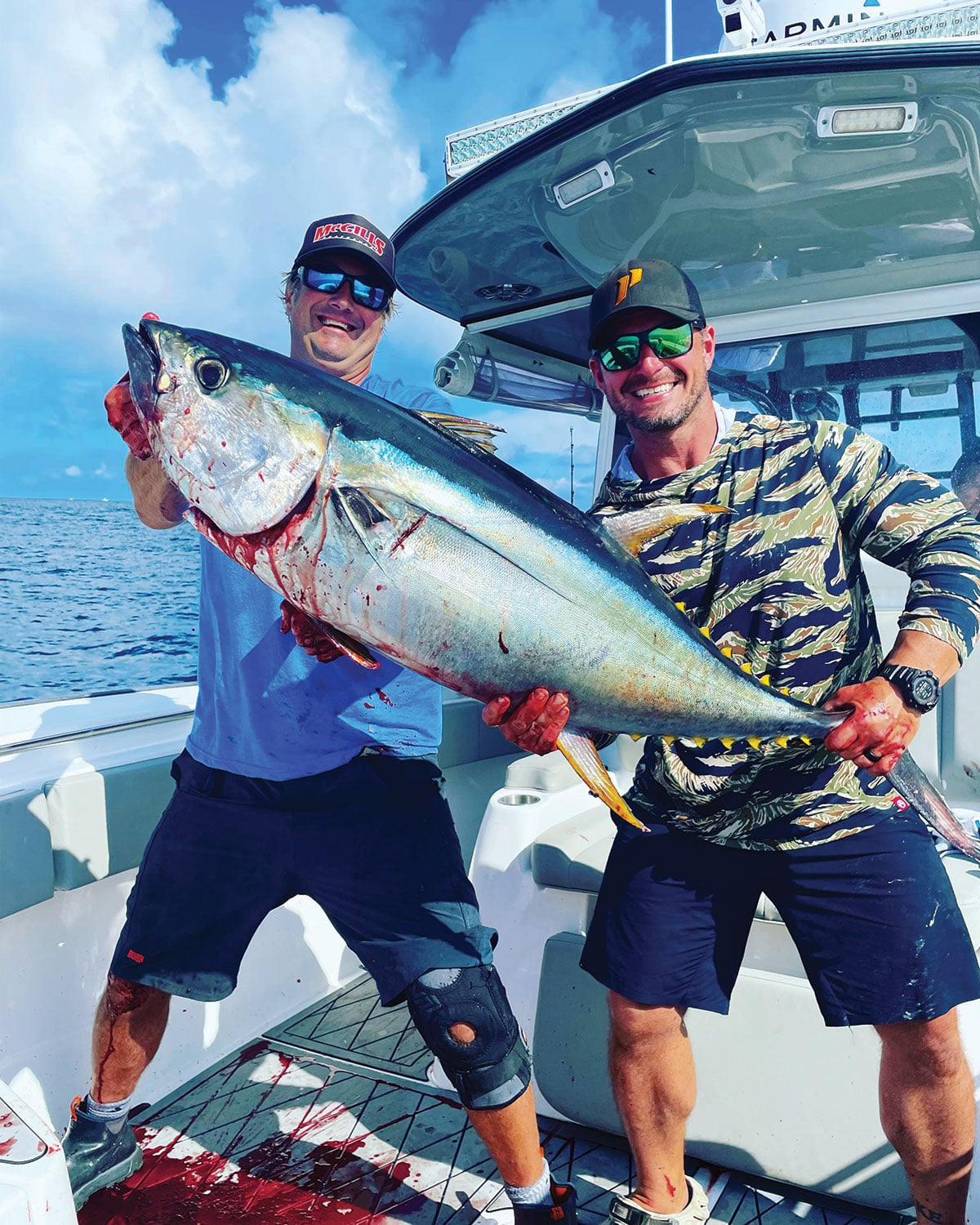
A few tips from the pros for finding offshore success this summer.
Offshore tuna fishing in the Northeast has always been popular, but the “tuna craze” that has taken our region by storm the past 5 to 8 years or so is like nothing we’ve seen since the 80s. With the advent of booming stock markets flooding waters with rocket sleds outfitted with triple and quad 350hp engines, non-stop social media content, and tuna schools pushing super close inshore following old migration routes, tuna fishing has become almost as popular and pursued as striper fishing along the coastlines.
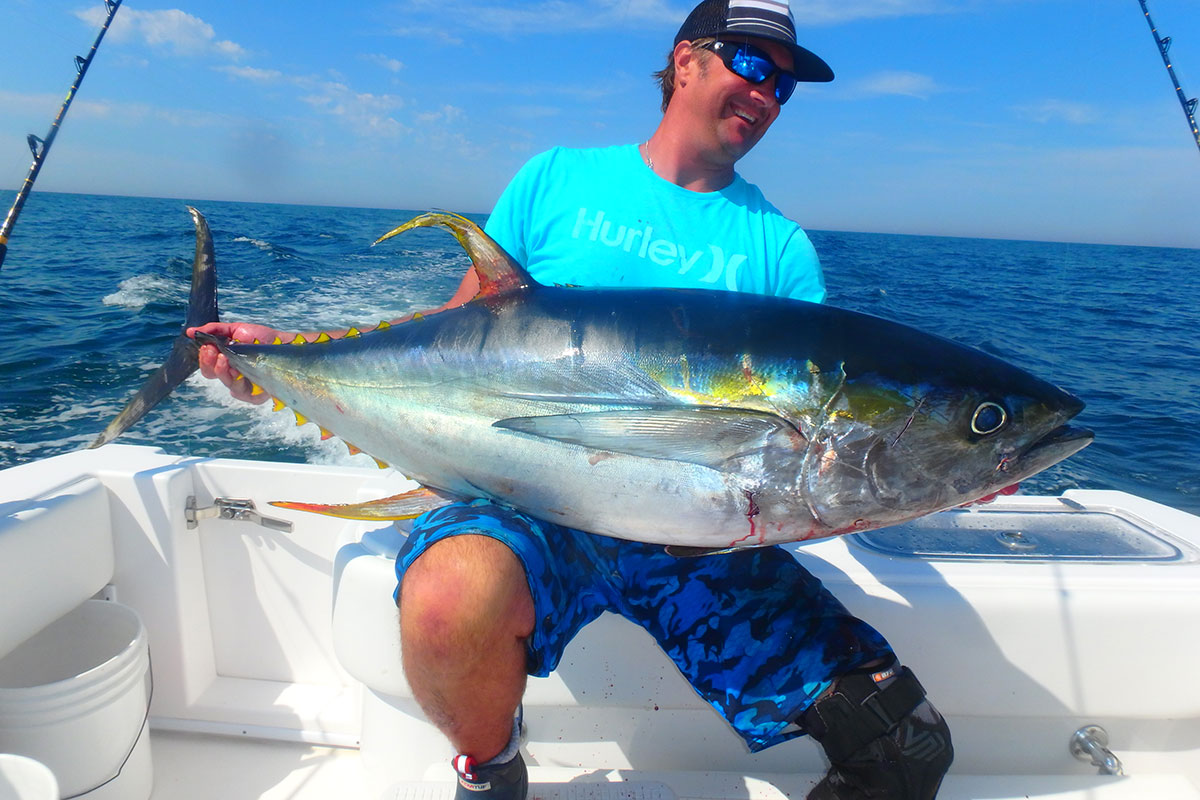
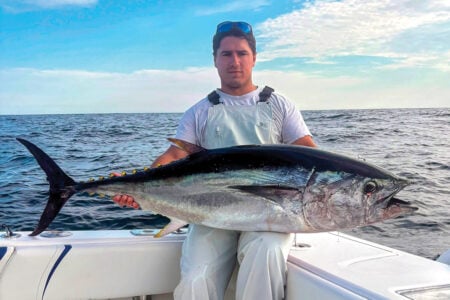
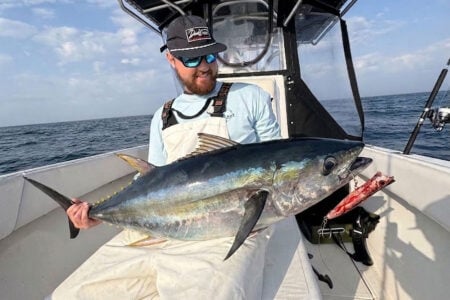
We have recently been in some true “glory days” for tuna anglers. That said, tuna fishing is booming from Massachusetts to the DELMARVA region during the months from May through November with a sweet spot seemingly landing between July to September. With new Atlantic Coast bluefin regulations in place for June 1 after a devastating mid-summer closure in 2025, summertime is ripe with action to raise bluefin, yellowfin and bigeye on the troll.
Spread It Out
While its wildly exciting running and gunning chasing after tuna schools blowing up on the surface, there are times when no visuals are prevalent, which is a good time to set out the trolling spread. “I think a lot of guys off our Jersey coast miss out on the early season tuna from June to July when trolling tends to be most productive,” states Capt. Alan Lee of the Mushin out of Point Pleasant. “Everybody loves to chunk, jig, and pop, but those are often times more productive in August through October when the offshore tuna are schooled up,” Capt. Lee noted, adding “Trolling is a more active search and destroy in June and July when bluefin and yellowfin tend to be more mobile and not schooled up.”
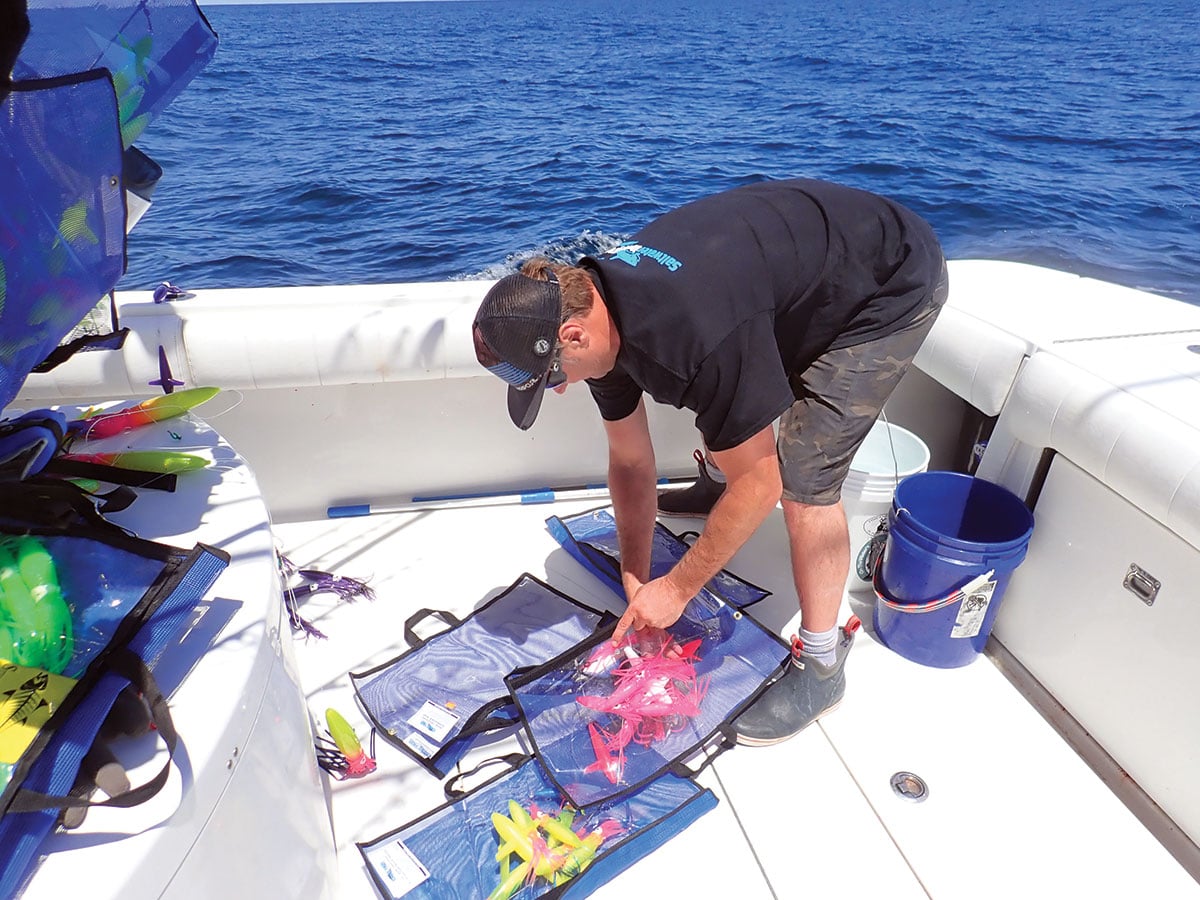
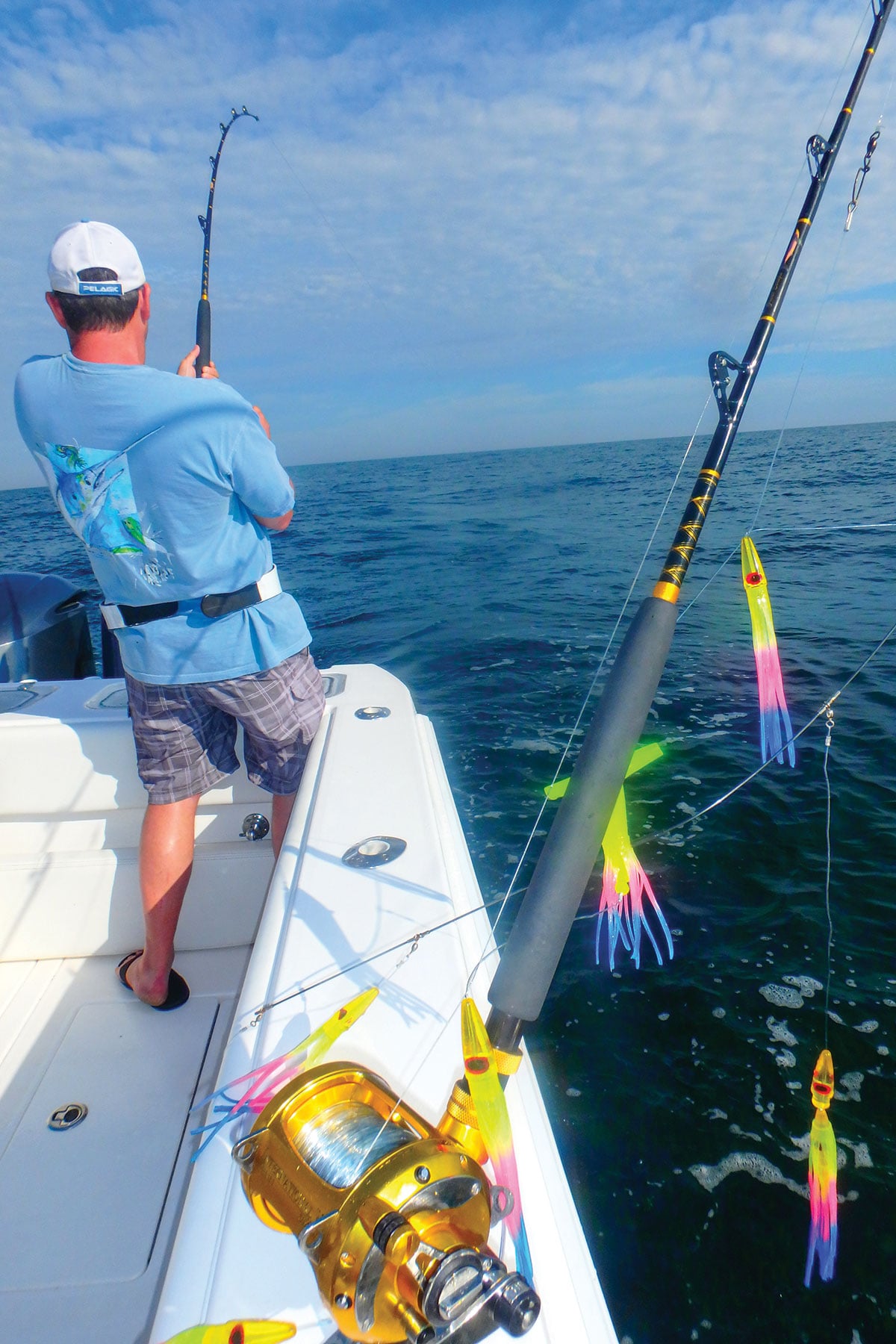
A general trolling pattern follows a textbook W-spread, with five main spreader bars, daisy chains or Ilanders rigged with Ballyhoo out in the W, then two cedar plugs off the flatlines for a total of seven lines in the water. Spreader bar trolling will tackle bluefin, yellowfin and bigeye tuna.
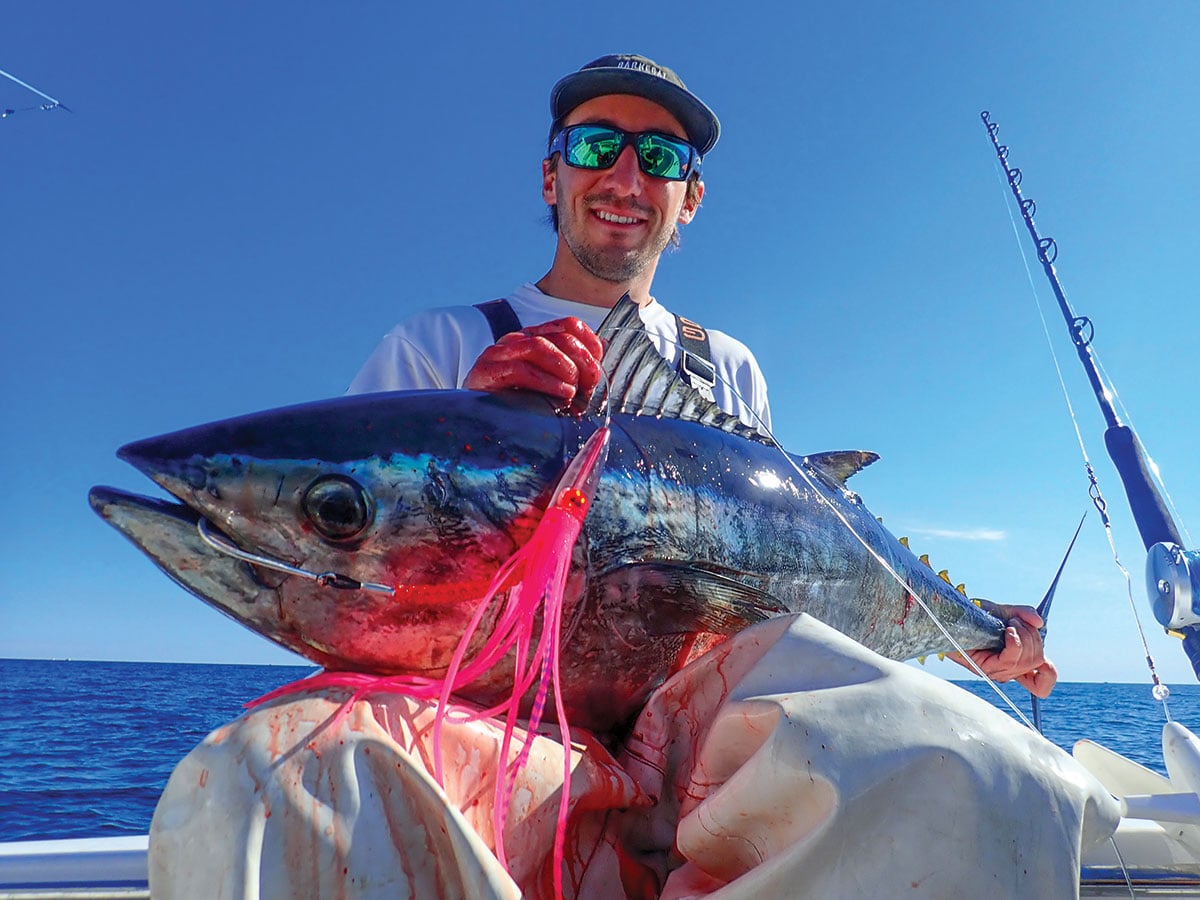
Capt. Craig Angelini of the Canyon Runner consistently puts tuna limits on deck using spreaders. “It’s obvious to say match the hatch, but generally our bait to mimic revolves around squid, with the key being to pay attention to the size and color of the squid when selecting a spreader bar,” said Angelini. “If we are seeing the large, orangish squid at night, we’ll throw out the 9-inch pink/brown combo or red squids, otherwise if it’s a general pink size, then the 6-inch squids go out, usually in Bloomin’ Silver or Mini Mamba color patterns,” Capt. Angelini advised, adding “The smaller squid work better too during the earlier part of the season in June and July.”
| GEARED UP |
| The author’s recommendations for trolling gear on the Northeast tuna grounds.
Trolling Rods: Shimano or Daiwa stand up 50 to 100-pound rods Trolling reels: Shimano 50 wide, Daiwa Seaborg Trolling Lures: Chatter Lures Sidetrackers, Sterling Tackle Widetrackers, (Black/Purple, Cucumber, Rainbow) Cedar Plugs, Green Machines, Williamson feathers |
In terms of isolating bluefin tuna, Capt. Jack Sprengel of East Coast Charters in Warwick, RI said it’s critical to start with the best available intel, and be prepared to cover ground rapidly. ”We search for bait concentrations, diving birds, feeding marine mammals, temp breaks, water color changes or surface slicks – they are If tuna aren’t readily visualized, it’s time to troll,” Capt. Sprengel said.
Capt. Sprengel sets seven troll lines out to incite a bite starting with four side tracker spreader bars rigged with rubber squids. “In addition to the four tracker bars we will also often deploy a deep-diver lipped lure that will get down 30 to 50 feet below the spread and can often trigger a bite from less brazen, deeper holding fish,” said Sprengel, adding “The last two of the seven rods are rigged with ballyhoo baits fixed with weighted Joe Shute skirts. The ballyhoo are fished Shotgun style, way back down the middle.”
The Hunt For Bigeye
Perennial bigeye tuna tournament winner Mike Yocco of the MJ’s has a special strategy when targeting bigeyes. “When we mark bigeye, usually you will see them hang in wolfpacks of three to five fish, but there could be four or five pods in the area at any given time, totaling 20 to 30 fish in the area,” says Yocco. “They are deeper swimming fish that migrate vertically in the water columns, staying deep at 400 to 500 feet and more during the day, but coming up to within the top 100 feet of the water column when night falls,” Capt. Yocco advised, adding “They come up at night to warm up their muscles, and also to feed on squid as they push up to the surface.”
| BLUEFIN REGS |
| As of June 1, 2026, Highly Migratory Species (HMS) permit holders in the HMS Angling category are allowed two bluefin tuna from 27 to less than 73 inches, of which only one may be a large school/small medium bluefin tuna measuring 47 to less than 73 inches. For HMS charter boat operators it’s three bluefin tuna measuring 27 to less than 73 inches, of which only one may be a large school/small medium bluefin tuna measuring 47 to less than 73 inches. For headboats the retention limit as of June 1 is six bluefin tuna measuring 27 to less than 73 inches, of which only one may be a large school/small medium bluefin tuna measuring 47 to less than 73 inches.
To purchase a 2026 HMS Permit for your vessel go to hmspermits.noaa.gov. |
Yocco’s number one choices for bigeye are bullet-headed, subsurface lures as they track straight in the water. Bullet lures can be rigged with or without ballyhoo. “We’ll take a Joe Shute or Ilander lure, 5 ounces and lighter, and rig a ballyhoo or an 8 to 10-inch Hogy tail on it. Then throw out other bullet trollers like Laceration Lure Bob’s Bullet or a 7Strand Green Machine, 8 to 10 inches long and 5 to 10 ounces so it tracks properly,” said Capt. Yocco, noting that the ideal trolling speed is between 6 and 6.8 knots.
Regarding colors, Yocco said a lot of that decision comes down to time of day. “During daytime go with darker colored lures for contrast like blue and purple combos or blue and crystal,” said Capt. Yocco, adding “Night trolling until 11 p.m. you still have the ambient light from the sunset as it usually sets around 9:30 p.m. during the heart of the summer in late June and early July.”
Capt. Yocco advised, “Night trolling we use a crystal skirt Joe Shute with a ballyhoo, or glo skirts or bullets with the glo resin in the heads.”
As the summer heats up, get ready for the tuna fishing to follow suit. Set the trolling spread this July and get mad into some wild tuna action.