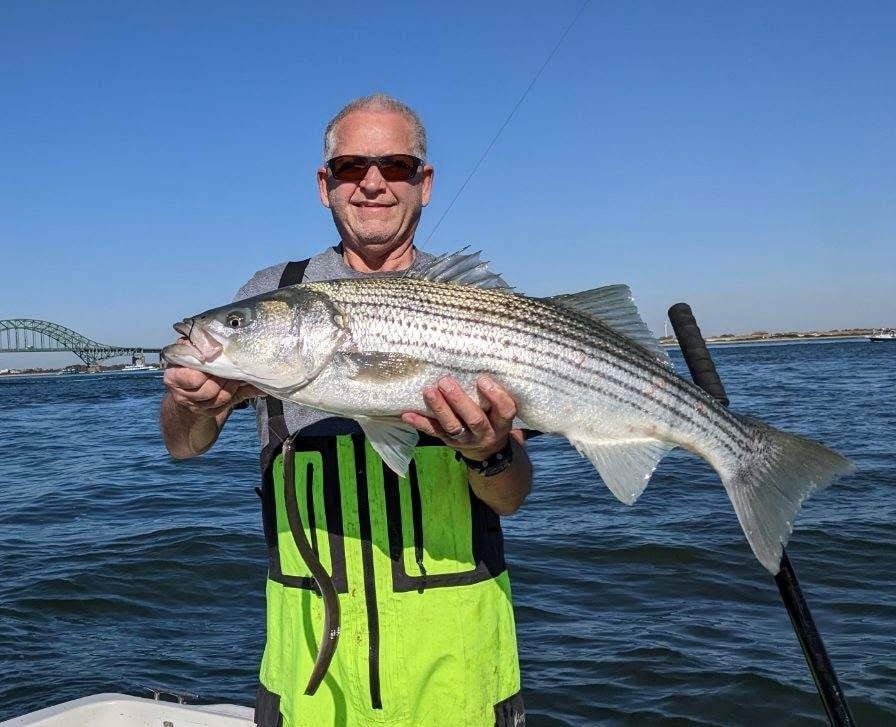
Live eel fishing for striped bass is not just a spring and fall event.
The striper season kicks off in April with the first shot at bass mostly school size fish. Then some larger fish hit the area and most are all over the early season bunker pods. As June and the moons roll in, night striper action with live eels becomes a staple, from the open beaches by surfcasters to anglers hitting the inlets and back bays by boat, live eels account for a lot of fish. As July and August roll in, for some reason, anglers abandon live eels. Why? I just don’t know!
Gotta Eat!
Bass eat and fatten up from the time they arrive in the spring, all the way to the end of the season when they head out. Basically, a striped bass is an eating machine, and in my opinion, similar to sharks in the fact that they will eat anything. All they do is eat and lay eggs.
Live eels are prominent in several areas of Long Island – Long Island Sound, and from what I could gather – Georgica Pond in East Hampton. The Georgica Pond area is quite intriguing as eels grow throughout the years in this location. Could it be that when they used to open Georgica it wasn’t just baitfish that caused a massive blitz, but the eels flowing out instead? In any event, for the most part, eels are prominent on the North Shore, but I do believe there is an ample supply of the snakes sliding around and out of the inlets and bridges. I also feel, as the name implies – “bass candy,” that bass absolutely love them.
Easy To Use
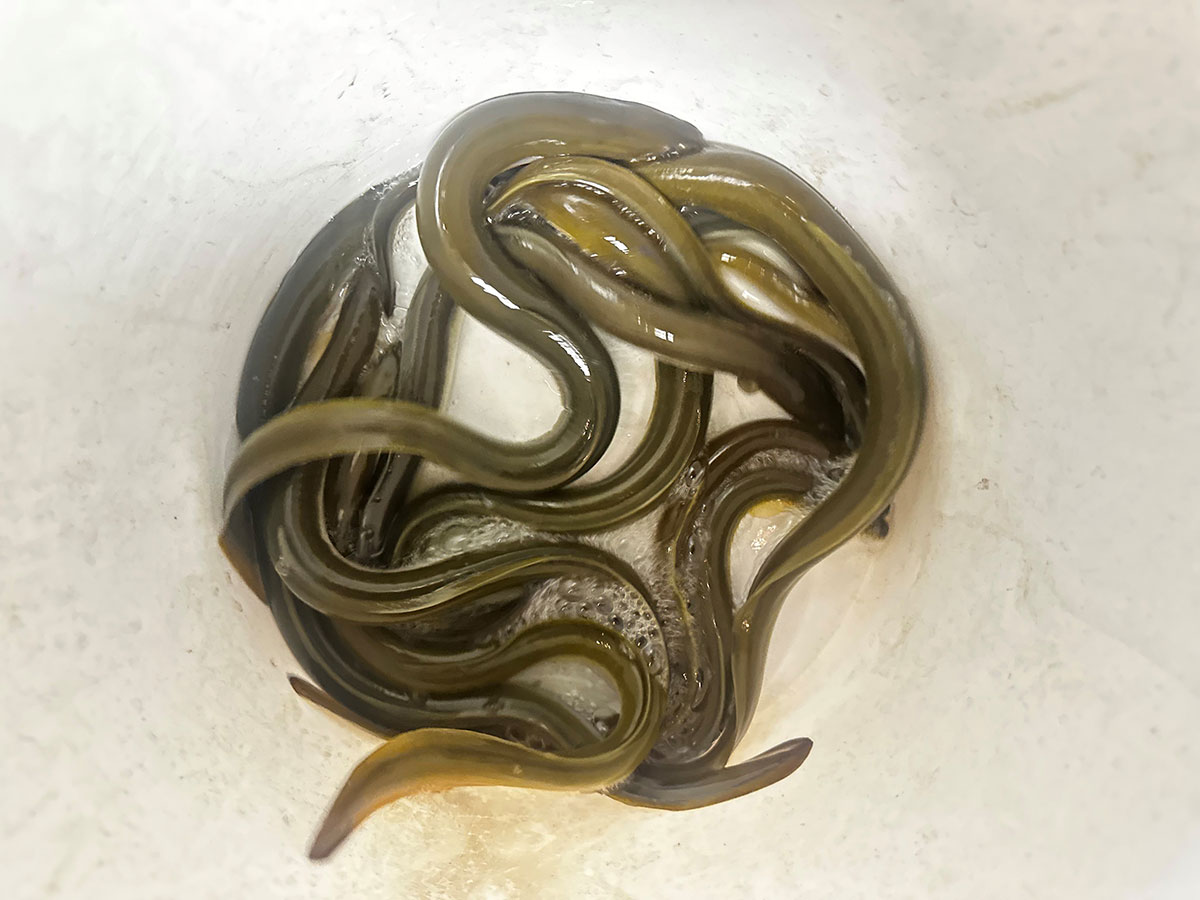
Some anglers hate using live eels due their nature of balling up on a hook, making for an impossible mess. I have seen eels almost kill themselves, tying into a knot too remove the hook.
Eels are not all that unmanageable if you pay attention. There are several ways to slow them down, one of which I never use, but works. If you smack the tail hard, on a hard surface, they will not ball up as much. I feel this is really not needed if you pay attention to the eel’s movements and your rod.
For starters, you need to keep the eel moving at all times. I fish eels in two ways; free lining or with an egg sinker. Free lining I strictly use when fishing the open beach or jetty. We always called an eel, the living lure because you fished it just like a lure – always moving. It does not have to be fished fast, just fast enough to make the eel not have the ability to ball itself up.
The second method with the egg sinker is employed on the boat. I use whatever size egg I need to get the eel to the bottom, depending on current and drift. Typically weights from 1/2 to 3 ounces is all that is needed. The egg is on my braided main line, then a barrel swivel, then a trace of fluorocarbon or Ande pink mono in 40-pound test for the leader. The leader length will vary from 3 to 8 feet. In stronger currents I like the longer leader as it allows the eel to stem the stronger current and remain out of the rocks. The key here, just like free-lining is to always have the eel moving, whether it be the drift, current or lifting and dropping the rod tip.
Shore Or Boat
For shorebound fishing (surfcasting) I like to work the late nights or just before first light. Typical areas should include open stretches of beaches, with a focus on leading edges of bars where water is being pushed up onto them or flowing over. I also like the pockets to each side of the jetties, when the wind is out of the south. At inlets like Shinnecock and Moriches, the southerly wind will have bass stacked up in these pockets.
Moving to the boat, Fire Island Inlet area all the way from Ocean Beach to the inlet itself will always produce. For me, the best tide has always been the outgoing current, with the later it starting the better. If you can pick a current phase that starts at midnight, and a new moon, you need to be on the water.
Catching Made Easy
Live eel fishing is nothing short of easy pickings, if you find the fish. Scope out the areas, listen to the chatter online and in fishing reports for bass activity. Once you have homed in on where bass have been caught, bring out the snakes after dark.
Hooking bass while using live eels is pretty easy, and made even easier using circle hooks. I use a 3/0 to 5/0 Gamakatsu 90% of the time. These hooks are razor sharp and work well.
When using an eel, the hookset used to be “bow to the cow,” then rear back and cross its eyes. This was a surefire method that virtually always worked. In today’s world of circles, it’s as simple as feeling for weight, then slowly bowing, and slowly just lifting the rod tip. When I feel weight, I like to give it a good rap to ensure the hook penetrated and is not loosely hanging at the edge of the mouth.
Release Em’ Too!
With our current regulations only allowing one fish of 28 to 31 inches, a lot of the fish you catch may not fit into the slot. Releasing bass is as important as catching them to me. I love the fight, the photo and the joy it brings to anglers faces. For whatever reason, striped bass have more anglers lining up than any other fish.
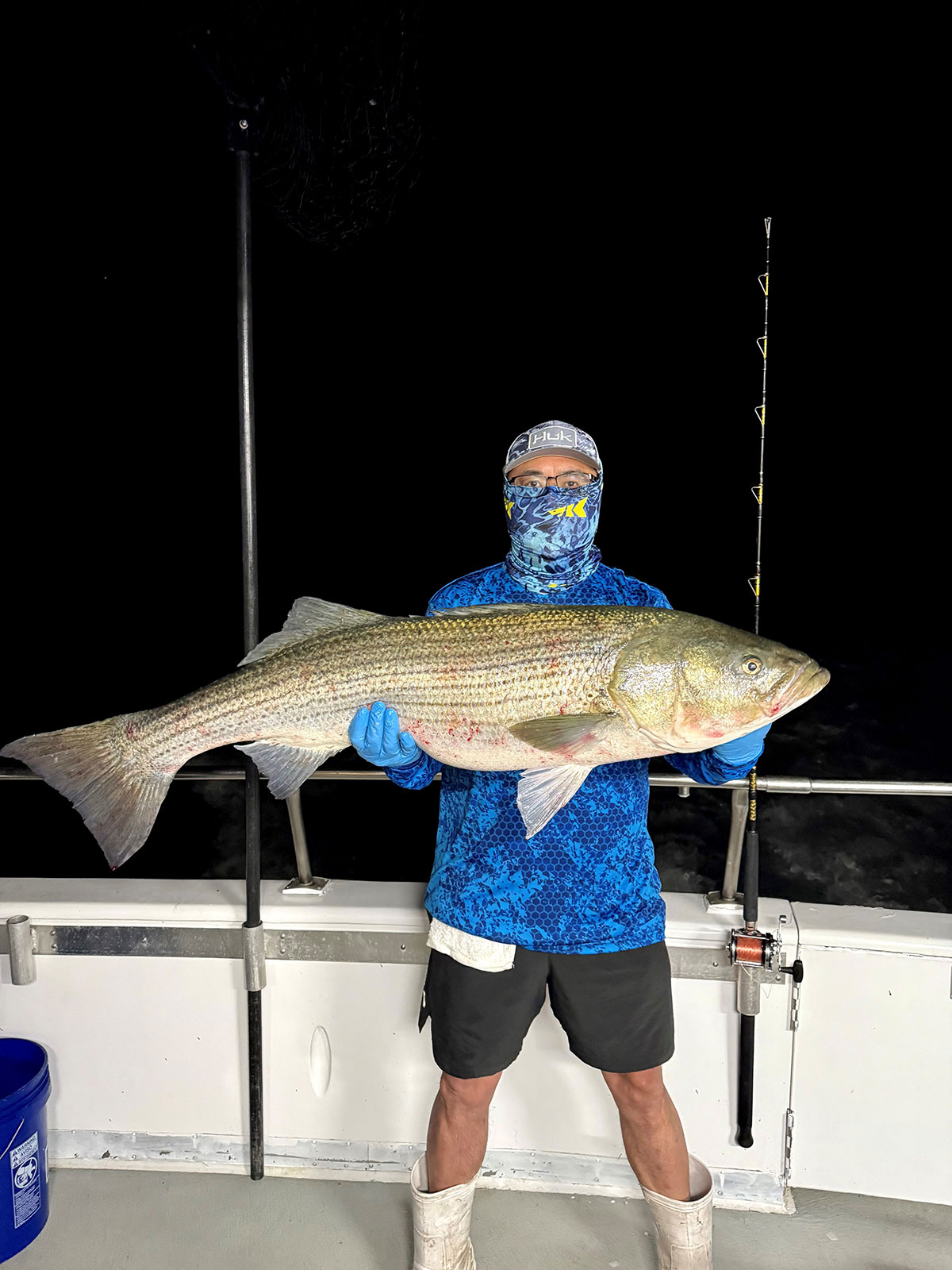
After catching a bass by boat, never use a gaff to land them, no matter how big. A gaff will surely mean death in most cases. A large landing net or reaching down and grabbing the fish by its mouth is a much better option. Once landed, stripers out of the slot range must be immediately returned to the water. A quick photo for the memory is all that is needed, so always have the camera (or phone) set and ready to shoot. From the open beach, simply slide the bass onto the sand, revive, photo and release.
Speaking of reviving, depending on the fight, will depend on the revival needed. If you fight a fish for a “good” period of time, you need to ensure they are ready to go, not just drop them back in. By moving the fish back and forth in the water, she will usually let you know she is ready to be released. This will be a strong tail slap or clamping down on your thumb with its maw.
Live eel fishing for striped bass is not just a spring and fall event. This year, before heading out, stop by your favorite shop and grab some snakes. I am sure you will be pleasantly surprised with the outcome.