Cold-season tactics for Long Island’s white perch.
The “end” of the season always comes so quickly. It’s warm, fishing’s good, and then all of a sudden—or it feels like all of a sudden—things get cold, Thanksgiving and the calling of the Holidays are upon us, and winter beckons. For weeks it was albacore, big bass, and more stripers, and then all of a sudden, they’re gone. What happened? It’s at this time of the year that I start hearing the call of white perch. I’ll be doing some cold-water largemouth bass and panfishing at this time too, but the quarry that’s geographically closest to me is the white perch, nestled in the nearby shallow salt ponds. Four weeks ago, six weeks ago, it would have been “what’s a white perch?” Now, they look like a prime target. How your current situation changes your perspective!
About The White Perch
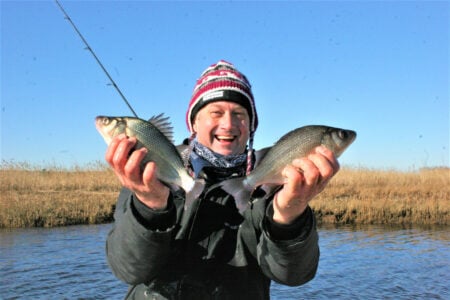
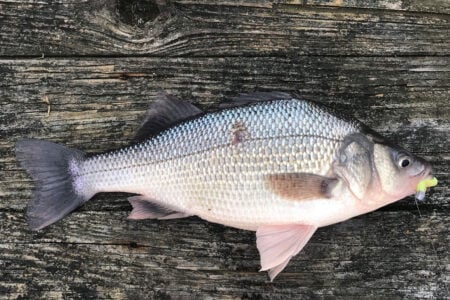
White perch are a relatively small 6- to 18-inch silvery panfish, which incidentally are delicious to eat, that often are found in schools, and frequently in brackish water like that found in salt ponds and the lower end of creeks emptying into saltwater areas. Sometimes you’ll find them in freshwater proper. As the water gets cold they remain active feeders, so December and January fishing can be good, sometimes really good for them.
You might well find an active school where you can catch 10, 20, 30, or even 40 fish out of a big school, or maybe you’ll have to work for 10, or at times even one or two. You just go out there and take your chances. If there’s one fish species that’s thrown me into a “feast or famine” situation in my lifetime, it’s white perch. One day fishing can be incredible for them, and the next it’s “where did they go?” It’s our wintertime fish (especially for saltwater fishermen), and fishing for them can be spectacular in December, and if it stays warm enough, January too.
Finding Winter Perch
Again, search out local salt ponds. Many harbor perch. Here on eastern Long Island there are lots of them. Sagaponack Pond in Easthampton, and Hook Pond and Georgica Pond in Southampton are some. Fort Pond, although it’s all freshwater, is another place to explore.
Any river or creek that enters saltwater may have white perch inside its mouth, or just upriver. Find out from local anglers or tackle shops which of these areas contain white perch, as well as which local freshwater lakes, ponds, and moving water areas have them as well. Try to also find out which places have the biggest concentrations and numbers of fish. This gives you the best chance for running into them.
Tackle And Techniques
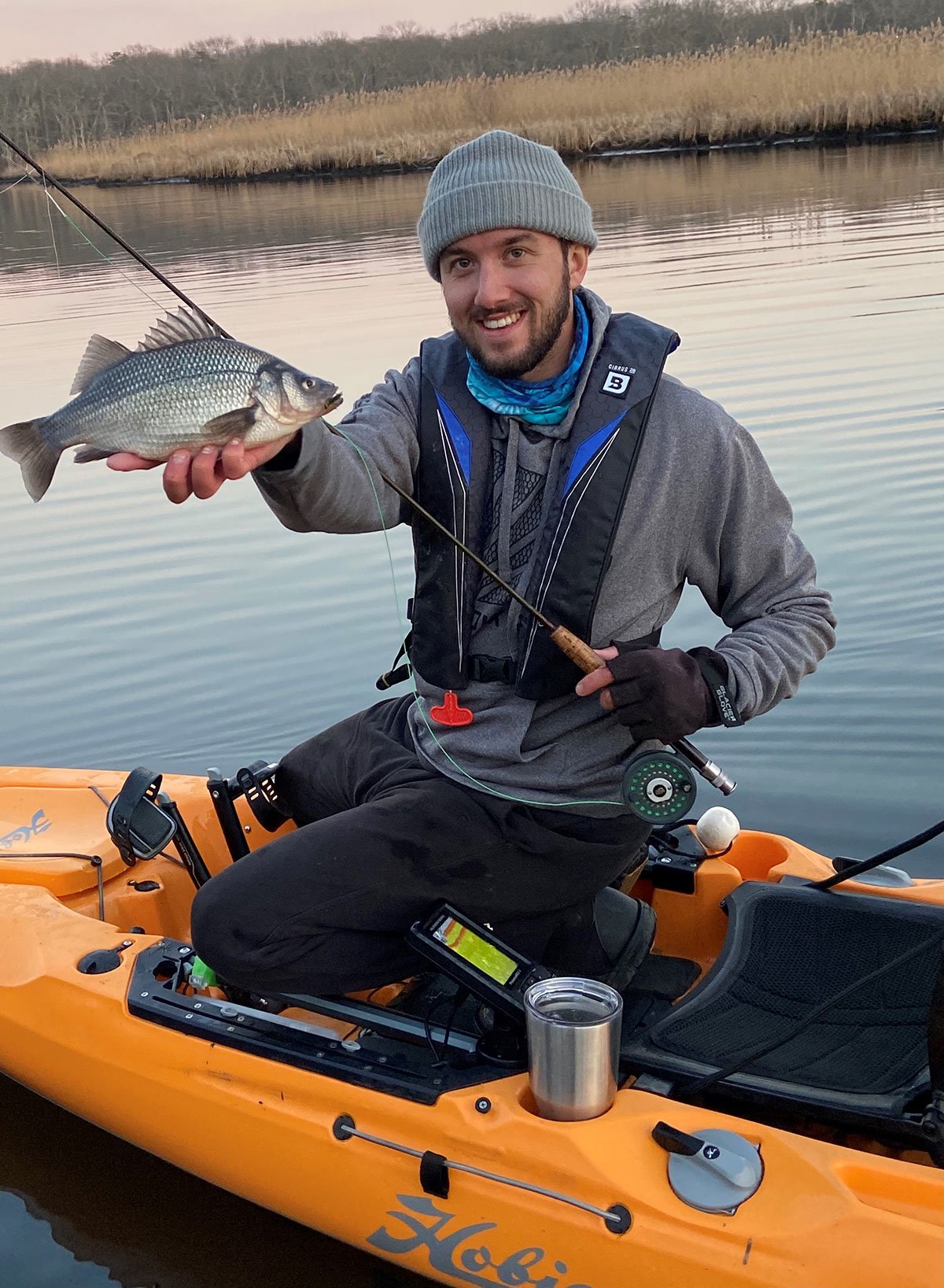
Get some sport out of small but tough fighting fish by using light or ultra-light spinning gear—rod lengths of 5 to 7 feet, with 4- or 6-pound mono, or 8- or 10-pound braid. A light fly rod is excellent too—say one that casts a 5 wt. line, or even a 4 to 7 wt. one. Use tippets from 4X to 1X with an 8- to 9-foot leader.
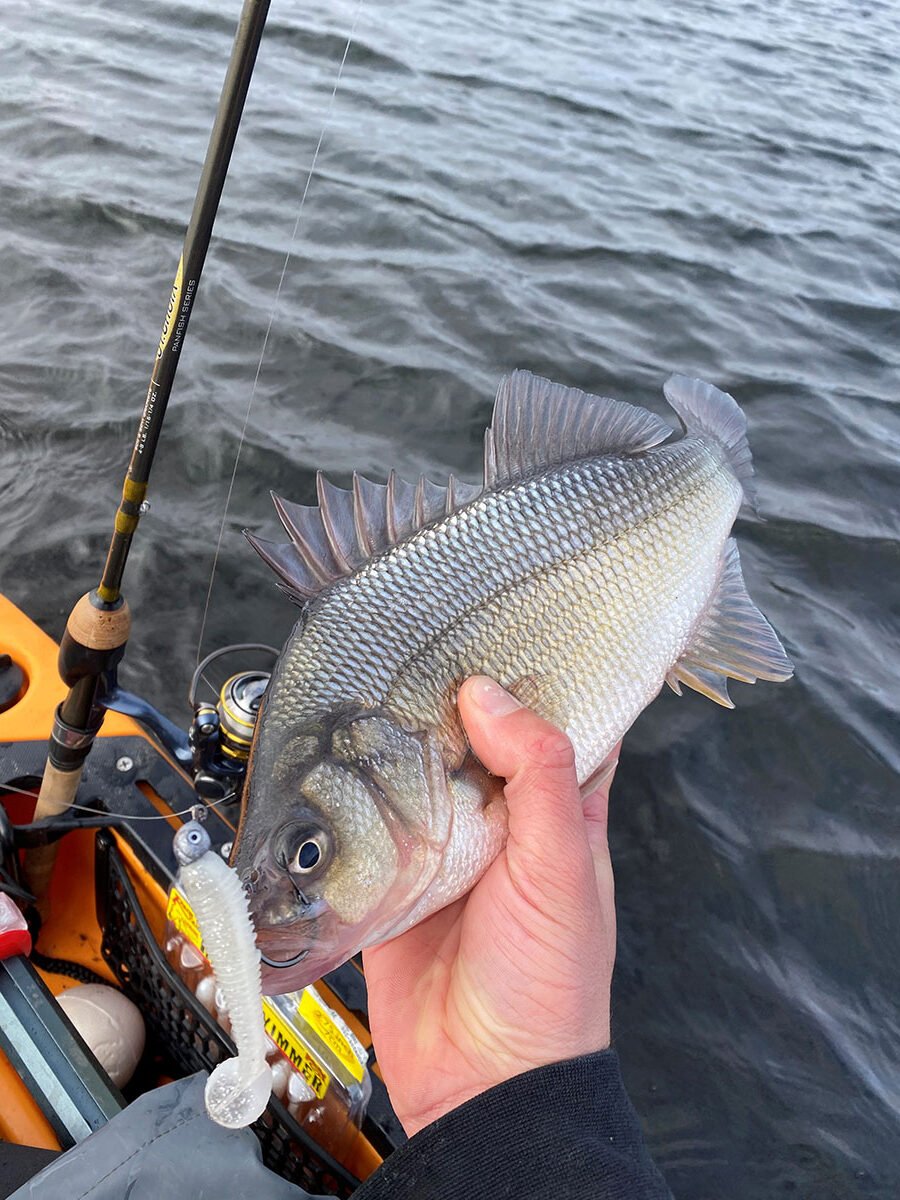
Use small marabou or crappie jigs, or bucktail jigs that weigh 1/16 to 1/8 (maybe to 1/4) ounce. Any color should suffice. Small soft plastic curlytails or paddletails on 1/8-ounce leadheads work well too. Again, color is your choice, though many anglers like chartreuse or white. A small spoon, say 1/8–1/4 ounce (or even perhaps 3/8 to 1/2 ounce—spoons this size can still appear small) or small spinners can work wonders. Kastmaster, Krocodile, and Sidewinder are names that work well.
Spinning Methods
Cast out or (if fish are below you, say you’re fishing from a bridge) drop your jig, and when it’s at the proper depth, give it short, sharp, repeated “jigs” with short pauses in between. Make casts all over, short and far, and “cover the water” until you find fish. Try different depths too. Also try different speed retrieves, but usually slower is better.
You can use an old staple of crappie fishing and fish your jig under a bobber or float. Find out the depth of the water immediately before you and set that bobber above the jig at a distance just short of that depth. Do also try different distances above that too. For example: jig set at two or three feet below float in four or five feet of water. Perch sometimes suspend off bottom and will often “come up” to a jig from below too. Just keep twitching and jerking that bobber (sometimes with pauses—of different lengths—in between) to give that lure attractive action. When the bobber twitches on its own, pops, moves off, or “goes under,” set the hook. It’s a fish. This is a deadly way to fish, and if you think about it, it’s vertical fishing at different distances.
Curly Tails and Small Paddletails: These soft plastics have great inherent action just from a straight retrieve, and that’s a great way to fish them. Cast out and begin your retrieve immediately, or use different-length pauses initially to fish the lure at different depths. You can jig these soft plastics effectively too.
Spoons and Spinners: Cast out and retrieve straight, steady, and not too fast, and you will often be OK. Try pausing different lengths after the lure “touches down” to explore different depths too. You can jig spoons as well, or pause them during the retrieve. Small 1/8-ounce (or so) spinners retrieved steadily and straight at different depths will catch plenty of white perch. Never neglect fishing right off the bottom.
Grass Shrimp: This is the most popular “live” bait used for this species. If you can net them, good for you. Otherwise, I guess you can find them at a bait shop. To use, put them on a hook underneath a bobber or float. Suspend your shrimp at different depths until you find the fish. As with the jig, when your float bobs, twitches, pops, moves off, or goes under, set the hook.

Fly-Fishing Methods
This is a wonderful way to fish perch, as well as any other panfish, and it’s my favorite method to fish this species. Small #12– #4 hook streamers (classics like Mickey Finn, Black Ghost, Black Nose Dace, Grey Ghost, etc.), Clousers, weighted Woolly Buggers, weighted rabbit flies, and Rabbit Strip Jiggy are all effective. Keep your streamers small for the most part. I will use Rabbit Strip Jiggies at both 2-1/2 and 3-3/4-inch lengths so there can be a range of effective fly sizes –Don’t go too big though.
I only use a floating fly line for white perch, and with it, usually an 8-foot leader. Nine or 10 feet is fine too. An 8-footer tangles less. Casting and retrieving straight, with one-hand strips, is a classic streamer technique and works well here too. Try different depths, retrieves, and pauses. You probably won’t need a fast retrieve.
With the Rabbit Strip Jiggy—fish different depths, although fishing just above bottom is often the most productive. Try straight retrieves or very active, short, sharp jigging ones. See which one works that day. In fishing from above, jig Jiggy or a weighted fly with the rod tip from above.
Under Indicator: Fish that Jiggy under an indicator just like a jig on spinning tackle. Get that indicator so the fly suspends just off bottom. Cast out and twitch or jerk the indicator to give the fly action. Try different-length pauses between jigs or series of jigs. When the indicator dances, twitches, bobs, pops, moves off, or goes underwater, set the hook. This is one EFFECTIVE way to fish a Rabbit Strip Jiggy. Suspend the Jiggy at different distances below the indicator to see how far perch will rise or whether the school is suspending.
Where And When To Fish
Fish along bridges, pilings, walls, edges of walls, docks, floats, weed edges, places where currents funnel, and in holes and deeper channels. If those holes and channels are adjacent to vast areas of very shallow water, so much the better. If your area is affected by tides, the fish often feed when the current moves the most. There is also a noticeable increase in the perch bite right before dark.
Sometimes you have to cover water to find biting perch. The schools move. A specific spot might offer gangbusters fishing one day and give up absolutely nothing the next. Sometimes you have to wait for the perch to “turn on.” That’s just white perch fishing. But whatever happens, it’s certainly fun and most definitely a welcome winter pastime.