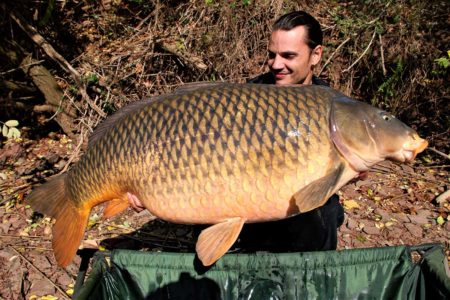
Whether you use a fly rod or spinning tackle, carp will push your tackle and skills to the limit.
Do you remember when you caught your very first carp? I do, although the exact date is amiss. It was in my early days of fishing the Islip High School lakes. These lakes were loaded with smallish orange, brown, white, and spotted carp, some of which I suspect now might have been koi from someone’s aquarium. Regardless of whether they were carp or koi, they would readily take a small round bread ball. My friend Steve and I would catch them at will, for hours. It became a game of seeing the colorful fish in the water and trying to cast ahead of the pack to get bit. You could actually watch your bread ball slowly sink. When it disappeared, you set the hook. At one point, Mendelson’s Aquarium in Islip offered us $0.50 a piece for them. One day we brought him about 20 and he said, “I can’t use 20!” Steve and I hurried back to the lake to release them. Although most of the ones we caught were in the 6 to 10-inch class, we occasionally ran into a brute brown that pushed our light tackle to the max and usually ended in a break-off. Fast forward to years later when I targeted larger carp in Belmont, Byrons, and Knapps lakes, it was always an adventure with fish pushing the 2 to 10-pound class. I will admit, even though I pursued these golden bones as Long Island fly anglers call them, I quickly turned my attention to largemouth bass. And, the largest carp I ever caught was about 12 pounds.
| River Bay Outfitters |
| 980 Church St Baldwin, NY 11510 (516) 415-7748 |
In talking with Paul McCain of River Bay Outfitters in Baldwin, who in my opinion, is the top fly shop on Long Island for fresh and saltwater gear and more importantly, advice, he feels carp is a fish that once you target and catch a few, you may only fish for them, and nothing else! These torpedoes will strip line from a reel, battle hard with no end fight, and give you a thrill you will not forget. Paul has some great tips to novice and seasoned anglers alike that will ensure success when searching out carp…on the fly.
The Long Wand Angle
“In my area, (Baldwin), most of the ponds that are fishable for carp are in the local parks where many people come to feed the ducks. Even though it is illegal to do that, grandmothers still take the grandkids and feed the ducks and the carp get used to the free meal of bread.” Anglers are not dumb, and will take any advantage given to them to score big fish. Fly fisherman are no different, and if they can think of it; someone has, or soon will, make it! Hence the Bread Fly! The key according to Paul on these smaller bodies of water was to find someone feeding the ducks and look for big lips sucking the floating pieces of bread off the surface. Paul on the other hand prefers to look for carp that are feeding on other things, like damsel nymphs. Believe it or not, carp will eat just about anything, even mulberries that fall from the branches that hang over water. If you can find a berry of any kind hanging over the water, check it out. The one problem with carp, except my earlier days targeting the colorful ones is that most are of the brown variety. You cannot sight cast for these, so looking for activity on the surface is the key to success.

The Hot Spots
I asked Paul about hot spots. Even though carp are in just about every body of water on Long Island, there are certain lakes and ponds that offer larger fish, and possible a more plentiful supply. One of my favorite spots was just west of Bay Shore on Montauk Highway. The small lakes in the community were loaded with big fish, but man these were some of the hardest to catch, and easiest to spook.
- Belmont Lake State Park – Easy access by shore, tin boat or canoe.
- McDonald Pond in Hempstead Lake State Park – Bank fishing, but no wading.
- Massapequa Reservoir – No boats, but good wading opportunities.
- Argyle Lake – Babylon – Very good access.
- Lake Ronkonkoma – Boat and good shorebound access.
- Fort Pond, Montauk – Boat, wading and limited shorebound access.
All of these ponds, plus just about any of the smaller ponds that dot the ‘Island will offer an ample opportunity for carp anglers.

Catch Them Up
In fly fishing, Paul suggest you use a 6 or 7 weight fly rod, weight forward floating fly line, 3X leader with 2 to 3-feet of 4X Fluorocarbon tippet. My suggestion to new and seasoned fly anglers alike is you visit Paul’s shop in Baldwin. They can set you up, offer pointers to aid in your success, and point to a few hot spots.
On the spinning side of things, it will definitely depend on what carp you are targeting. If you are looking at the smaller ones in the ponds – 6- to 12-inch fish, then a lighter spinning rod and reel with 20-pound braid and fluorocarbon leader will suffice. If you are searching out the 20-plus pounders I have seen in Lake Ronkonkoma and Montauk, then a heavier conventional and longer 8-foot rod is best.
| BAIT? |
| When fishing for carp, many anglers bait their hooks with sweet corn, flavored dough balls, good old-fashioned Wonder Bread (this bread by far makes the best balls!) or their own cooked up concoction. Every serious carp fisherman has his own special formula. I do not have a special formula, as my go-to bait has always been wonder bread or Pillsbury dough. I did on occasion use cooked corn kernels, but mostly the corn was spread into the water as a chum line. |
In closing, Paul reminds us “There are many very small ponds, loaded with carp in the many parks that we have. The trick is to do some investigation, explore and find your own secret spot.” “The best part of fly fishing for them is that they are in most ponds so when you can only get out for a few hours to feed your fishing habit, your opportunities are just around the corner. Are you planning a trip south to fish the Florida flats? Carp are a great way to sharpen your skills.”
As a kid, I loved fishing for carp, and although my love these days has turned to bass, I still break out the bread balls and give the golden bone a shot!