“I’ve caught everything on jerkbaits. I fish them all year.”
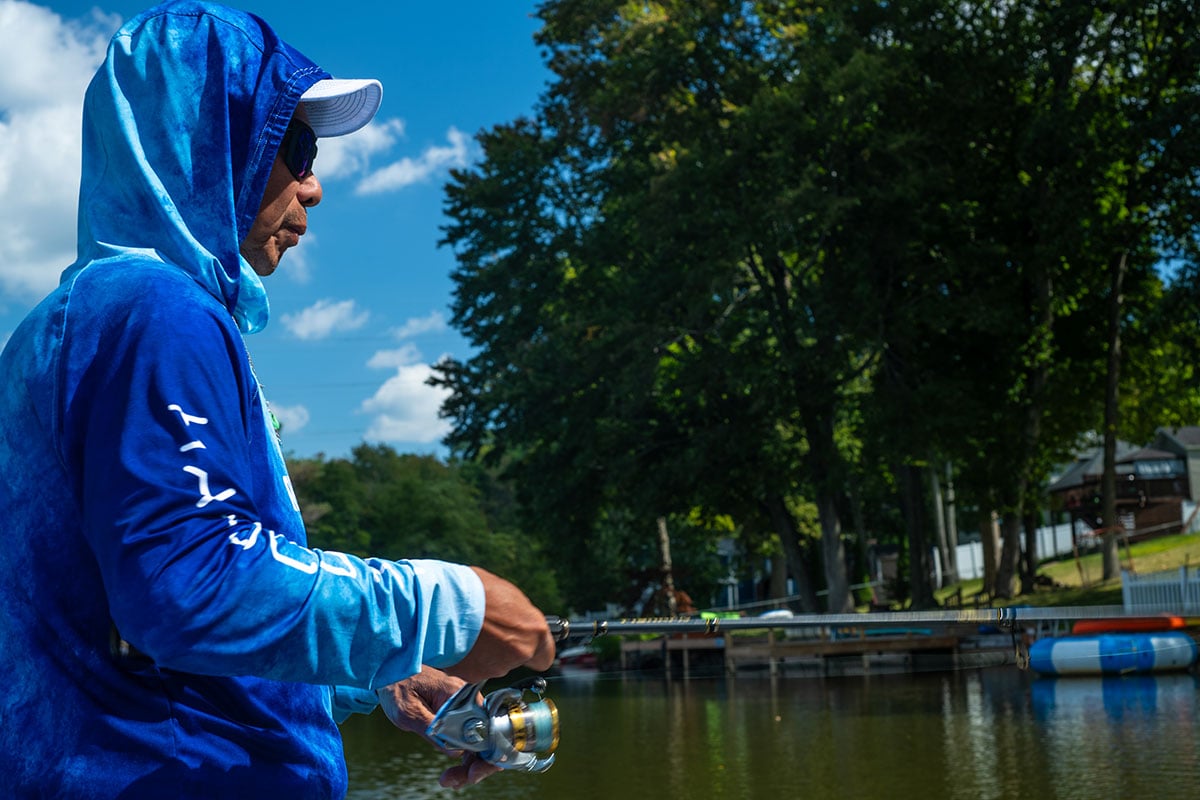
I don’t often think of an angler as a master, preferring instead to think of many who are good. When it does come to mastery, though, usually one particular something stands out from all the rest of the fishing. In Gen Wong’s example, jerkbait fishing is done in a way that impresses me as unique.
Wong doesn’t limit himself to jerkbaits. He knows when to switch out and use soft plastics. For another example, he’ll sometimes throw a topwater. The interest he takes in other lures reflects back on the jerkbaits he fishes best, because he only expects them to do what they can. He fishes lakes, reservoirs, ponds, rivers, and streams all with equal respect, He loves to fish the salt, spending his time aboard charter boats, head boats, and on the rocks of inlets.
I’ve fished with Wong on four occasions, two of them when I observed him throwing jerkbaits. I’m impressed by the way he snaps one of these plugs hard, long, and fast—then pauses. I’ve tried to do that and I fail to with ease. Wong must rely on muscle memory. The action he imparts to a jerkbait must be something he taught himself to do through trial and error, and I bet it wasn’t easy.
We fished in mid-September and early October when he threw jerkbaits, though he says, “Every season you use them differently. There’s a whole science to it. I’ve caught everything on jerkbaits. I fish them all year.”

As counterintuitive as it may seem, during the winter, he makes one behave in the most outlandish way. “I’ll fish it violently. I’ll throw a cast out, and I’ll jerk the hell out of the plug and create a lot of motion and flash. But then I’ll pause. They’ll see the violent action, but they’re not gonna chase, not in the cold. But you present it to get their attention, and then they see it sitting there. That’s when you’ll catch way more fish than if you worked it normally,” Wong said.
About the pause, he said, “The question people will ask me—I’ve done seminars—is, ‘How long do you wait?’ I say, ‘When you think you’ve waited long enough.’ Then I tell them, ‘Then wait some more.’”
Fixed Depth Fishing
Naturally, you might think of suspending jerkbaits as good for the cold-water months, if you use jerkbaits at all. A jig on the bottom might serve you better, but maybe not! Suspending jerkbaits are effective in the spring and fall, too, when the water is chilly but not on the verge of freezing. The method involves keeping awake, because it can be surprising when you feel that bump on a pause.
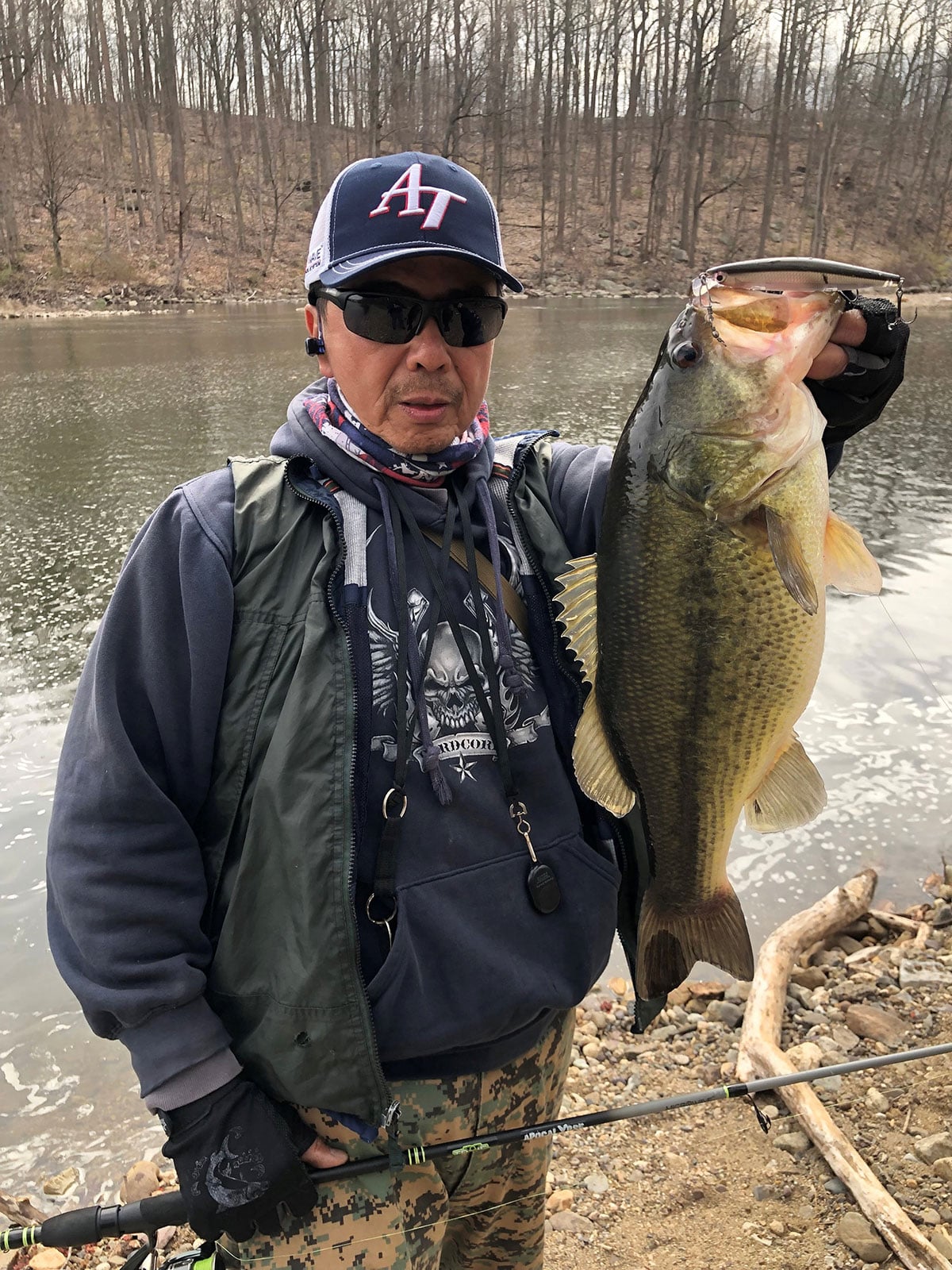
“Suspending jerkbaits changed the game,” Wong said. He’s watched the jerkbait game unfold since the 1970s, when his favorite jerkbait was the sinking Rapala Countdown. It was my favorite then, also. “Of course I used the floater, too,” he said; so did I. About the effectiveness of suspending jerkbaits, he said, “When you can jerk a bait, then leave it there in front of their face? They have to eat.”
He told me the story of catching one of his best largemouth bass on a suspending jerkbait, a Rapala Shadow Rap CD-ll, carbon color. He had paused it. The fish he believes weighed over 8 pounds, though he didn’t weigh it. “You know it wasn’t out of hunger. It was out of reaction. It wasn’t hungry. It had a 10-inch perch in its gut! You could see the tail sticking out of the mouth!”
Warmer Water
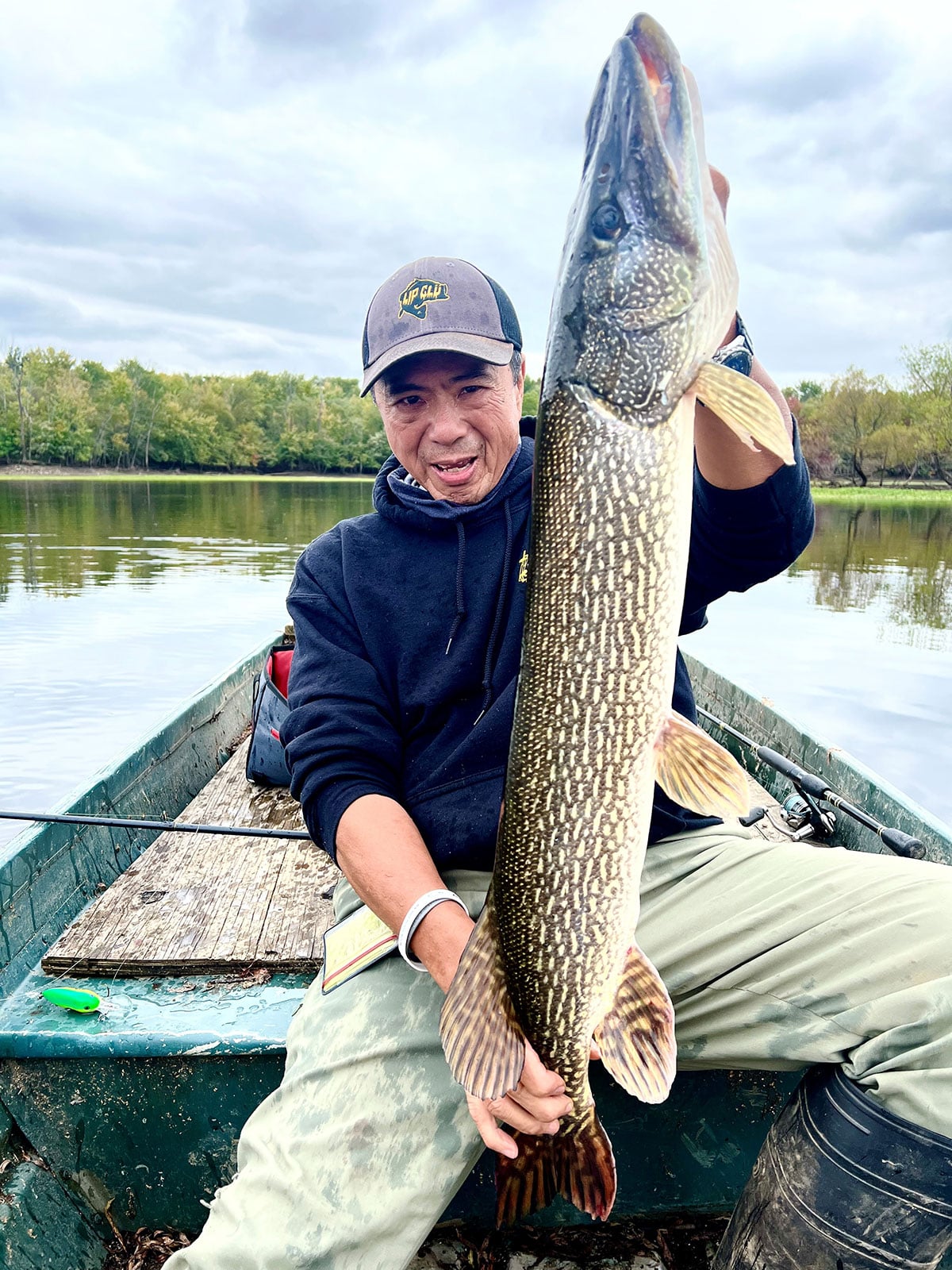
When Wong and I fished Lake Musconetcong in October last year, the water temperature was 66, but the fishing was tough. We fished pads—the edges and pockets. Near sunset, we returned from the very back of the lake and fished a couple of pad fields we had missed. I fished on top of them with a weedless Booyah Bait, nothing coming up for it until we got away from those pads and I put it between a couple of overhangs. I lost the bass, but judging the size when it leapt, it was the largest I’ve ever hooked in the lake.
Before that incident occurred, in the back of the lake, Wong threw a sliver Shadow Rap about 3-1/2 or 4 inches long and hooked a nice one. The bass was on for three or four seconds, and Wong got a look at it, estimating it at 2-1/2 to 3 pounds. When we fished Lake Hopatcong a couple of weeks before, the water temp was 70. I watched him carefully as he fished jerkbaits, but as I said earlier, I couldn’t replicate the snap with his effortless ease.
“In the summer, you can work it (a jerkbait) faster,” he said, “and sometimes you need to work it faster, but almost always, you’ll have to pause. And the pause makes them eat. Because they say, ‘Now I don’t have to expend a lot of energy.’”
Scents on the market now are developed through tank trials to prove their effectiveness. Wong said, “I’ll add Lip Glue scent to my jerkbait. That’s one more advantage. You’re leaving a scent trail.”
Speaking for myself, I’m taking lessons, because I’m in the habit of retrieving a jerkbait with jerks but not pauses. I will admit, though, that on more than one occasion while trolling one, throwing the outboard out of gear for a moment resulted in a strike. By what another friend of mine, Brenden Kuprel, told me, people have put camera sensors in front of trolled lures and have seen fish follow for dozens of yards. So, who knows? Maybe the fish followed the jerkbaits and hit when they slowed. My first thoughts had been that it seemed too much of a coincidence that fish happened to be there right when I put the motor in neutral.
Line, Rods, Colors, Divers
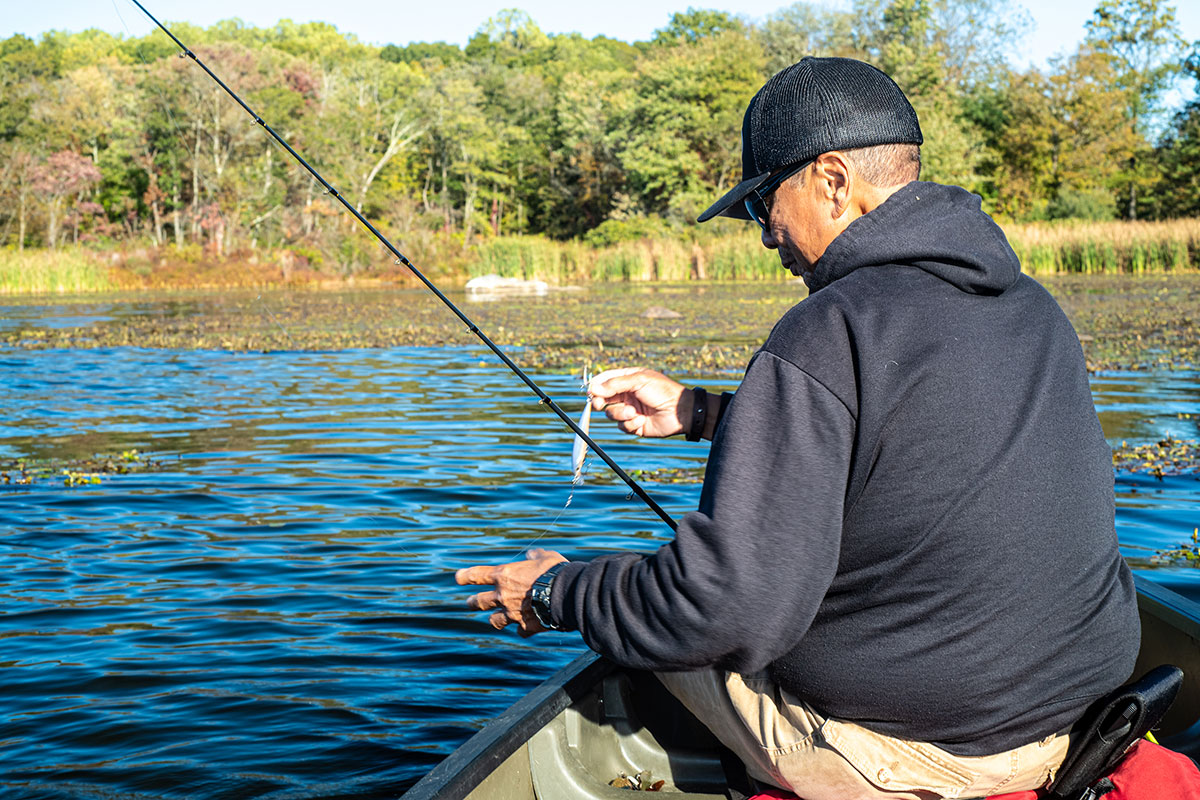
Wong uses braid line with a fluorocarbon leader tied into it by a uni-to-uni splice. Braid is the no-stretch solution to having a more direct connection to the lure you’re working. He said of the rods he uses, “All round, the fast action tip is better.”
I noticed, when we fished Hopatcong, that he’s very particular about color. He had left his Senkos behind, but he wanted to fish one, so I offered him my tote full of Yum Dingers and Shim-E-Sticks. We had crossed under a road to fish a backwater where the water clarity was compromised. He rooted through bags of the worms and found a color he believed would be visible against that stain to any bass.
It did work. He hooked a bass of at about a pound-and-a-half and had it on for a few seconds. He also caught a little smallmouth. I remained fishless along with Brian Cronk, who was also in the boat.
But with respect to jerkbaits, Wong said, “My main colors that I’ll use are natural colors. But one of my favorite colors is called carbon by Rapala. It’s like a dark green. People think you’ll always catch them on silver. Yeah, you do. But I’ve found that carbon will get me more fish, more often than not.”
Since I began flatline trolling small lakes from my squareback canoe and electric motor years ago, I’ve become interested in jerkbaits with a diving lip. A couple of options are the Yo-Zuri Crystal Minnow Deep Diver and the Rapala Deep Down Husky Jerk. About them, Wong said, “Even if they’re under it (a standard jerkbait), they’ll still come up and hit it. Of course, there are times they won’t come up and get it; that’s when I’ll use the divers.”
Relying On Artificials
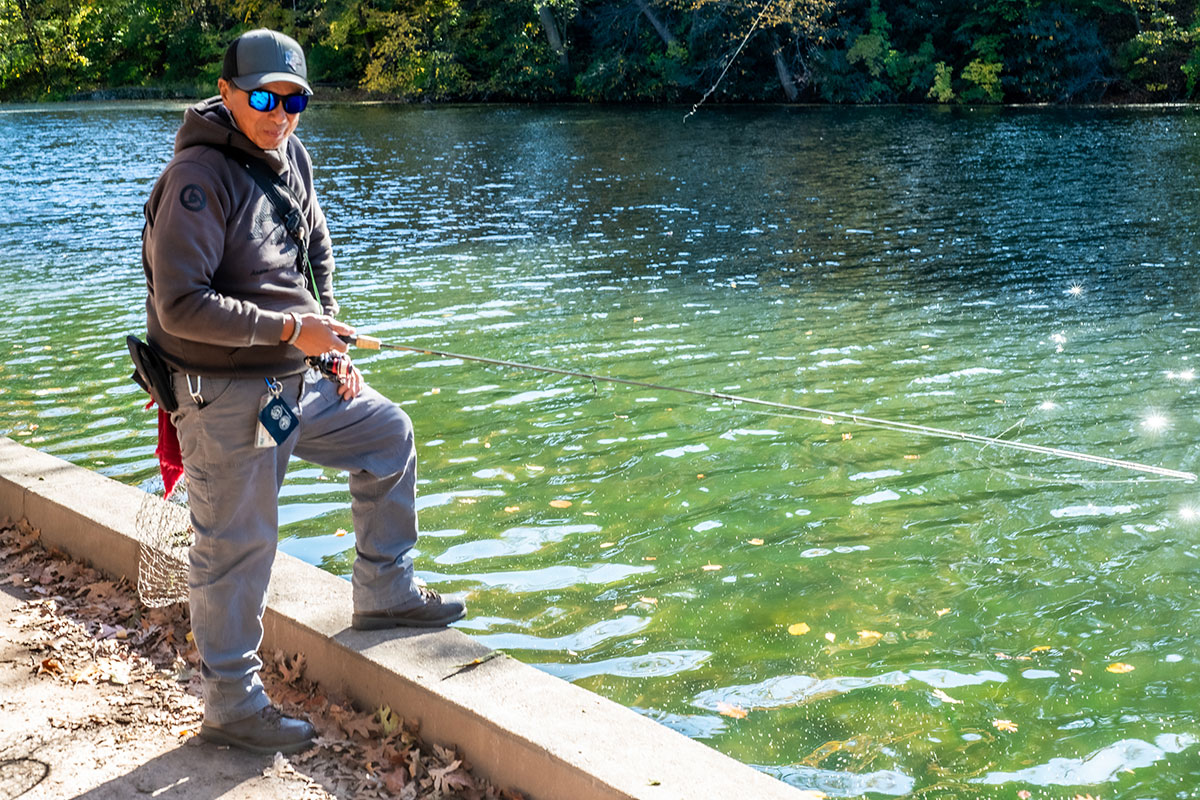
Like most fishermen, Wong uses bait—on occasion. “I’d say 95% of my fishing is artificials,” he said. Like the many different waters he fishes, he’s versed in the use of all sorts of lures. For black seabass, “I’m using an epoxy jig for weight and two big-eyed teasers. A piece of clam for smell, of course.” He told me a friend of his custom ties the teasers, the big eyes epoxied to the teaser hair. “I caught a triple limit in 2-1/2 hours, 30 keepers,” Wong said.
Like many of us, he loves topwaters. “If I could fish topwaters and catch fish all year, that’s what I’d do. There are times when smallmouths are in the eddies. I know I’ll catch 20 fish with a Rat-L-Trap, but I’d rather catch 5 fish on a topwater than 20, because it’s so much fun.” He told me about once catching two smallmouths at a time on a Heddon Spit’n Image.
Wong circled back to his favorite jerkbaits. “I use a smaller jerkbait for trout. Trout love jerkbaits, especially the browns. The tigers, the goldens, and the rainbows, too, but the rainbows are not always up to chasing the jerkbaits. I think the rainbows eat more bugs. Browns, they eat minnows all the time. They eat their own young.” He told me that depending on the situation and especially the fall season, he’ll try a brown-trout color pattern to tempt the cannibals. He used to modify his jerkbaits to resemble little brown trout, with markers on gold sinking Rapala Countdowns.
Mastery is method that attains the status of art, but it always seems to involve more than the fishing itself. What great fisherman isn’t known among others? And like any other individual achievement, the mastery of a fishing method carries the man from the shadows into the light. What does a great fisherman do about his good fortune?
Wong is a longstanding member of the Newark Bait and Flycasting Club, the oldest fishing club in New Jersey, established in 1907. They are a nonprofit who do charity events such as derbies for kids, the handicapped, veterans, Boy Scouts, and Girl Scouts. “I feel that’s how I can give back,” Wong said. “I enjoy it.”
“We have fundraisers and raffles. We stock trout in the spring, then we’ll stock largemouths and crappies,” he said.
The kids must feel like they’ve struck gold.