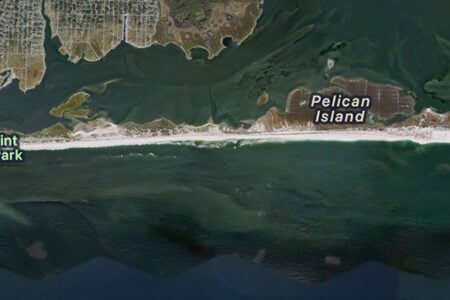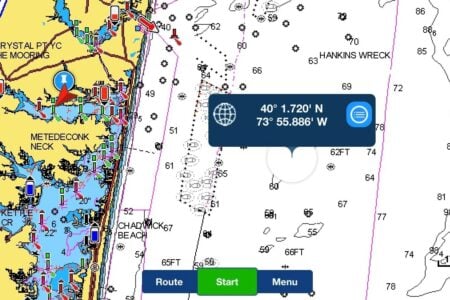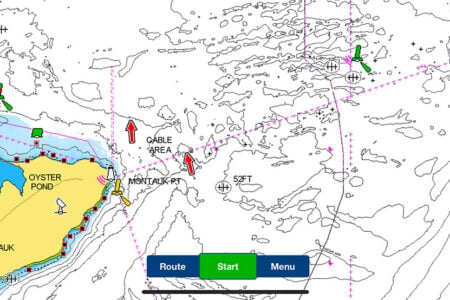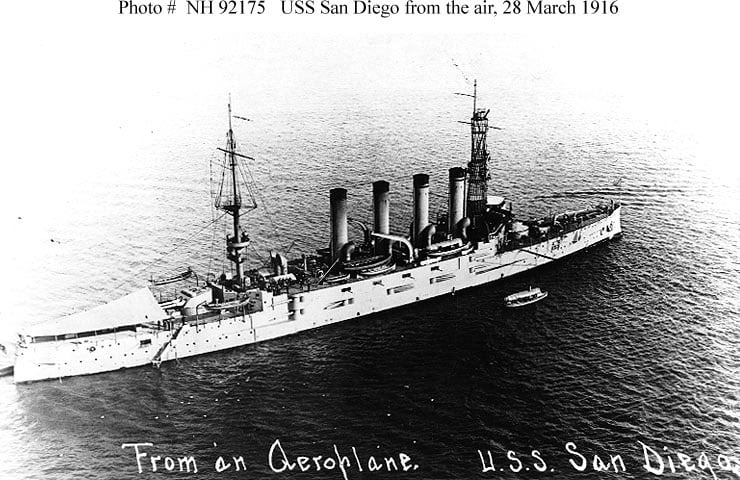
The USS San Diego (40°32.433’N / 73°02.484’W), originally commissioned as the USS California, met her fate in 1918 after being struck by a torpedo fired from a German U-boat. The cruiser sank in less than 30 minutes, claiming the lives of six sailors. Today, the San Diego rests upside down in 110 feet of water southeast of Fire Island Inlet, where she has become one of the most famous wrecks in the Northeast. The surrounding area is also home to several other warships and cargo vessels that have rested on the seafloor for nearly a century.
For a 500-foot naval vessel lying belly-up, the San Diego has endured plenty of abuse over the years. Her hull is pockmarked with what resemble giant moon craters, the result of friendly fire from U.S. aircraft that mistakenly identified the sunken cruiser as a German submarine. History books often state that the San Diego lies on her port side, but my close friend and professional diver, the late Kevin Osterbury of Euphoria Charters, always insisted the ship rests completely upside down. Having explored the wreck countless times, Kevin described numerous openings throughout the hull that provide sanctuary for an incredible variety of marine life.
Today, those cavities are home to countless baitfish, cod, tautog, ling, black sea bass, porgies, triggerfish, and large sea flounder. Around the outside of the wreck, depending on the season, anglers can also encounter bluefish, fluke, sharks, and, at times, heavy concentrations of dogfish.
In recent years, the San Diego has seen less fishing pressure than it once did, largely because it has become a premier destination for scuba divers. Many divers visit specifically to spearfish or search for the large lobsters that inhabit the interior of the wreck. However, anyone considering a dive should understand the dangers involved. Numerous experienced divers have lost their lives exploring the San Diego after entering openings in the hull and becoming disoriented and unable to find their way back out. Kevin, despite his years of experience, would only guide highly skilled divers on interior explorations of the wreck.
As for me, I preferred to anchor over a productive section of the wreck just before sunrise, enjoying two or three hours of excellent fishing before the first dive boats arrived.
The San Diego produces action nearly year-round, although the fall season undoubtedly offers the most consistent bottom fishing. From January through March, anglers can usually count on fair to good ling fishing by anchoring tight to either side of the ship. Ling tend to hug the silty bottom alongside both the port and starboard sides, and anchoring so the current carries your bait toward the wreck’s edge is often the key to success. Simple hi-low rigs baited with fresh clams will usually keep rods bending, with the occasional cod mixed in.
April brings the first blackfish of the season, many of them females carrying roe. Whenever possible, release these fish so they can complete their spawning cycle. By May and June, black sea bass become a regular part of the catch, and hi-low rigs baited with clams continue to produce excellent results.
From July through September, porgies arrive in force. While fresh clams remain a top bait, sandworms can often make a noticeable difference, especially when targeting larger scup. As October and November roll around, the San Diego truly comes alive. Porgies, sea bass, blackfish, ling, skipjack, and monster bluefish all converge on the wreck, creating some of the best mixed-bag fishing of the year. Clams, squid strips, green crabs, and worms will handle virtually every bottom species, while diamond jigs and other metals are perfect for the bluefish and skipjack that patrol above the wreck.
As for where to anchor, let your bottom machine make the decision. Most of these species roam both inside and outside the wreck depending on the tide and current, so don’t hesitate to move if the action slows. If the bite fizzles altogether, nearby wrecks such as the Wolcott and the Hylton Castle are only a short run away and can often save the day.