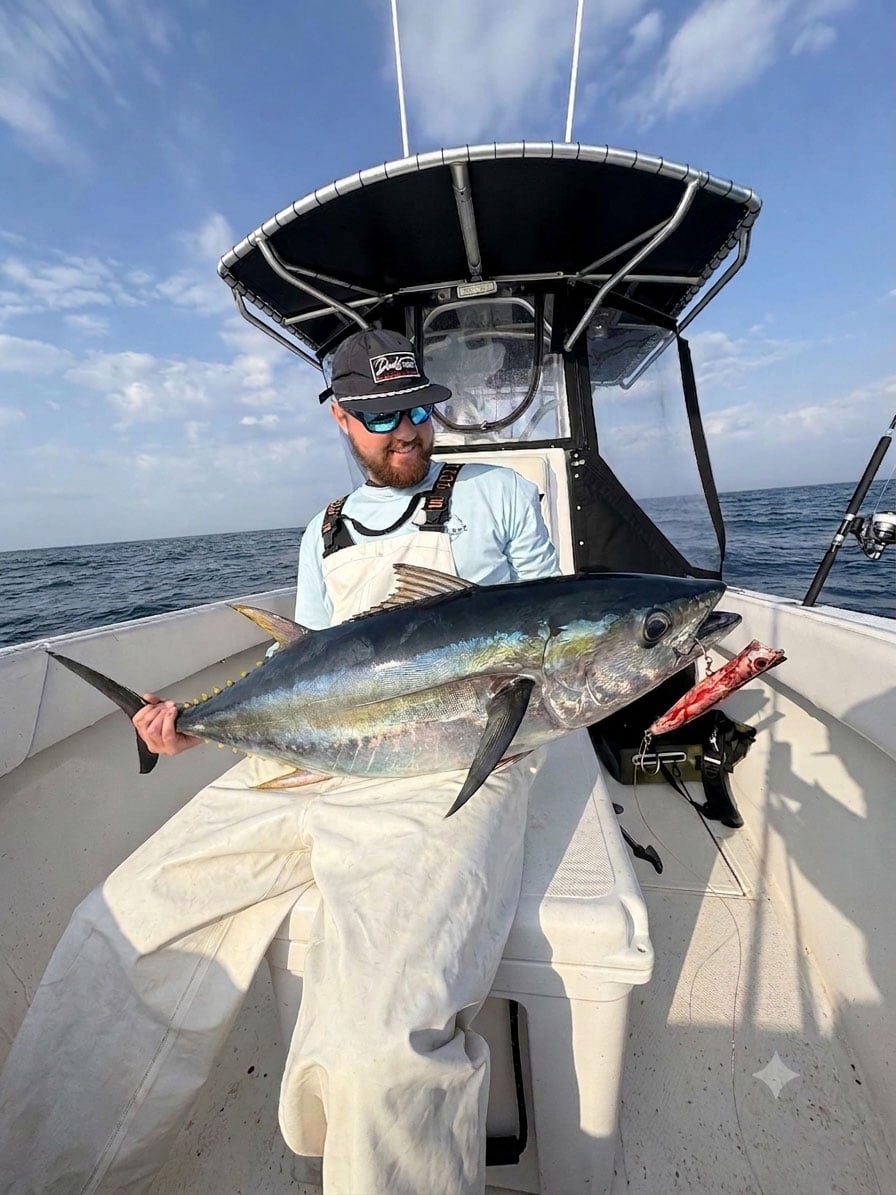
The pure adrenaline of yellowfin on top requires planning.
In any of our local fisheries, it’s hard to pick one that rivals a popper disappearing in a massive explosion with the flash of yellow sickles giving away the culprit. When opportunity arises, getting the chance to watch yellowfin tuna go nuclear on a popper is one of the most exciting sights to behold as a fisherman.
However, preparation is key, as these opportunities often present in remarkably short windows. Proper rods, reels, lures, line, leader, terminal tackle, and knots all need to be ready for when your window into one of the coolest fisheries in the Atlantic opens.
One of the most common misconceptions, when it comes to chasing yellowfin on spin, is that too many ‘first-timers’ go into it looking for a “do-all” rod for jig-n-pop. To keep it brief, this doesn’t exist or at least doesn’t exist well. A jigging rod is short, ideally under 6 feet in length. This is to work the jig correctly, as the stiffness of the rod allows you to impart darting action on the jig and allows for great leverage when fighting fish. What it doesn’t do well is sling poppers long distances or work one effectively.
Conversely, a popping rod is somewhere between 7-1/2 to 8-1/2 feet in length and can throw your offering as far as you need and work it back to the boat effectively. Trying to jig with a rod like this will only result in tired arms and a jig that isn’t darting through the water due to the softness of the tip of the rod.

Rod & Reel Selection
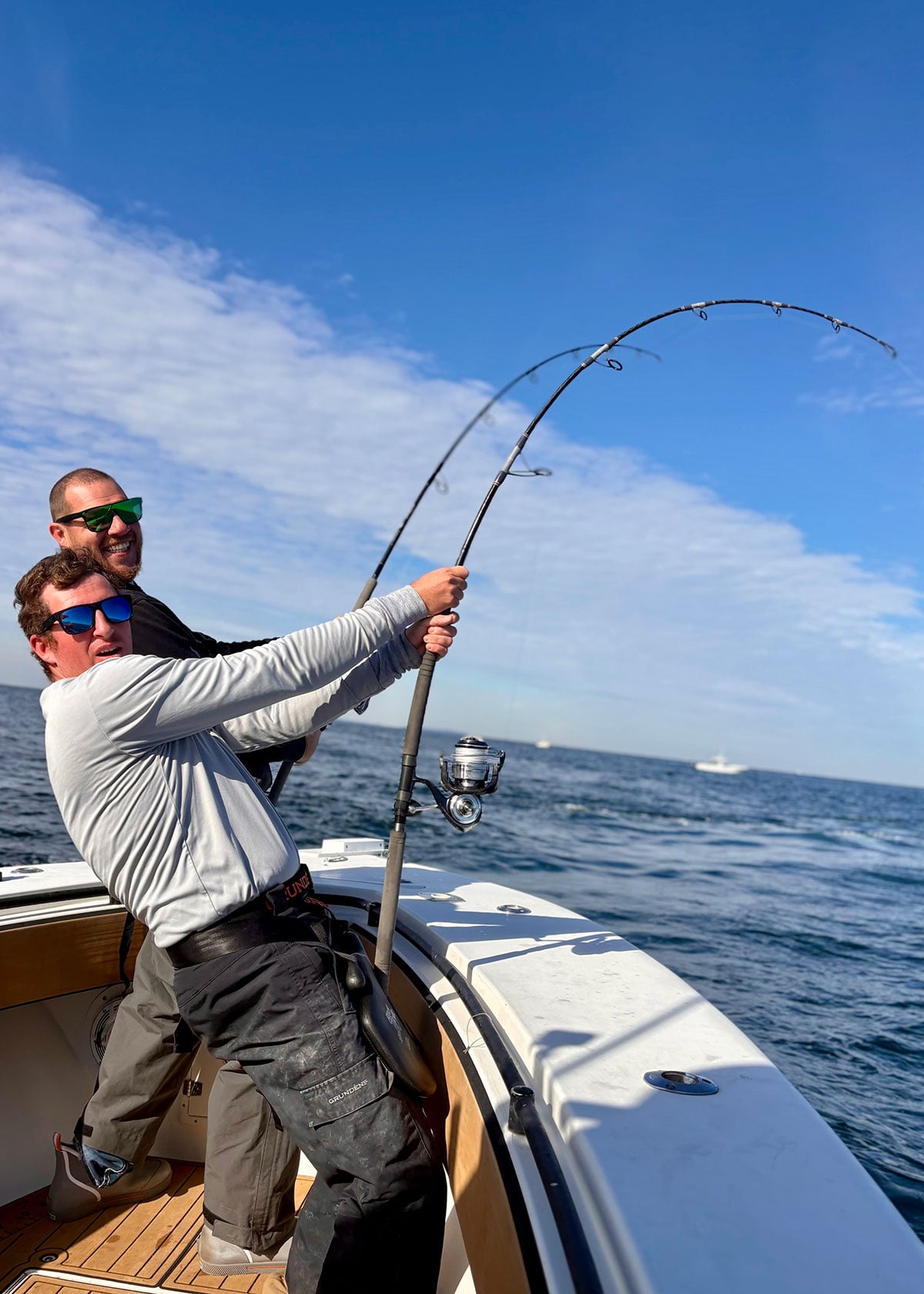
When choosing a rod, there are a few things to consider. These include the size of the lure you are throwing, the size class of the fish you are chasing, and the line rating you are using. The innovation of popping rods came from overseas, as it was not a style of fishery seen here in the U.S. Looking to learn about it, the pioneers who brought this style to our local fisheries had to find gear from overseas. Today, rod manufacturers have fine-tuned their builds, blanks, and many of the other components to fit the bill for our fisheries.
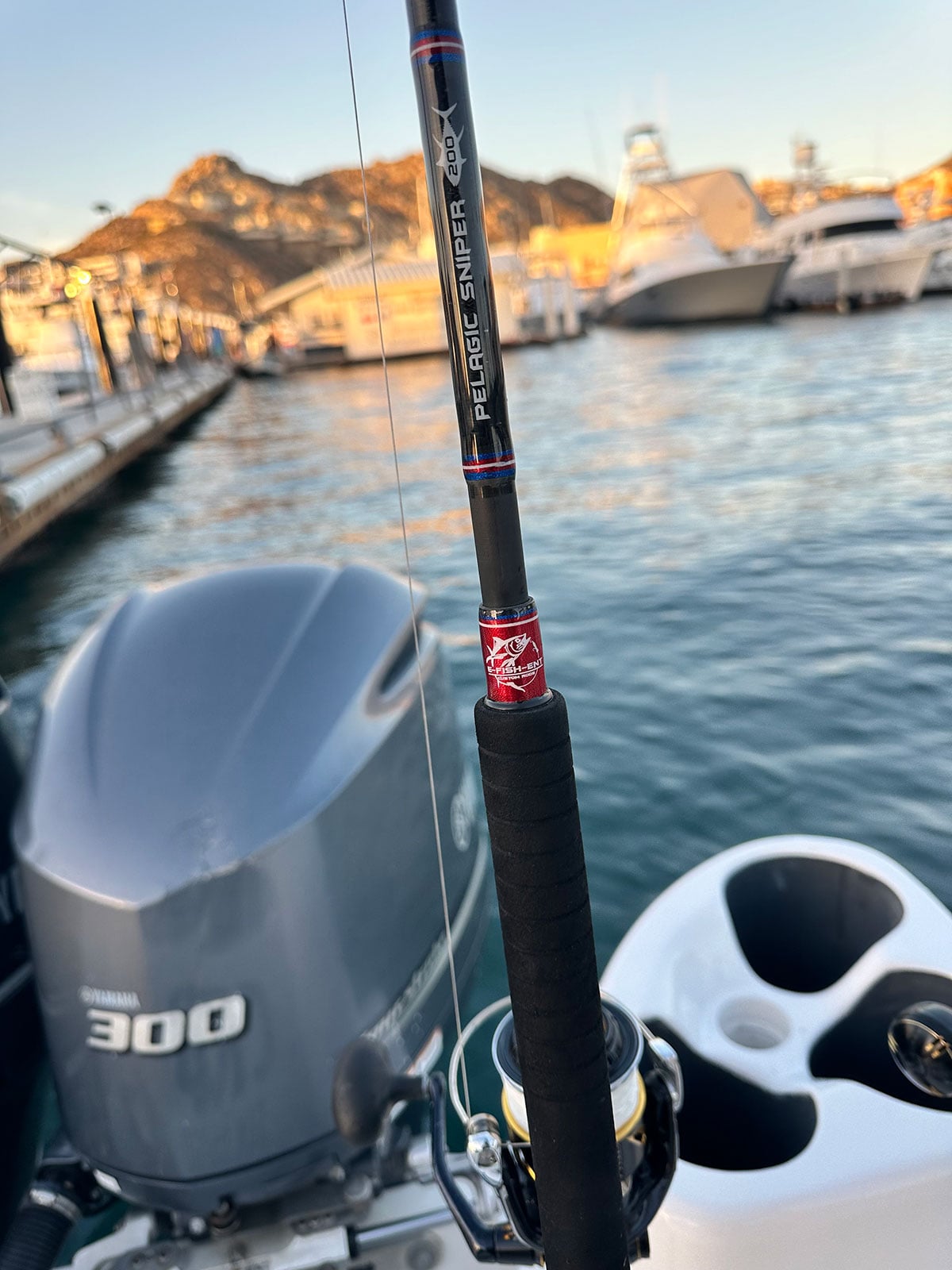
I believe that one of the best to do it has been E-Fish-Ent Custom Rods, with their Pelagic Sniper popping line. Offering rods from the 150 to 300 series – and now even a series for targeting giant bluefin – they are constantly on the cutting edge when it comes to spinning tackle for tuna. With all they offer, there are two rods that I find to be ideal for targeting yellowfin which are their Pelagic Sniper 150 and 200. The 150 is the lightest in the series and can throw some small offerings, having a more specialized feel to it, and lends itself to more of a “finesse style” presentation as well as fish fighting. The 200 is the most versatile, covering all the yellowfin needs, along with slotting into the inshore bluefin fishery.
Both rods are between the 8 and 8-1/2 feet in length, allowing for ample casting distance to reach fast-moving fish.
Once you settle into battle, the rod needs to offer sufficient lifting power in the lower section of the rod. These rods tout an impressive 28 and 35 pounds of drag rating, allowing you to put the necessary heat on fish whenever it’s needed. Research is vital to choosing the proper rod, as the amount of strain and pressure needed for tuna fishing combined with how supple the rod needs to be to cover distance and work small presentations eliminates many rods from being capable of doing both.
When choosing a reel, the most important factor is the drag system. It is a well-known fact how long and fast a tuna run can be, and reels not built for it will be prone to seizing due to the pressure and heat caused by these runs. When I am choosing a reel, I look for one that has a strong and smooth drag, ample gearing, good line capacity, and ideally some external seals to battle the constant salt spray of long offshore runs. Most major reel manufacturers have at least one offering, but I have to give the nod goes to Shimano for their Stella, TwinPower, and Saragossa lines which offer many if not all these features across three different price tiers.
Other good selections include Daiwa with their Saltiga and Certate lines, while Penn, Quantum, and others are also throwing their hats into the ring showing that, if you are loyal to a brand, they will have a reel to offer you. Now, if you had to ask me what I think is the most fitting reel for this fishery, the Shimano Stella SW 14000XG offers everything I need and more in a “buy-once” scenario, holding its place atop the tuna popping reels for good reason.
Lures, Lines & Leader
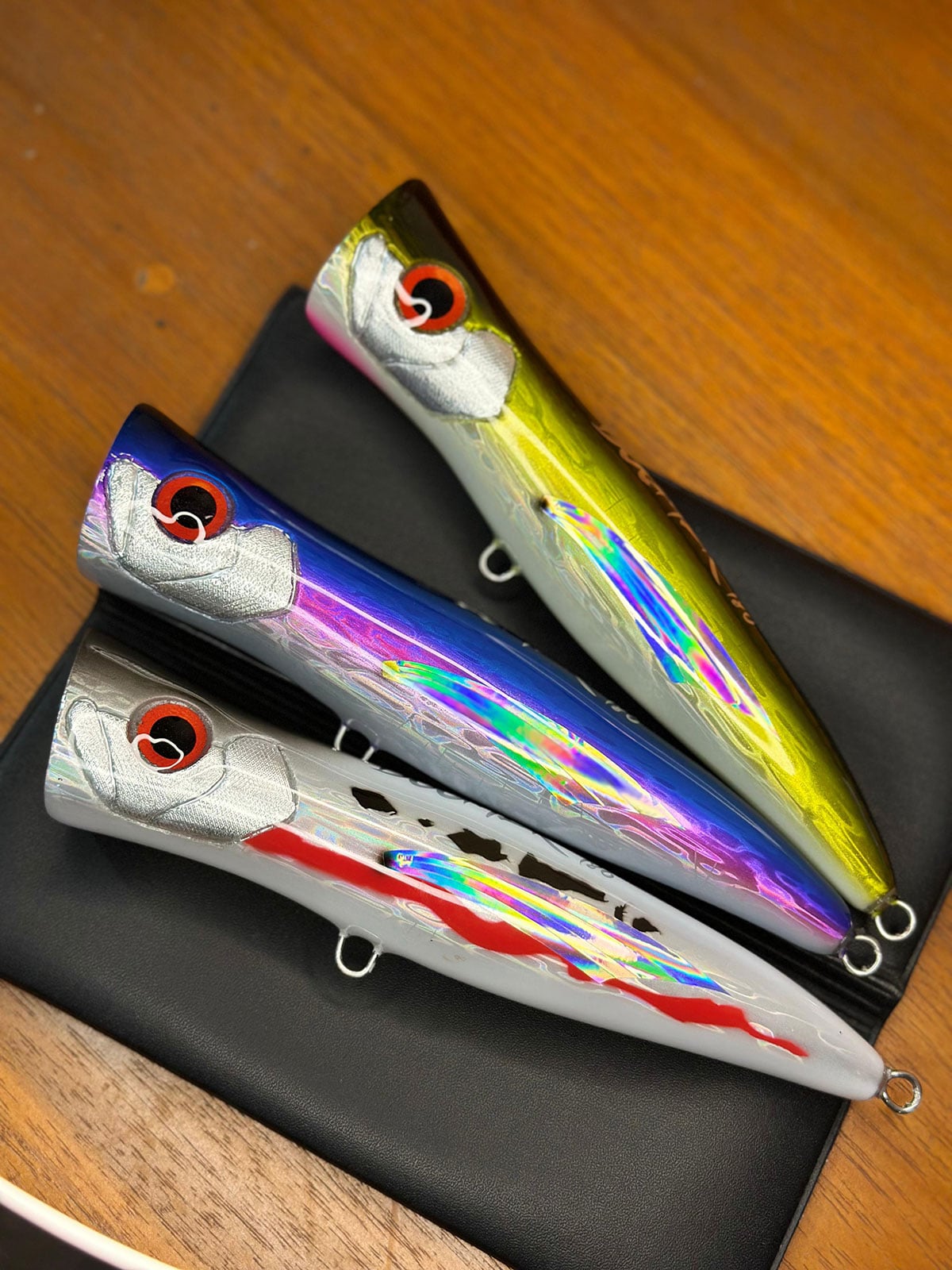
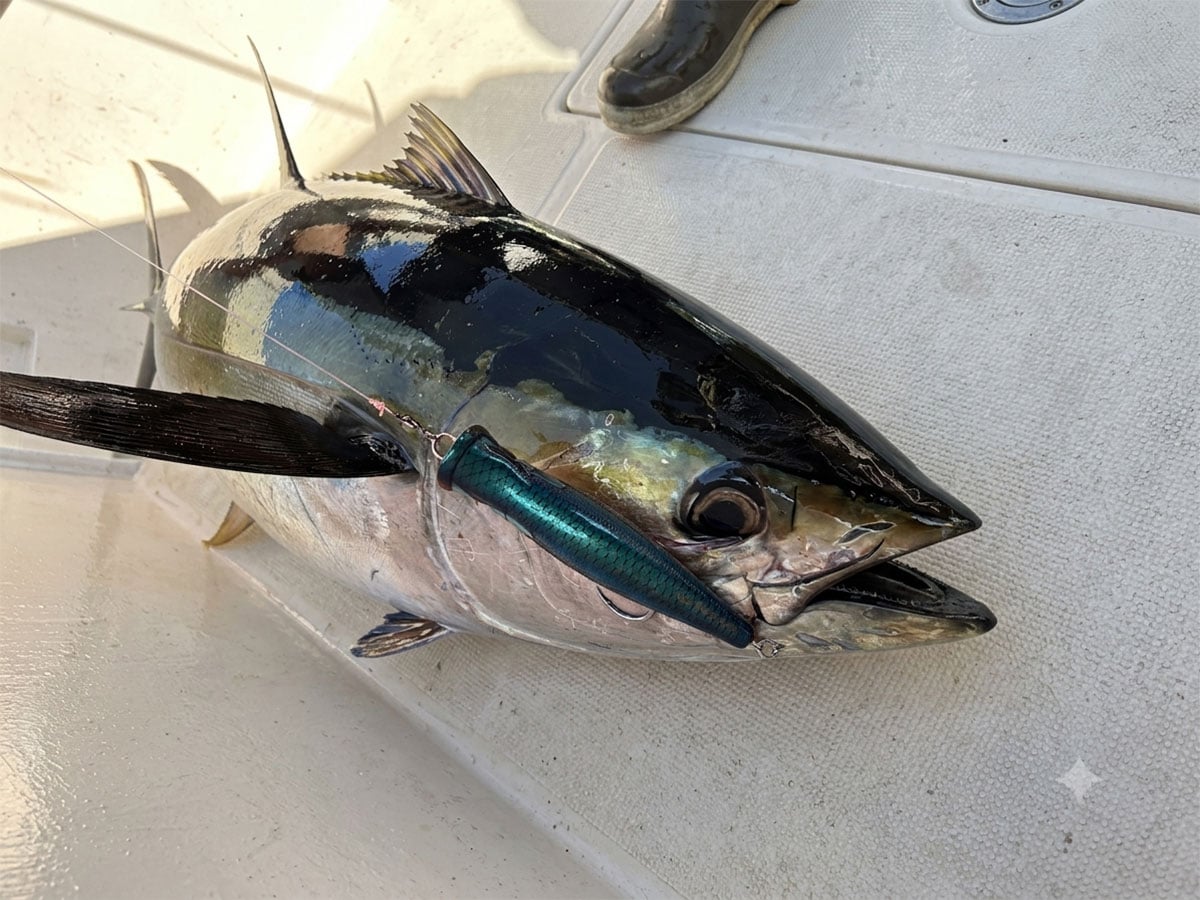
Popper selection is of the utmost importance. You need one that will coax a fish into biting while also being up to the task of handing these powerful fish without failure. There are quite a few options on the market, but a few have really gone through some rigorous field testing and seem to elicit more bites than others. It is hard to choose just one, so I’ll pick two proven fish catchers that check all the boxes: they’re tested, durable, feature quality hardware and are ready to go right out of the box!
The first one I love for yellowfin is the Bluewater Fishing Tackle Boomer 180. This popper comes rigged with some mean terminal tackle that is fully up to the test to handling any size yellowfin. It throws a large splash with every pop and is extremely durable. Coming in a few different colors and sizes, these poppers were overbuilt and punch way above their weight class in terms of hooks and split rings, making them perfect for yellowfin.
My other favorite would be the Small Lure Company Mikros-Pop. It comes in a 130 and 170 size, so it is a step down in size from the Boomer for when the fish seem to be a little more finicky. The Mikros-Pop is the successor to the Mikros from Strategic Angler, which was a stickbait, this gives the Mikros-Pop the unique ability to be swum like a stickbait, like its predecessor! Both sizes come rigged and ready out of the box with heavy duty hooks and split rings.
Braided line is the only way to go when it comes to popping yellowfin. The small diameter to strength ratio is needed for this style of fishing. Some people like to go the hollow core route when it comes to tuna fishing, but this is largely unnecessary for this fishery. I go with 50- to 65-pound braid, or PE 4-6, depending on the brand. Cortland Masterbraid or Ocean Devil Silk Ocean Cast are both highly touted lines, and you cannot go wrong with either. If I know I am looking for line to throw some smaller offering, I will choose the lighter end of the spectrum and if I am going to be throwing some of the average to heavier offerings, I will go with the heavier end of the spectrum.
When choosing a leader, it comes down to fluorocarbon or monofilament. Many believe that using a fluoro leader for popping is unnecessary because using an ‘invisible’ leader for topwater applications cancels out its invisibility. However, I still opt to fish fluorocarbon leaders. Fluorocarbon can be straightened out by putting pressure on it, removing the line memory. This reduces fouling up the leader on the popper on the pause. Fishing with fluorocarbon also gives me versatility to switch to a subsurface bait like a stickbait or a soft plastic and not have to change leader materials.
There are quite a few brands out there, but the one I trust the most is Yo-Zuri HD Carbon. The leader material seems highly abrasion resistant, ties a knot well, and is very stiff which seems to translate the imparted action from the rod to the lure better. I seem to always gravitate to 80-pound test as my go-to for yellowfin. It seems to be the perfect balance of strength and does not need to be crimped.
The Business End
The terminal tackle is your “end tackle,” it’s what will connect your leader to your lure. Traditionally, you would just tie directly to your popper. When it comes to rigging up though, I prefer to tie my leader to a ball bearing swivel and heavy duty split ring, rather than tying directly to the popper. I go with a Spro Ball Bearing Swivel size 5 and a Spro Power Split Ring size 7. The ball bearing snap swivel allows for the fish to swim freely in its circles without causing the leader to twist.
The split ring provides a strong connection to the popper and allows quick changes in lures with a pair of split ring pliers. I always carry a pair of pliers that have the split ring addition and line cutters. The Danco Lunar-1 Carbon Steel has a great split ring opener and a reliable line cutter for all the quick rigging you may need to do.
Arguably the most important part of the setup is your knots. Tuna fishing is always going to put your knots to the ultimate test. If they are tied wrong or weak, a tuna is going to let you know, and let you know fast. There are only two knots in your setup, the one connecting your running line to your leader and the one connecting your leader to your terminal tackle. For connecting your running line to your leader, the FG Knot is the standout. It is exceptionally strong for starters, often being cited as retaining most, if not all, of the line’s breaking strength.
The most prominent feature of the FG Knot is how slim the knot is. Configured similar to a “Chinese finger trap,” the knot is virtually the same diameter as the leader, passing through the guides without getting hung up. This allows you to fish a long leader; I prefer 8 to 10 feet. This allows for the leader material to be up against the fish when it is running, rather than the braid. It also allows me to cutback a few inches if the knot gets chafed and retie without having to use a new leader.
When tying on your terminal tackle, it really is dealer’s choice. I keep it simple and tie a clinch knot, but whatever knot you feel most confident in tying on a hook is what you would use here.
While some days may see feeds go on for hours, other times the fish may be keyed in on small baits. You may also find your window is incredibly short, making it difficult to capitalize on a bite. Spending crucial time on the water tying knots in a hurry, searching for the right lure to throw, or questioning your gear can all lead to missed fish and unnecessary heartbreak.
This fishery is truly “know before you go” in terms of achieving greater success.