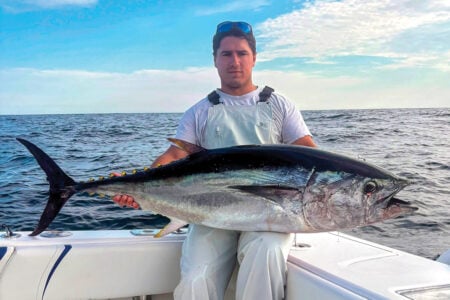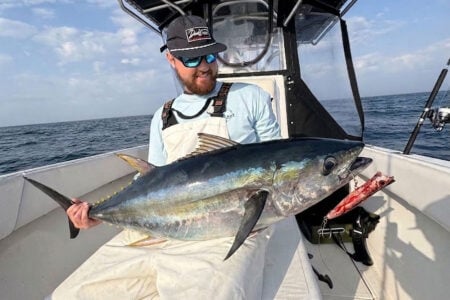
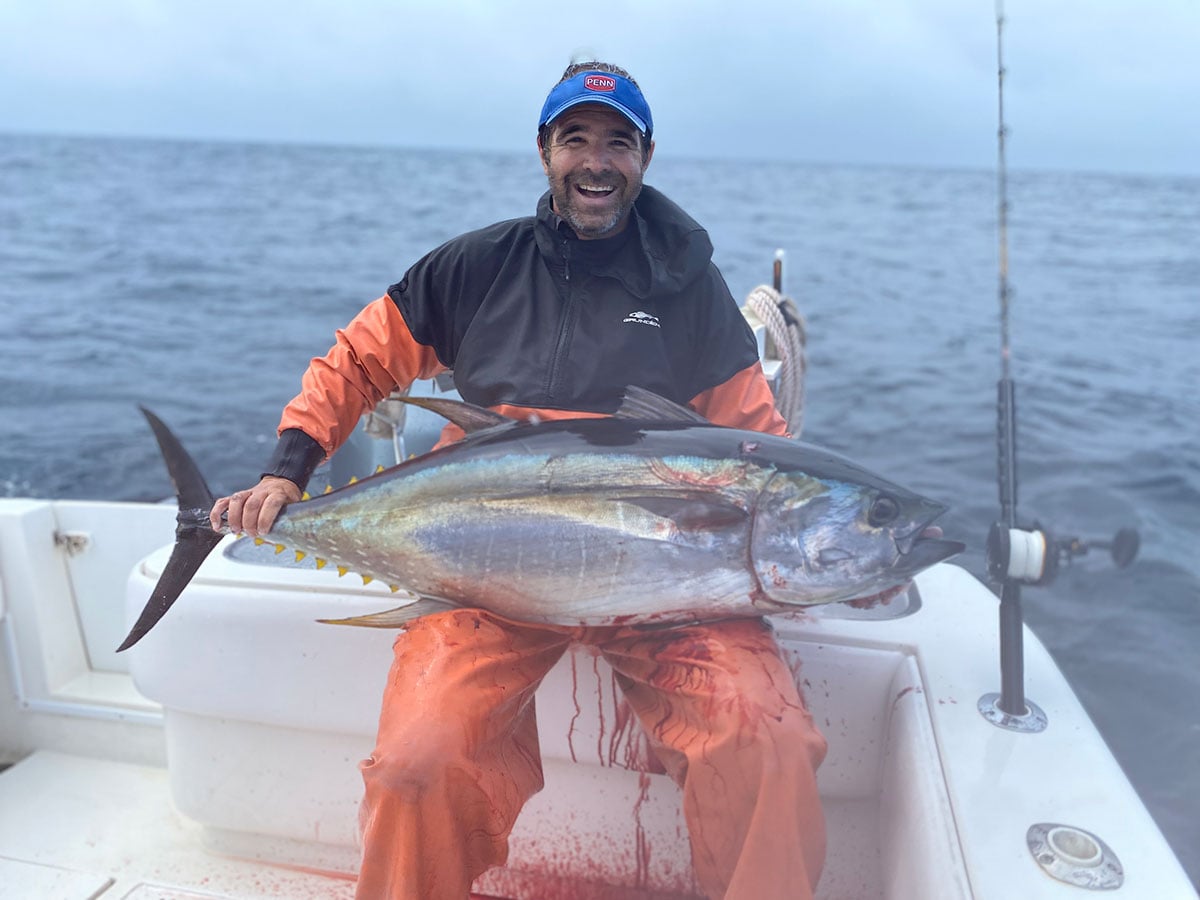
Make use of those little dockside candies on big ahi with a sweet tooth!
The yellowfin were busting all around us. They weren’t rats either!
The 40- to 80-pound yellowfin were chasing and exploding all over the live peanut bunker tossed down current, thus becoming the spread itself. The juvenile menhaden could be seen swimming for their lives, jumping from the water with tuna in hot pursuit. Sometimes, the forage fish won and sometimes the yellowfin won the individual stand-offs, but the inevitable demise of the peanuts could not be avoided for long.
We had made the 55-mile run from Atlantic City in a lumpy 3- to 4-foot sea. Capt. Tyler Hartensteiner of Tyin’ Knots Charters (tyinknotscharter.com) was happy to arrive at our location where yellowfin had been feeding for a week. First mate Alex was in charge of getting the chum slick going. We didn’t anchor, but instead Alex used a ladle to fancast our frisky peanuts. It’s better to spray the bait behind the boat versus dropping them in a narrow method. The peanuts instinctively looked to school up while looking for a place to hide. Those that found their way back to the vessel could hide under the boat for a period of time; those that did not, were swimming all over behind us for a hundred yards or more.
Each angler slowly let their peanut drift out in the current, which was substantial on this particular day. The idea behind any chunking operation, whether it be with live bait or not, is to send the baits back as naturally as possible so they are no different than those in the slick. Once our hooked baits floated back more than 150 yards without a bite, we reeled them back in and began the process all over again.

Lighten Up For Bites
We ran 40-pound test fluorocarbon leader to a 3/0 circle hook. In the event the tuna are line shy, anglers should be ready to lighten their leader to 30-pound in order to get the bites. There is indeed a risk of breaking tuna off, but getting bit is the first priority. Angler skill in properly fighting a yellowfin on light tackle will put more fish in the boat. Fish do get broken off at the leader once in a while due to the light leader tactic. What’s more, fishermen occasionally get sharked, as tired tuna after an elongated battle are easy often prey for sharks.
“I use Penn Fathom 40 two-speed reels on 20- to 40-pound Magic Tail rods,” Capt. Tyler said, adding “I like the light rods because of the flex; heavy, stiff rods are rigid and will cause way more hooks to pull. Main line we run 50 to 65-pound Spiderwire with a Cortland as a second preference.”
We continued to watch blow-ups and chattered amongst ourselves in excited anticipation. With all of that feeding, it was clearly just a matter of time before we got a take. Or so it seemed; as any fisherman knows, there’s no such thing as a guarantee. Then I heard the drag zip out on one of the reels. “Fish on,” our mate Alex proclaimed after the angler pressed the lever up and engaged the drag. “She’s heading deep. Just wait for the first run to end before trying to take back line. There’s no point in trying to reel against the drag,” said Alex, continuing to lend advice.
When a tuna grabs a chunk or live bait when slowly paid out, anglers should wait a few seconds to engage the lever drag mechanism and push it to engage the standard drag. The circle hook will grab the corner or top of a tuna’s mouth and then the fishermen can fight the fish conventionally. Circle hooks are chemically sharpened at the point, and can get dull after a few fish. Pay attention to that detail, and sharpen or replace accordingly.
Just as the first fish was getting near gaff range, the next rod went off! Capt. Tyler wheeled around and flashed a huge grin and said, “Let’s go! Now we need a triple header!” And that’s exactly what happened as the angler next to me struck gold. “We are tripled up,” said Tyler, adding “Try to steer them best you can as they approached the boat.” There were moments when we had to do a tuna tango passing lines above and below one another and shuffling into different positions on the deck. Unfortunately, one fish popped, but the other two made it boatside.
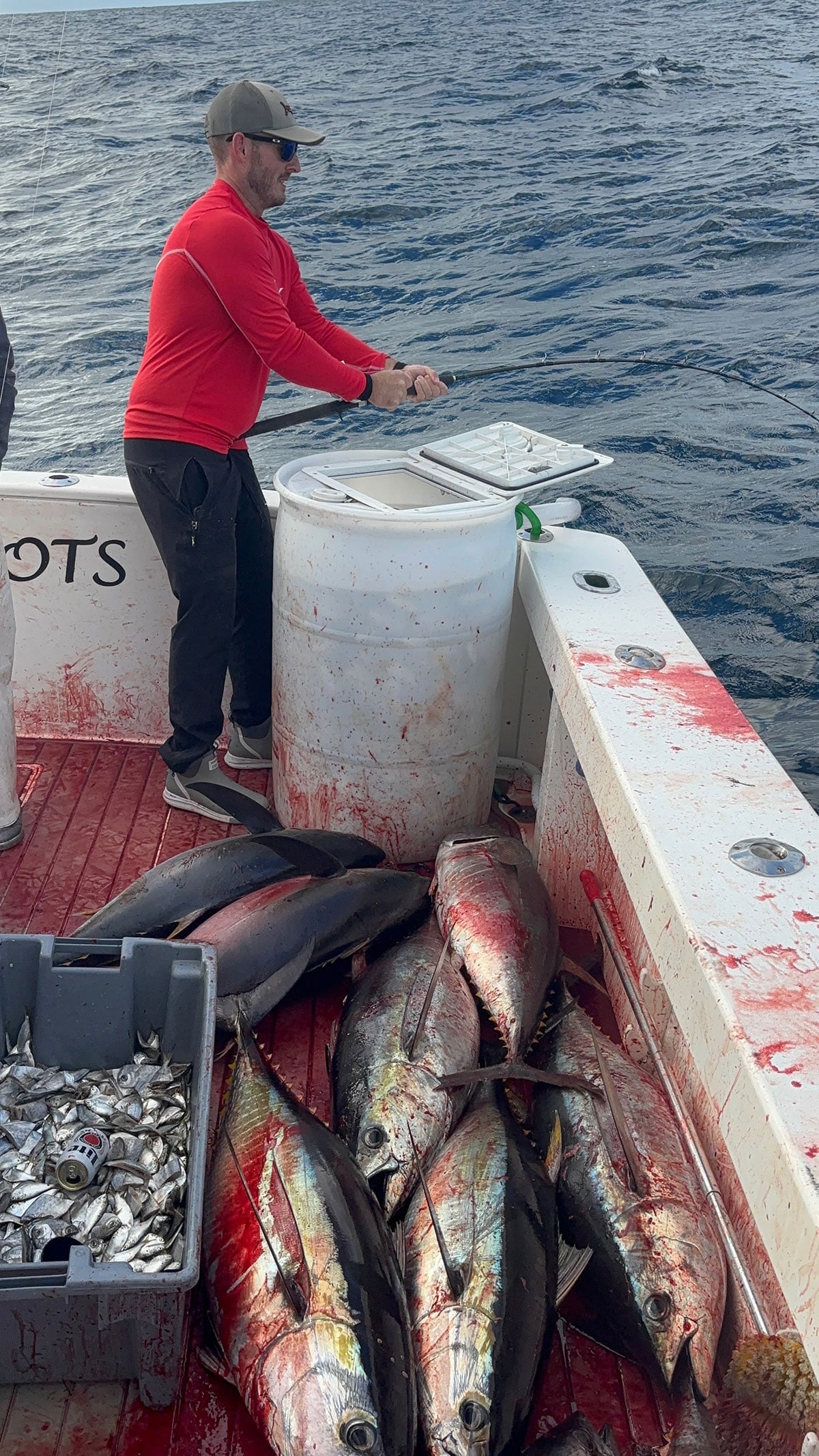
Duties Yield Yellow
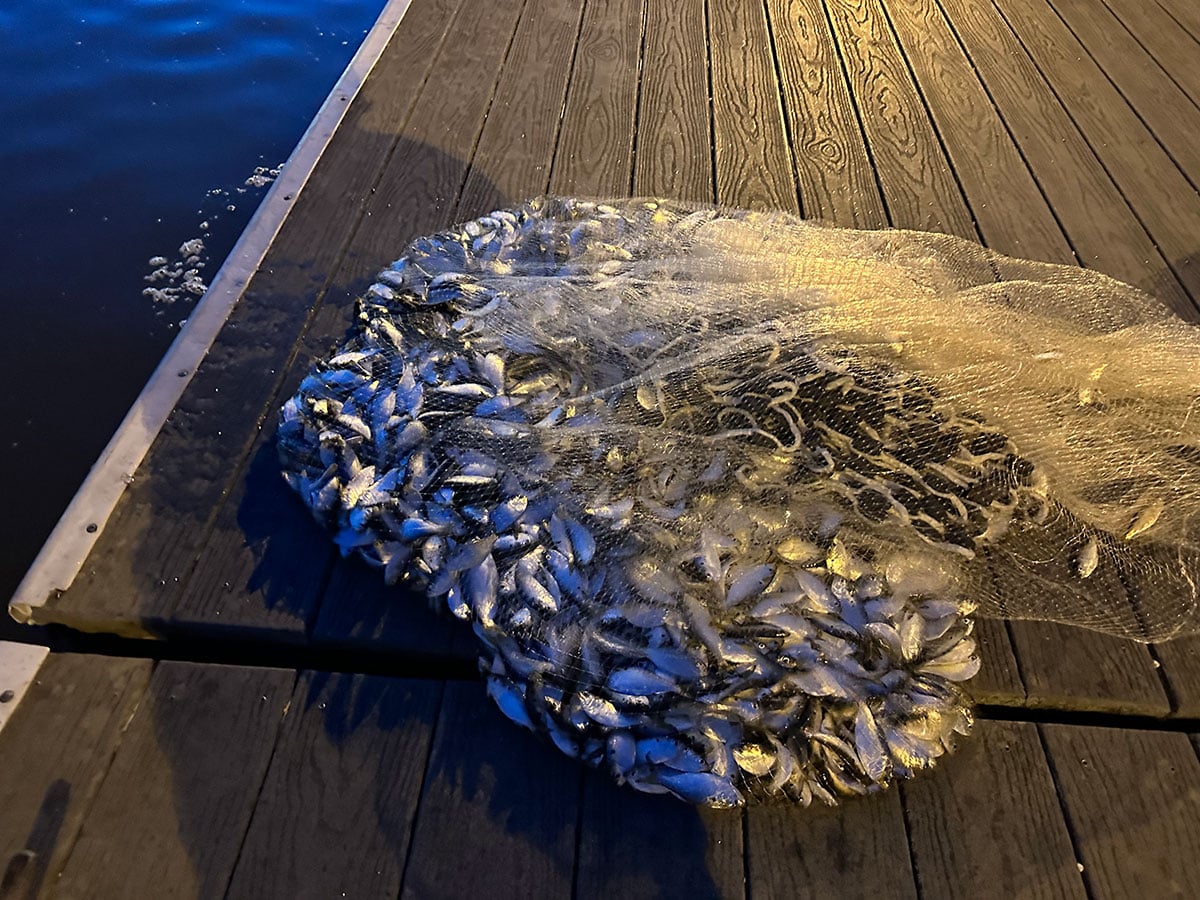
Alex was fulfilling multiple duties flying around with the gaff, landing tuna and maintaining fresh menhaden behind the vessel. Every 10 to 15 minutes maximum, he’d send out more peanuts. Capt. Tyler cast-netted the bait in a local basin the evening before. These young-of-the-year bunker become active on the surface right before dark, making them easy to collected provided you have the ability to aerate them overnight. The best places to look for peanut bunker are marinas, basins and creeks. Capt. Tyler has a large livewell capacity and loads them up in full knowledge that the peanuts aren’t just bait on the hook, they are also the main component of the slick.
Often the Tyin’ Knots captain doesn’t even use butterfish chunks instead relying totally on the live peanuts. Other days, he might use chunks and live menhaden combined as each outing dictates different strategy. He likes to hook the live peanuts through the back so they swim in a sideways, distressed manner. Up through the lip is fine too, but when baitfish zig and zag and look injured, they tend to get hit quickly. A strong pump is enormously important for this operation. While chunks bring the scent, nothing fires up the tuna like the live peanuts. It can be the difference in struggling to get bit versus having a banner day.
It’s often asked if dead peanuts are good for chunking tuna. “They will work,” Capt. Tyler and Alex both agreed. “But they are a distant second place to live peanuts and they tend to float. If you crush them, you can get some to sink at a slow rate, but then there’s the shark factor. Sharks love dead menhaden scent and we don’t need sharks behind the boat. They are time wasted and require leader changes and can make a mess of valuable fishing time.”
Both agreed it’s not bad to have dead menhaden, but they don’t want to leave home without the real deal – live menhaden and they do the work to make sure they have it. They will put in overtime if needed to find live peanuts. I can attest to this personally. There’s been more than a few occasions where the menhaden weren’t flipping near Capt. Tyler’s marina and he called me to see if they were readily available on the creek I use most prominently. Reliable intel plays a role even when making bait.
On this particular day, we were drifting beam to sea which helped with a really good stagger of the lines which increased efficiency and lessens the tangles. When a group of peanuts darted in the direction of my line, I just sensed it was about to be my turn. I could see the tuna following and torpedoing after the fleeing group of peanuts toward my hapless bait. The drag was set in the lightest setting possible for a fish to strip line without a bird’s nest taking place. Therefore, the tuna could eat the bait, turn its head and swim. Moments later, my line peeled off the reel and I pushed the lever drag on the Penn Squall 2 speed up to the appropriate position and the tuna was hooked!
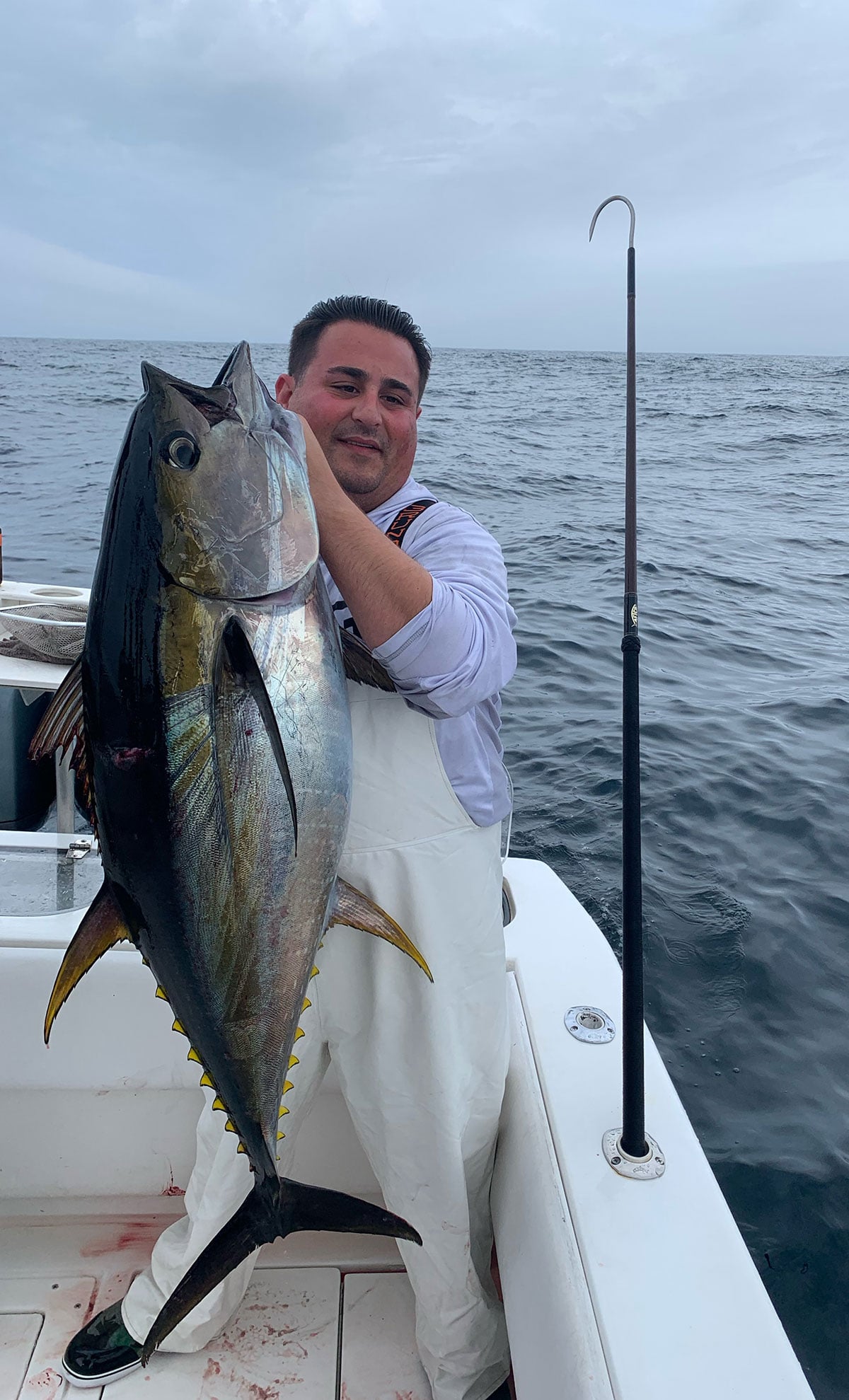
Attention To Details
The mate used a line-to-line FG knot connection to avoid using a swivel. Tuna have insane sight and can see any abnormality so the less hardware the better. It’s common for mates to clean their leaders with alcohol if they get salted up or any other kind of crud. It’s extremely important to pay attention to this matter and leaders need to be replaced for any reason, complacency doesn’t have a place within serious offshore fishing. Yes, details matter, especially offshore.
Setting up on the drift, Capt. Tyler made certain to drift over the high part of the lump. There were a good number of boats, but luckily, they knew how to fish within a small chunk fleet so everyone had enough space to work. This isn’t always the case. If a vessel is too close, there’s a chance a hooked tuna might run under the boat in the lee causing all kinds of tangle situations and destroyed line and leader. If it’s absolutely necessary that boats fish near each other, it’s better if they are off to each other’s sides and with some latitude.
In addition, the chunking boats are part of what keep the yellowfin from swimming on. “It’s very good that there are boats chunking every day,” Capt. Tyler said. “The tuna become conditioned to knowing there will be a fleet of boats putting chunks and live baits in the water starting a dawn every morning. Some even stay through the night especially later in summer. The tuna expect the forage and are ready to bite,” he added. It’s Pavlov’s Dog theory at work!
Capt. Tyler runs two boats – a 31’ Contender and a 41’ Henriques. He has made certain both have the ability to carry enormous amounts of peanuts to the grounds. I have also carried the baby menhaden to the grounds, but my smaller Contender doesn’t have the same capacity. Overloading only works with adequate space and high power pumps. Furthermore, rough seas and bouncing can cause the bunker to die or get prematurely worn out. Hence I try to find the sweet spot in the seas at the same time I’m speeding out to the grounds. I once had a rougher ocean than was predicted and the peanut bunker were on death’s door when I arrived for the chunk. Having knowledge of my livewell and the amount I was carrying, I determined that my pounding through a rough ocean clearly hurt that batch on that outing.
Peanut bunker chunking for yellowfin in the Northeast generally begins in July, but really picks up steam in August and lasts into October, sometimes even until November. The consensus is that boats want to be on the scene with peanuts in the water when the sky is just barely illuminated. Like many fisheries, dawn is a terrific time to get tuna behind the boat. It’s not to say the afternoon and evening bite doesn’t erupt too.
Captains that stick it out during slow mornings may get rewarded in the late afternoons. It’s noteworthy that bluefin tuna will respond to the same tactics. So heading offshore with a well full of menhaden for the other species is worth a crack and has caught over the years also.