A fishing-obsessed kid that grew up into a fishing obsessed guide.
“My dad was a firefighter and a fly fisherman”, said Captain Corey Pietrasek, as we sipped a cup of coffee in one of Fairhaven, MA’s breakfast joints. “Growing up, we had an 18-foot, wooden, Rhode Island quahog skiff, painted red, with a tiller outboard. Dad worked long shifts, so he also had a good amount of time off, that included a lot of fishing. It was 1987, I wasn’t even 10 years old, when he had me running the outboard, so I could hold us in place while he cast big streamers to the down tide side of any boulder, where a striper might be holding.”
Formative Moments
“It’s a funny thing”, Corey continued, “Dad didn’t care how big the fish were. In fact, he’d prefer to catch schoolie-sized fish all day long. I was largely a deckhand when fishing with my dad, but I can remember the exact moment, when my destiny to become a professional charter captain crystalized. We were fishing at Sakonnet Point and I was at the tiller. We’d happened on a cove where a school of tinker mackerel had been pinned in the corner by some hungry bass and we’d just released a decent-sized bass.”
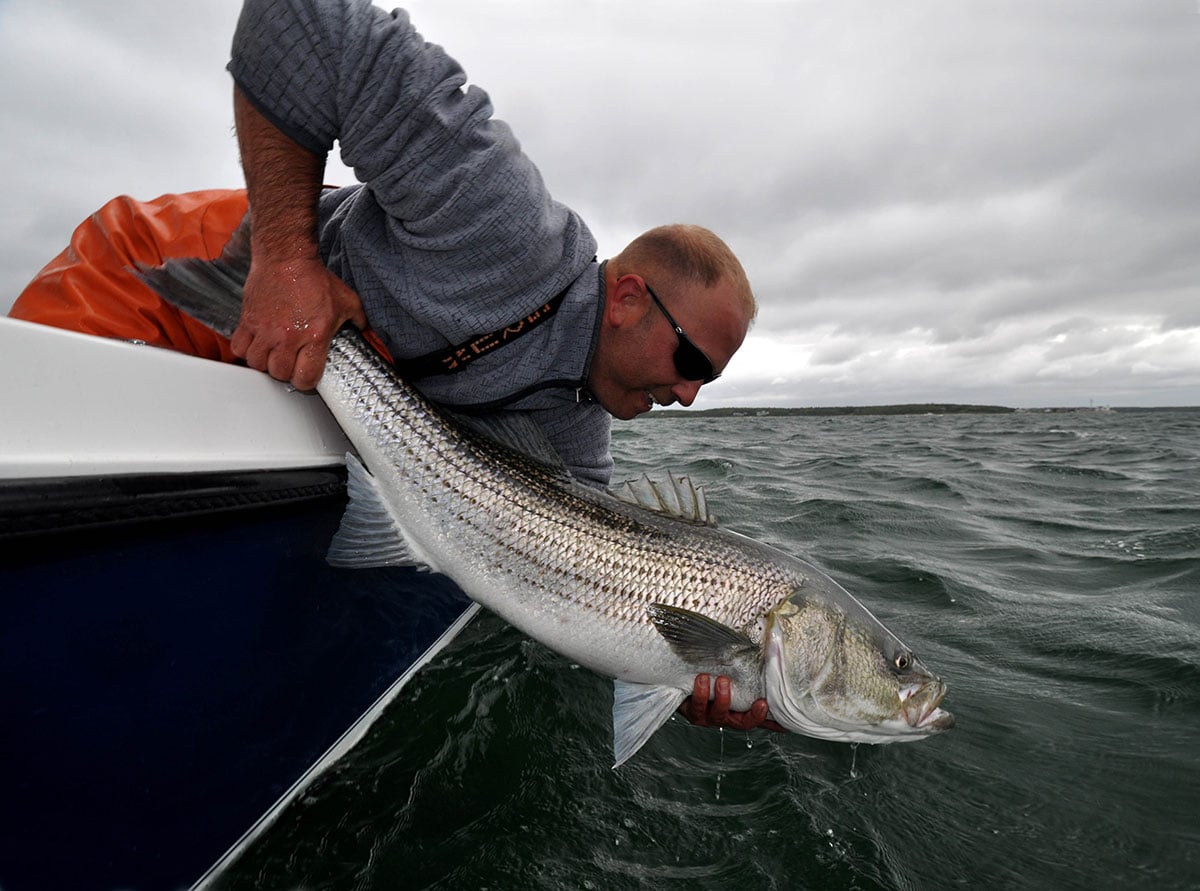
“Dad made a couple false casts and began his retrieve again. Strip, pause, strip, pause, Dad drew his streamer back to the boat. When his fly was about 40 feet away, we saw a very long and dark shadow gliding toward the fly. It was probably a 30-pound fish and I can still see it clearly, as it was calm that morning. Dad stripped again and the fish continued to follow, making a subtle bulge on the surface. Two more strips and the fish was clearly in view. I’d never seen a bass so big. Dad, stripped again, but you could see the big fish wasn’t going to take the fly. The biggest bass of my young life didn’t turn abruptly at the side of the boat with a huge boil, but rather, just settled in the water, the brightness of its markings and enormity of size fading away.”
“Watching that big bass, for no more than 10 seconds”, said Corey, “set the course of my life. It’s pretty amazing, isn’t it?”
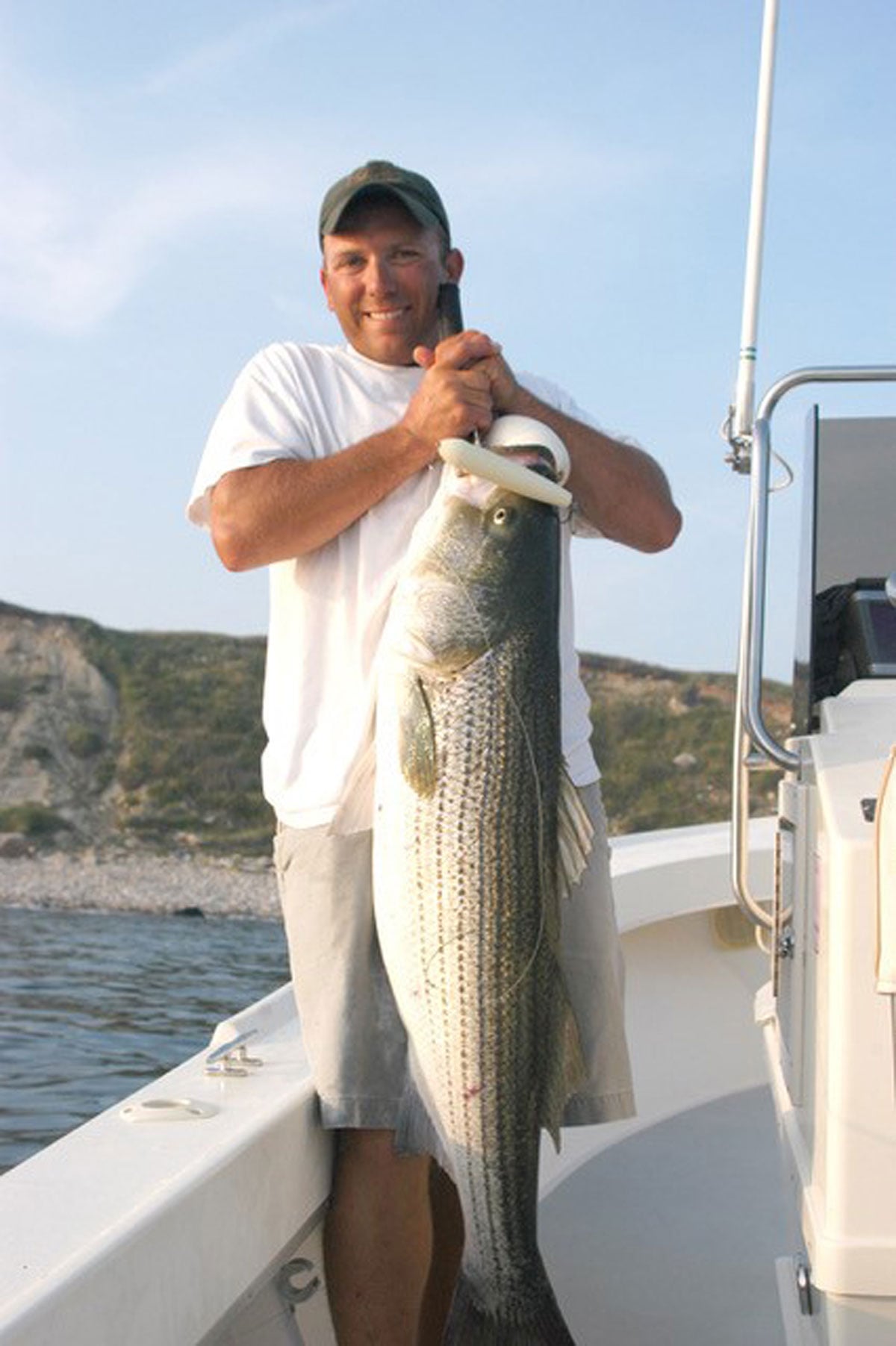
“Dad wanted me to get a good education, so that I could possibly have more career choices than he’d had, but I wasn’t a very committed student in high school. I was obsessed with fishing and it was common knowledge that if I wasn’t at school on a May morning, you could be sure our family skiff was gone.”
Independence at a young age is an opportunity to learn, as long as you don’t get hurt or worse. “We weren’t even in junior high school, when my friends and I would take the skiff to Cuttyhunk from Fairhaven, almost an hour boat ride away, because we had heard there were big fish there”, said Corey. “That was of course, without GPS or any adult supervision, other than some of the commercial skiff fishermen telling my dad they’d seen us fishing where it wasn’t safe to be.”
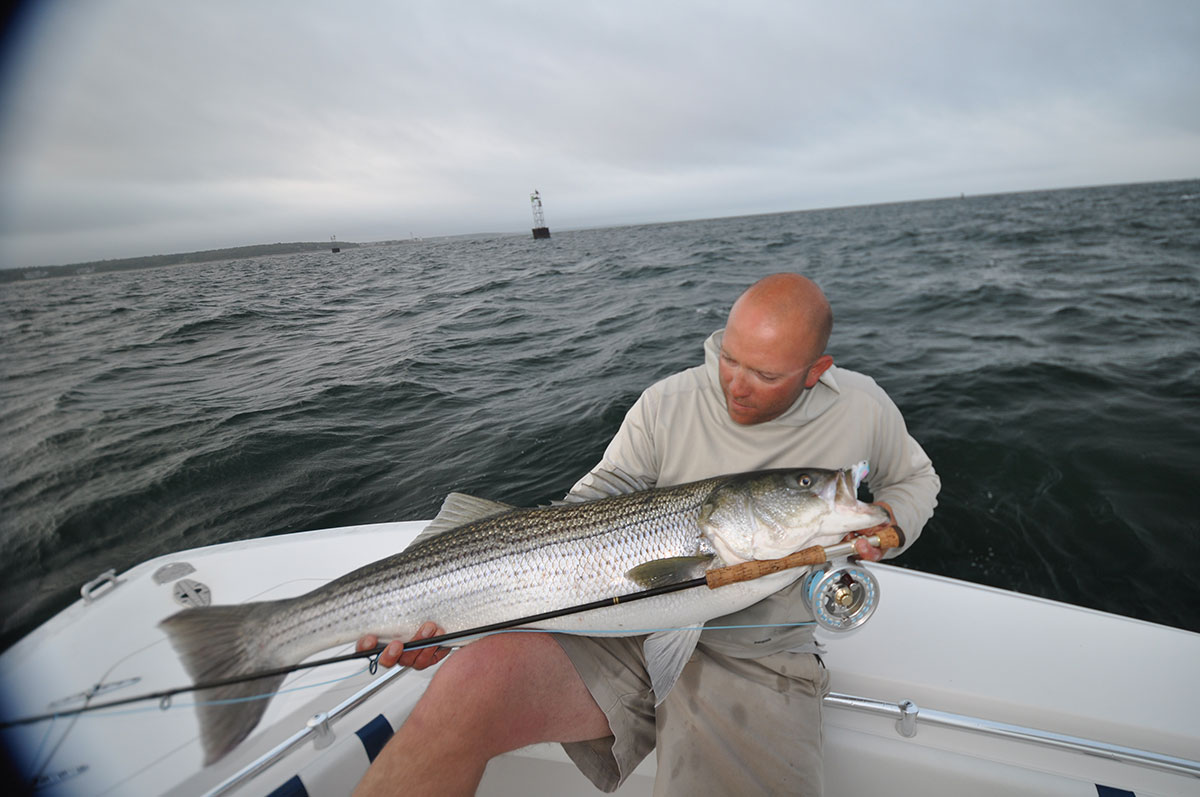
The Transition To Guide
“I think I was about 16 years old, when a guy my dad’s age said that he’d pay me to take him fishing. Dad let me take the skiff and we caught some fish. I took my dad’s friend a few more times and began to think that maybe there was something to this guiding idea.”
“I don’t know how, but they let me graduate from high school. I was 18 years old, was married, had a baby boy and was working for an engineering company. At a fishing show, I met a dentist named David Gale, who asked me if I could take him on a guided fishing trip some upcoming Friday. We caught some fish and he asked if we could make some additional Friday trips. ‘Somehow,’ at work, they knew I liked to fish and when I asked my boss if I could take some Fridays off to fish, he was kind enough to say, “If taking every Friday off is what you’d like, you can do that.” I think this really was the start of my career as a charter captain. My fishing friends knew David as “the Friday guy” because I guided him so regularly on the day he was available.”
“I told my Dad, that I wanted to be a professional guide and asked if I could use the family skiff. I know why Dad said no, (because he wanted me to further my education and he didn’t want me to put so many hours on the red skiff), so I borrowed a friend’s boat and began taking charters out on a regular basis.”
At The Edge
“I discovered the Saltwater Edge tackle store in Middletown, RI in the late 1990s. Greg Weatherby and Peter Jenkins were the owners at the time. It was pretty much a fly shop then. I started working there, part time, in 2001, then full time, not long afterwards. Peter was and is a huge influence on my career as a fisherman. He let me use his Sea Hunt skiff to start guiding on a regular basis, which led to my creating Plug and Play Charters. Peter’s support gave me the momentum to purchase a 21-foot Parker outboard that I used to guide out of Newport for many years. As there is now, there was a great community of good fishermen that worked in the shop and also who came in to get their stuff.”
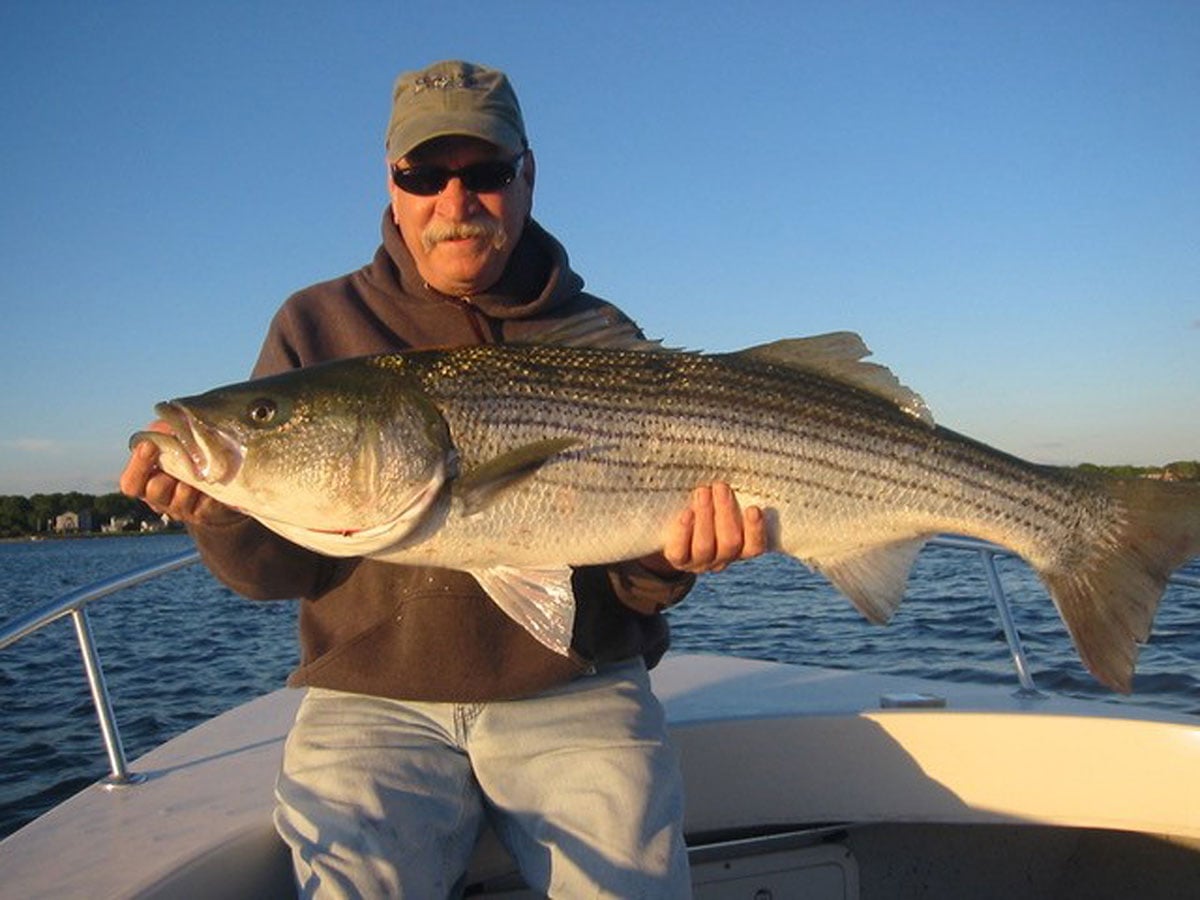
With all of the fishermen coming in and out of the shop, it’s only natural that new ideas would be hatched in those conversations, at some point in the early 2000s Corey and some friends made an incredible discovery. “We had some freshwater guys at the shop and I was really interested in the big freshwater plugs they used when pike and largemouth bass fishing. It’s difficult to say, who actually discovered that the big ‘spook-style’ plugs used by the musky fishermen would work so well for stripers, but I did enjoy being one of the few guys using the 7- and 9-inch Doc plugs for many years before the secret finally got out.”
Finding Fish
Corey’s Dad passed away about 10 years ago but he still carries the lessons and instincts of the old school mindset with him to this day, “Guys of my Dad’s era found fish using their eyes, nose and ears. At best they might have a Sitex black and white, paper machine as a bottom sonar if they were boat fishing. It’s funny, I love side-scan sonar, but for the most part I still find striped bass the same way the old timers did. I look for visual clues like dipping terns or cormorants diving, the smell of a baitfish slick or a sound made by feeding or fleeing fish.”
As a charter captain who has spent decades on the water, you pick up tactics along the way that many others overlook, “One of the tactics I’ve learned as a charter captain is the importance of ‘pre-fishing’ before you take clients on a trip. It’s just like what the tournament largemouth bass fishermen do before a tournament. I can’t emphasize enough how important it is to take make an effort to get dialed in to current conditions before taking people out for the day.”
What’s Next?
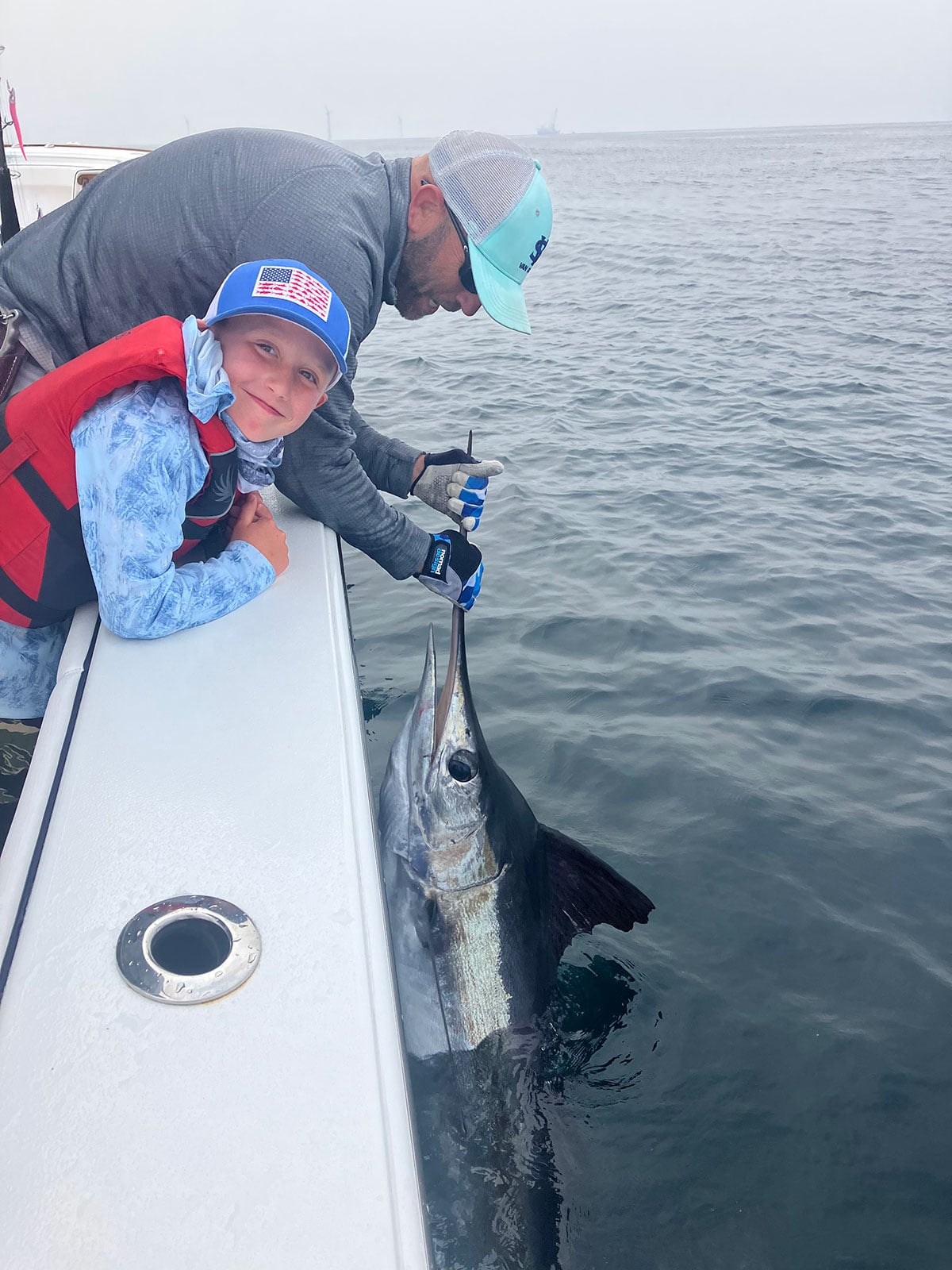
“I will always love fishing for stripers, but if you made me pick one fish as my favorite, I think I would have to pick white marlin. Just like that seeing that first big bass with my Dad, I love seeing white marlin. We sight fish for them and when you can see that they are ‘lit up’, their iridescent purple back and bright white stripes signaling that they are on the hunt, it’s such a beautiful sight.”
“I really like people,” Corey continued, “but when I’m fishing, I like having some space. Fishing offshore gives me that space. Another thing I enjoy about white marlin is that finding them can often be more of a more an art, when compared to many other species. They are pelagic predators, constantly on the move and the clues to where you might find them are often subtle. Thankfully, I have the benefit of some 15 years fishing for them, which is a big help given that their migrations bring them within range of Rhode Island for only about a month each summer.”
| A HARD-LEARNED LESSON |
| “When I was younger and fishing with Dad, he often encouraged me to get him closer and closer to the wash zone of a rocky shore, so his casts could reach the whitewater. If you’ve ever stared at the dark space that is a steep, night-time wave, about to curl outside of your shallow location, you’ve learned to never trust that you are safe in a small boat in the shallows. Fishing with Dad, I developed a sense for always looking over my shoulder, an awareness that allowed me to guide clients into the shallow water, years later. Bad judgement can lead to good judgement, if you don’t get hurt too badly.” |
What about traveling? Is there any out-of-state fishing that makes you want to hop a plane? “I had the chance to fish in Mexico recently with another Saltwater Edge buddy, Rudy Babikian, Corey laughed excitedly, “and as they say, ‘it was epic.’ I really want to go back to Mexico and fish for roosterfish with the fly rod.”
Any closing thoughts for our readers? Corey thought for a minute and said, “I know my obsession with fishing was a bit frustrating for my parents and teachers, but I have come to realize that when we live our lives doing what makes us feel alive, we are on the right path. When I find active marlin on the surface or we are heading home toward a setting sun after a great day of chasing stripers, there is nothing like it. I’ve benefitted from a lot of kind and knowledgeable people through fishing. I hope I can extend the same kindness to others, as I continue to guide and fish myself.”