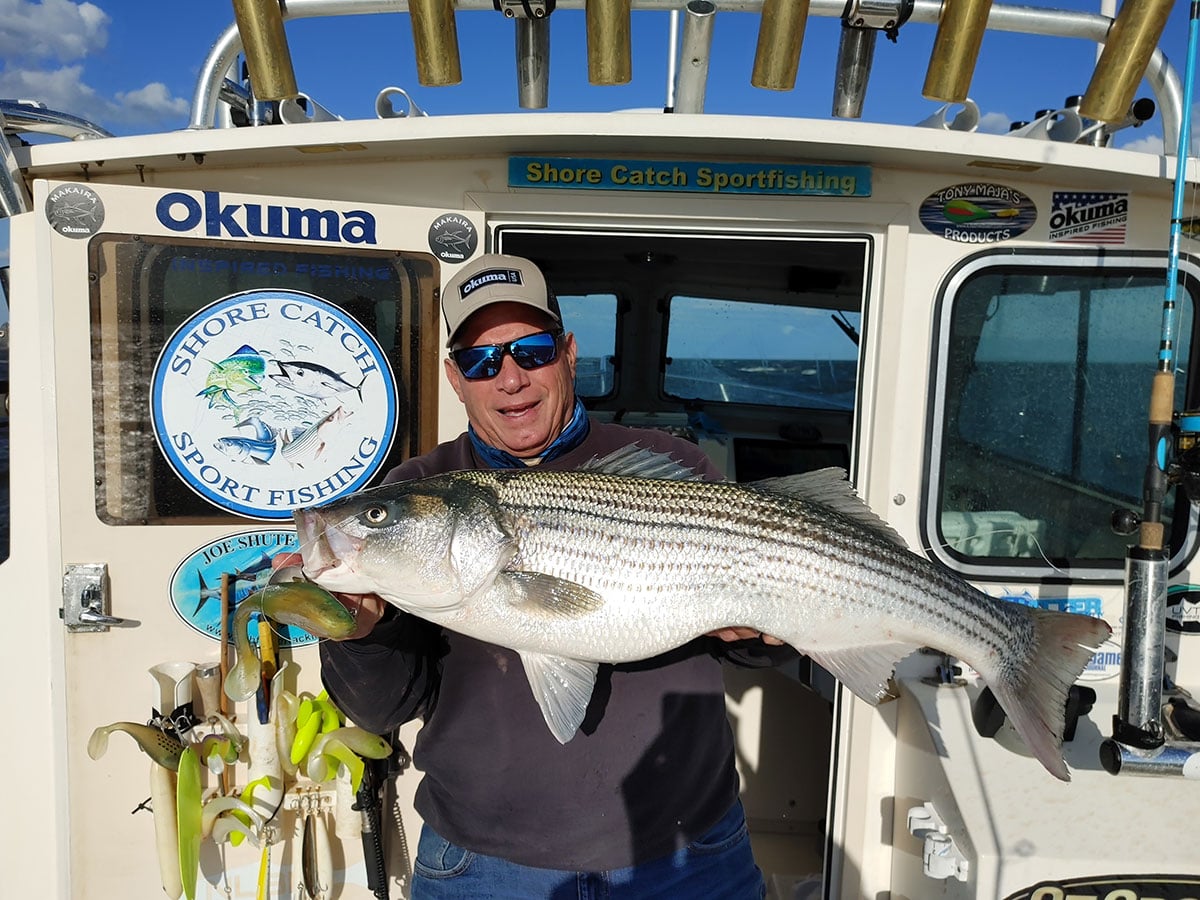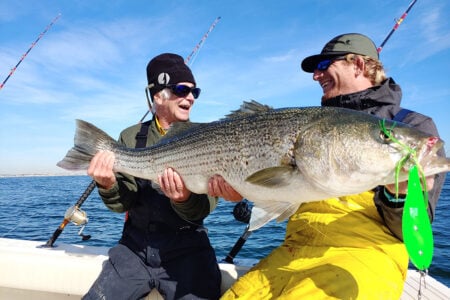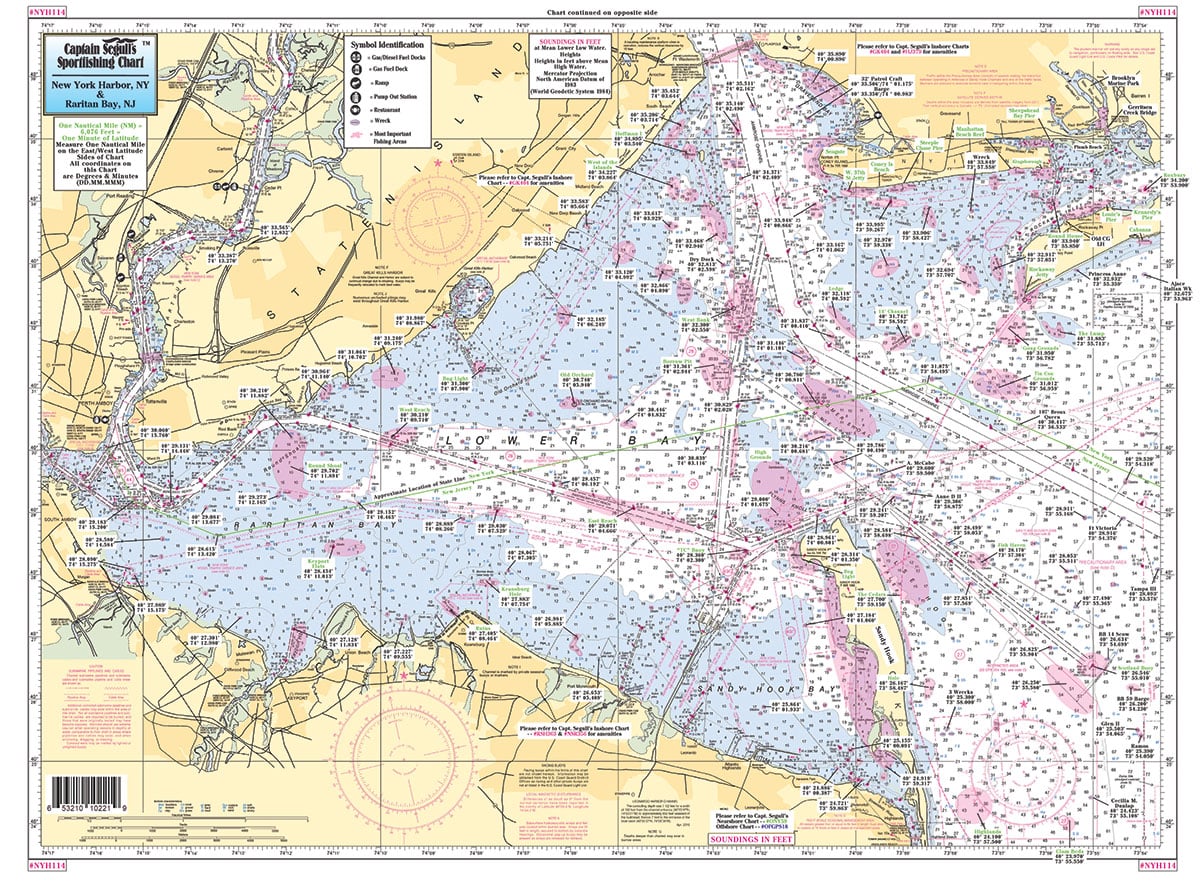
Is this the new spring “Mecca” for the striped bass afflicted?
One of the things I love about bringing my boat to the Raritan Bay in the spring is that opportunities present themselves to catch big striped bass both on top and on the bottom.
Big bass love big baits and in the spring Raritan Bay becomes a virtual pool that is filled to the brim with them. Anadromous herring, both alewife and bluebacks, come into the bay seeking out the freshwaters of the surrounding rivers to fulfill their annual innate spawning ritual. And adult Atlantic menhaden, aka bunker, arrive simultaneously to feed on the spring plankton blooms. These big baits fuel the pre-spawning run of the Hudson River stock of bass.
When the Hudson stock enters the bay – or perhaps awakens from their winter slumber – these bass are in their pre-spawn mode. They stage in areas on the Raritan, feeding ravenously until the Hudson River rises to their optimum spawning temperature of 58 to 64 degrees when they will now run up the river. Some hefty bass can be found at these times with the largest females in the 30- to 40-pound class, and males will be in the high teen to 20-pound class.
There’s good reason why this area has been drawing in boaters and surfcasters far and wide in recent years; you’ll see it in the trailer plates parked along the bayshore ramps (Delaware, Pennsylvania, New York and Rhode Island), as well as rack-topped vehicles parked along desolate street ends adorned with MV and The End stickers on the bumper.
Cold Water, Hot Bite
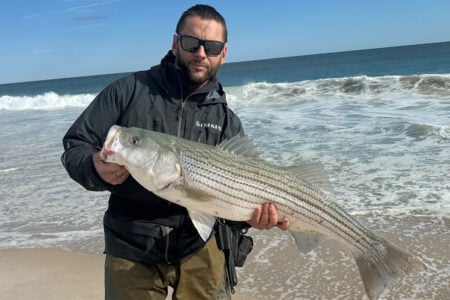
In the early part of April when bay waters are still on the cold side, in the low 50-degree temperature ranges, we will find the bass on the western flats in 2 to 6 feet of water. First arrivals are seeking out the warmest water in the back of the bay far away from the cold ocean influx of the incoming tides. For this reason, surfcasting all along the Raritan Bayshore is phenomenal during the month of April as big fish find their way into shallow waters close to shore in which to feed. For boaters, southerly facing shorelines are prime locations to pull into and search out as these waters warm the quickest due to their dark mud bottoms that absorb the sun’s rays as it transverses the sky from east to west.
When we slide into the flats many times the waters are muddied from spring rains and run-off but this doesn’t stop a striped bass from striking out at the topwater commotion that planks, spooks, and Docs will produce. When the water is clear one can usually see a big bass waking behind the artificial and then exploding on it as it is retrieved back. This adds an extra measure of excitement to each cast as the strike becomes highly visible. All three are “walk the dog” style artificials. That is with the correct action they will move across the top of the surface darting side to side. This motion gives the appearance of an injured bunker or herring struggling on the surface. My favorite colors are bone or white and my “go to” lures are the Madd Mantis plank, JP spooks, and the original Doc.
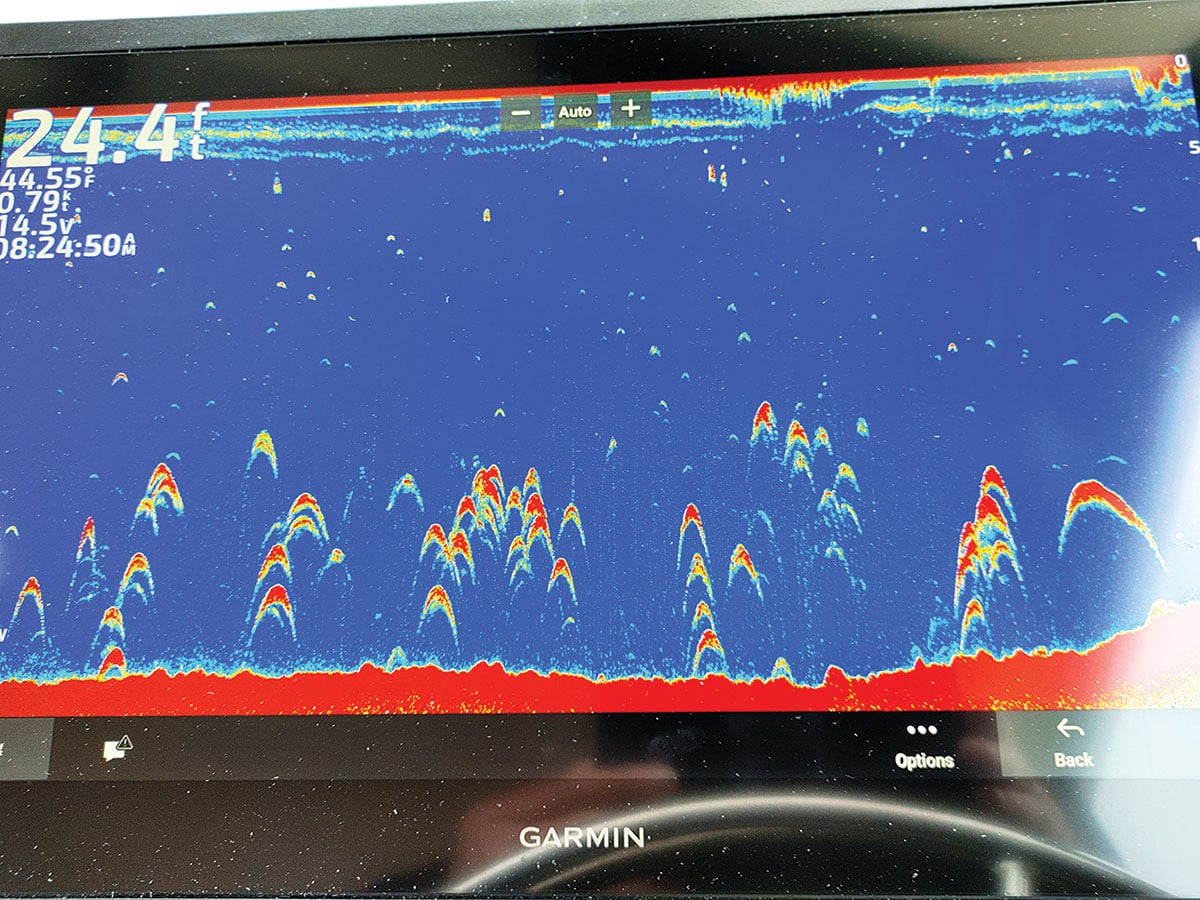
What I have also found in the early spring is that a percentage of bass that will hunker down in the deeper holes in the back rivers and then make their way out to the bay proper and congregate together on the bottom. These are usually the hold over bass from the winter and are smaller in size. I have read good concentrations of bass in different water depths from 12 to 25 feet. These bass open the door for a flutter spoon bite as you can use your fishfinder to position and sit right on top of them.
Flutter spoons are a large piece of polished metal that is tear-dropped shape and mimics a dying bunker or herring when the spoon drops to the bottom. It will randomly flutter and dart as it reflects an orb of light when the correct action is applied. To work the spoon correctly it is important to let it drop freely with just the right amount slack in your line so you do not hold the spoon back thereby decreasing its action. When it hits the bottom the rod is snapped up and the drop repeated. When the bass are stacked like cordwood under the boat inevitably a bass can accidently be snagged in the belly when the spoon is lifted.
I like to use spoons in the 8- to 11-inch range in chartreuse, white, gold, or silver. When the water is murky from runoff from heavy rains chartreuse rules. My go to spoons are the Tsunami Pro, Tony Maja Drift spoon, Ben Parker Magnum, TAK, Aherns, and AllPro Flutter Pro.
One soft bait that I have had very good success vertical jigging when the bass are stacked is the 8-inch NLBN in the butter color fished on a 1- to 2-ounce head. This bait has the length of a small bunker or herring but does not resemble them in body shape. However this bait works well when snapped jigged off the bottom like how you would fish a bucktail or diamond jig. The up and down motion tight to the bottom resembles a dead bunker or herring getting tossed around in the bottom current and this draws the strike.
Top & Bottom
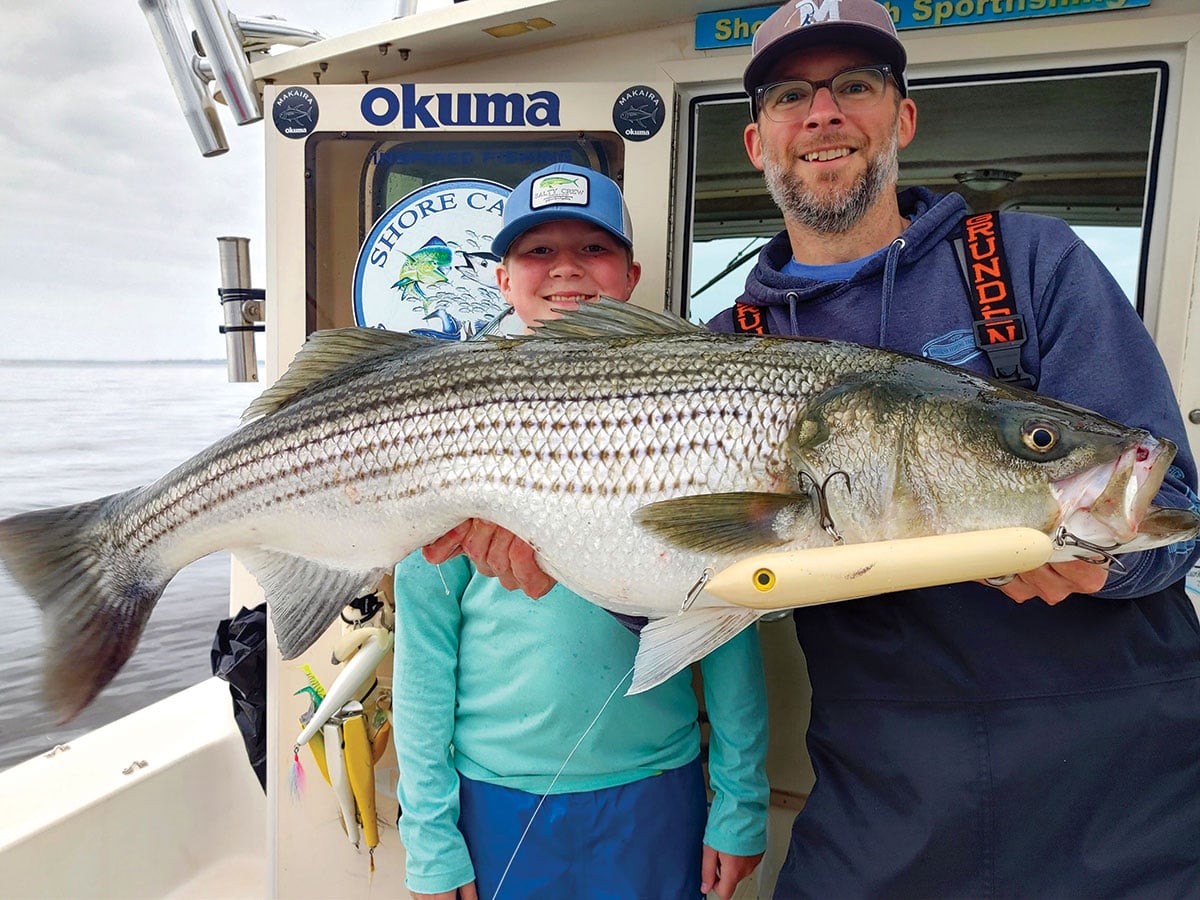
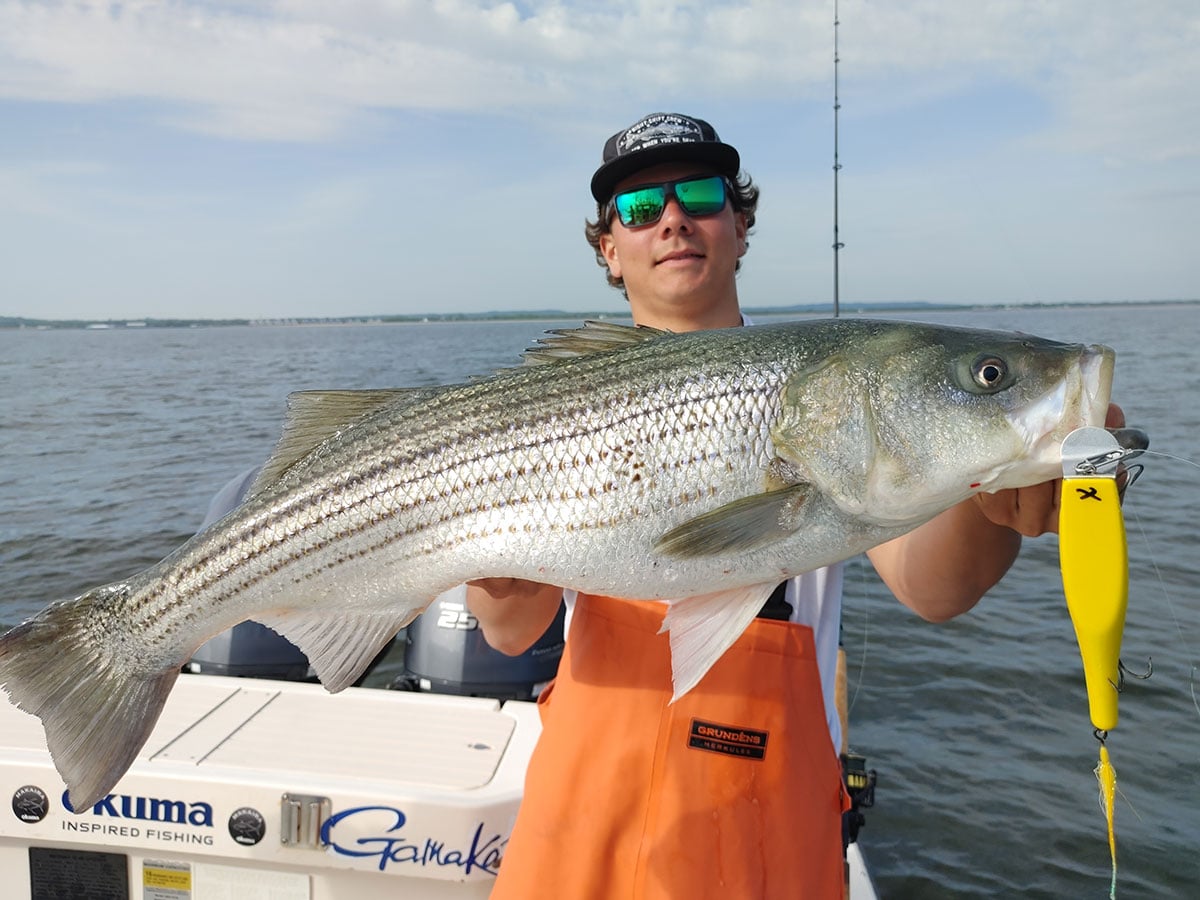
When water temperatures in the bay increase to 56 to 65 degrees the bass will now spread out in the bay as they prepare to run up the Hudson. Now the bass can be found all throughout the water column so topwater action will break wide open as will fishing shallow or deep-diving metal-lipped swimmers. Three of my favorite metal lips to use are the deep diving Back Bay and Salty C’s, and the surface swimming JP Surfster.
Different speeds of retrieve can get the deep divers to different depths. Hard cranking can get them down to 12 feet while slower retrieves will have them run shallower and impart more of a wider wobble. Shallow metal lips will run 1 to 3 feet beneath the surface. My go to metal-lip colors are all white, followed by yellow, chartreuse, and bunker.
Another reason I charter out of Raritan Bay in April and May, besides the number of bass that are concentrated there, is that I can fish it even when the wind is blowing 20-plus mph. These winds would keep me off the ocean if I was back in my home port in Manasquan along the Central Jersey oceanfront. I have found that when the wind is up enough to have the bay white capping the bass stay deep. This is when I break out the Tsunami Holographic 9-inch swim shads.

Because of their weight of 6-1/4 ounces these particular baits can be fished effectively by casting them out as far as you can into the wind and then scope out as much line as needed to get them to hug the bottom. From this point allow the boat to do the work as you just hold the rod and give it a few twitches or jerks every few seconds. This white capping will push the boat that allows me to set up on a very long drift. The enticing action of the tail of this bait as it is pulled through the water will draw the strikes. I prefer the dual hook bait as this will get those short strikes when the bass are not overly aggressive and strike at only the tail of the bait. Best colors are shades of holographic green, lime, or chartreuse. White and bunker color can also be very effective.
For snap jigging flutter spoons or NLBN’s I use the Okuma 8-foot PCH conventional rod paired with the Cavalla 5-II lever drag reel. For spinning gear casting the big deep diving metal-lips require a bigger rod because of their weight so I use the Okuma 7-foot, 9-inch extra heavy Silver Slayer paired with the 6000 Tesoro reel. For shallow swimming metal lips and topwater planks, spooks, and Docs I like to use the 7-foot heavy Silver Slayer paired with the 6000 Tesoro. All my reels are spooled with 50-pound Nomad Panderra X8 braid with an FG knot connecting a 6- to 8-foot length of 40-pound fluorocarbon leader.
Also all the above artificials are connected to my leader with a 175-pound Tactical Anglers power clip. The TA clip allows for a quick and easy change of an artificial making no retying necessary.
| RAMP OPTIONS |
| Great Kills Park Boat Ramp
3270 Hylan Boulevard, Staten Island, NY Part of the Gateway National Recreation Area, a Boat Launch Permit is required to park within the Boat Launch Parking Area; get details on 2026 permits at recreation.gov.
Carteret Marina 100 Cooke Avenue, Carteret, NJ 732-541-3800 (ext. 3103)
Keyport Municipal Boat Ramp 1 Broad Street, Keyport, NJ Daily passes ($20) may be purchased at the Boat Ramp. Annual passes are available from the Borough Clerk’s office upon presentation of driver’s license, vehicle and trailer registrations. 732-888-4781
Leonardo State Marina 102 Concord Avenue, Leonardo, NJ New Jersey residents $20 per launch, non-residents $25 732-291-1333 nj.gov/dep/parksandforests/parks/marinas.html
Atlantic Highlands Municipal Harbor 2 Simon Lake Drive, Atlantic Highlands, NJ Monday through Friday $23 per launch, Saturday, Sundays and holidays $28. Boats over 30 feet are $36. Public parking, first-come first-served. 732-291-1670 ahharbor@ahnj.com |