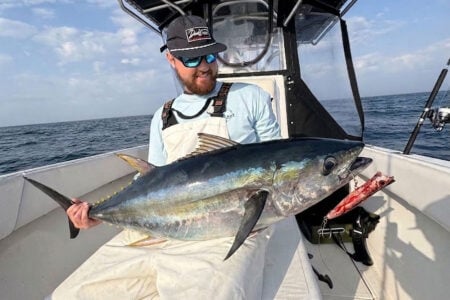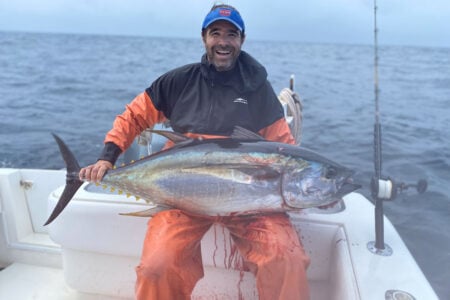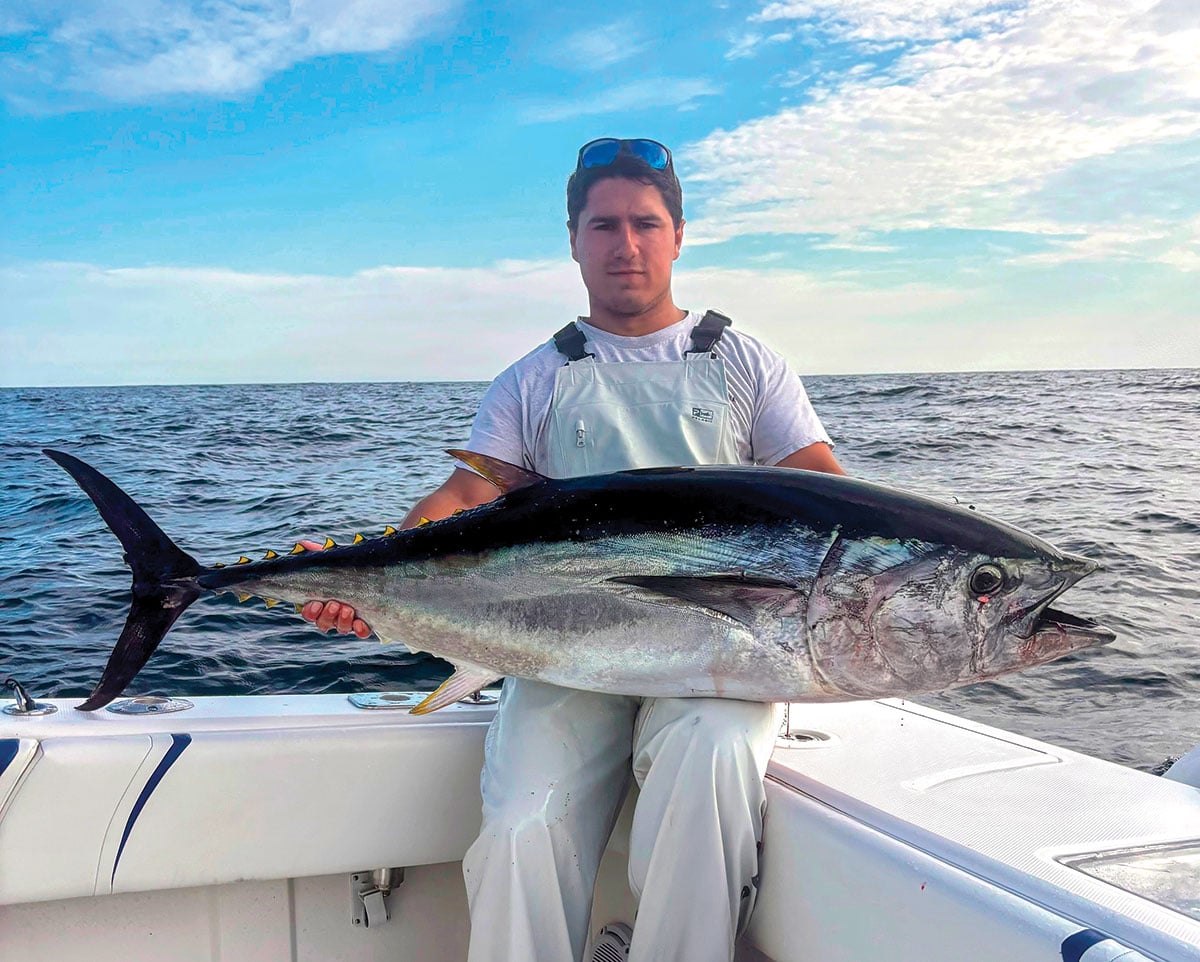
Trolling – run & gun style – to adapt to whatever the tuna Gods throw your way.
When I’m guiding a charter for near-offshore bluefin in 20 fathoms or less, or targeting yellowfin and bluefin in the 25- to 40-fathom zone, I rely on five proven methods. The first is surface trolling with a mix of single lures, ballyhoo, squid bars, daisy chains and diving plugs. The second is casting poppers, stickbaits and sliders to marauding schools on the surface or around porpoise pods, the classic “run and gun” approach.
The third method is jigging the mid-depths and bottom with metal jigs and leadhead sand eel plastics, especially around surface slicks and bird activity. Fourth is chunking with dead baits such as butterfish, peanut bunker and sardines, occasionally spiced up with live baits including killies, porgies, spot, bluefish, snappers and bunker.
Finally, there’s livelining baits caught on the way offshore, including bluefish, bunker, red hake, whiting, spots and squid. These can be presented at various depths around wrecks, ridges, bait balls, draggers and other likely tuna gathering spots.
One variation of this five-finger approach is “dragger hopping,” which might incorporate several of these techniques during the same encounter. When commercial draggers stop to haul their gear and sort their catch, the noise of chains, wires and doors being hauled aboard travels an incredible distance underwater. To nearby tuna, it can act like a dinner bell.
Working The Draggers
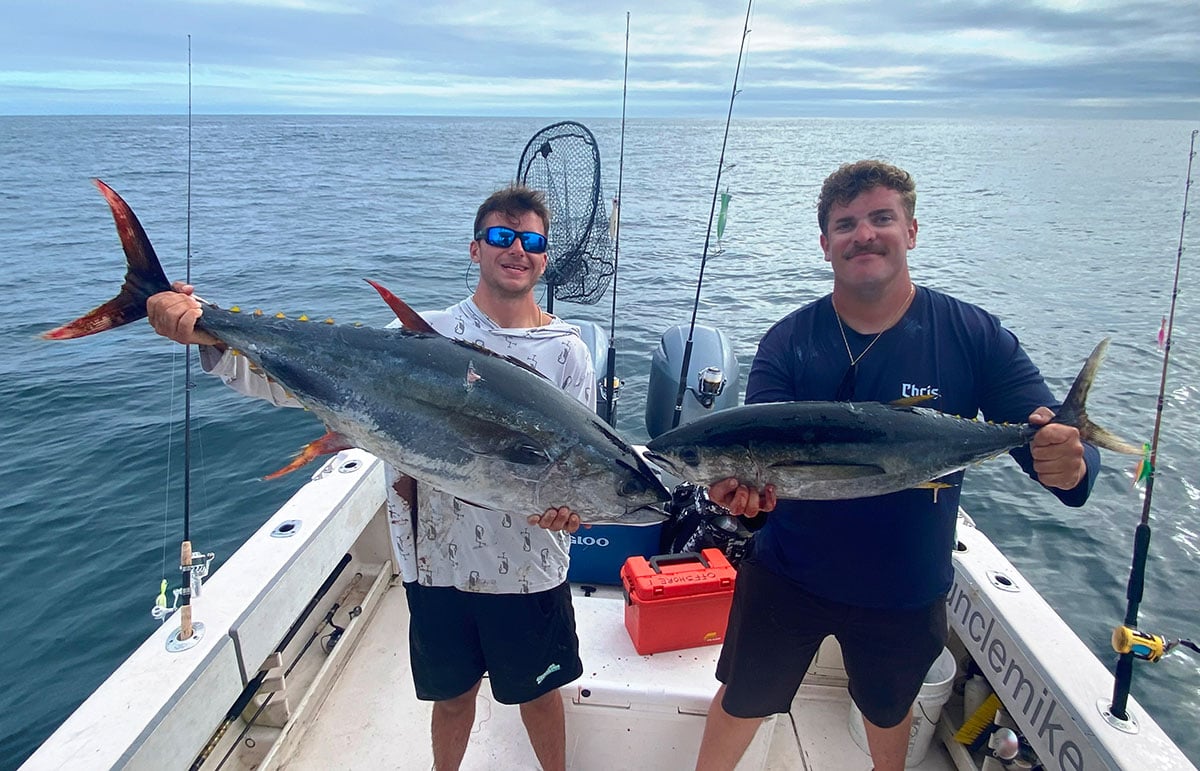
I’ve trolled hundreds of bluefin, yellowfin and longfin albacore while zig-zagging through or crossing dragger wakes. My crews have also scooped up discarded fish when commercial crews sort their catch and shovel non-marketable species overboard. We simply put a hook into one of those fresh discards and send it back into the wake, where it can produce a vicious strike.
Another option is to stand off to one side of the dragger as it cruises by and toss over a handful of chunks, a live bait or fresh discard. That approach has hooked and boated many impressive tuna during my decades of pursuing these powerful pelagic speedsters. When scallop draggers stop and begin shucking, discarded shells and scallop guts can create a chum slick that brings tuna directly underneath the vessel.
By hovering nearby and sending down whole clam baits on tuna hooks, my anglers have hooked tuna approaching the 200-pound mark while they circled beneath these steel-hulled commercial boats. Poppers can also be effective when dragger hopping, but sharks can make that an expensive proposition. Unless I can clearly see wolf packs of tuna busting behind the dragger, I typically keep the expensive topwaters put away.
The Troll & Gun Spread
All five traditional methods will put tuna in the boat, but over the past few seasons I’ve developed a hybrid approach that combines two of them. I call it “trolling and gunning,” and it has become one of the most versatile ways I’ve found to locate and catch tuna.
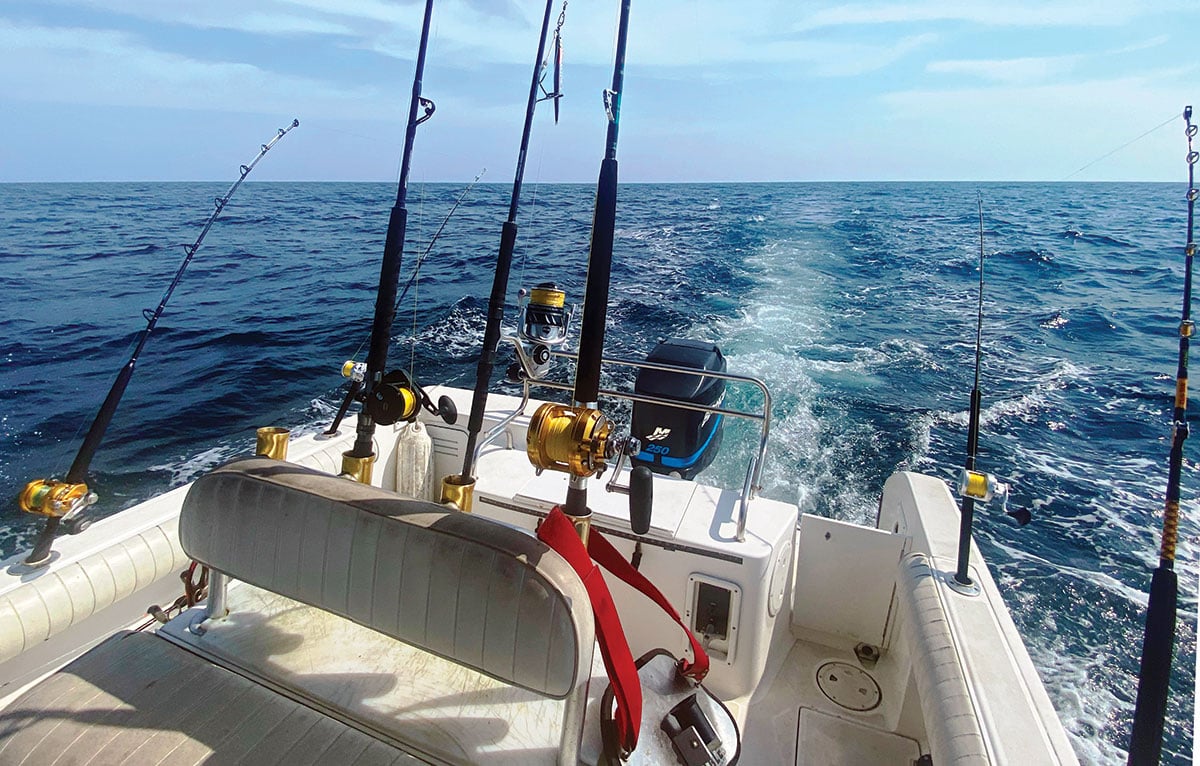
As the name implies, trolling and gunning combines a traditional trolling spread with the ability to immediately cast at surface-feeding fish. After experimenting with this approach over the past few years, I’ve developed a system that works extremely well with the layout of my EdgeWater 228 CC. I never use outriggers and rarely experience a tangle, even when making relatively sharp turns.
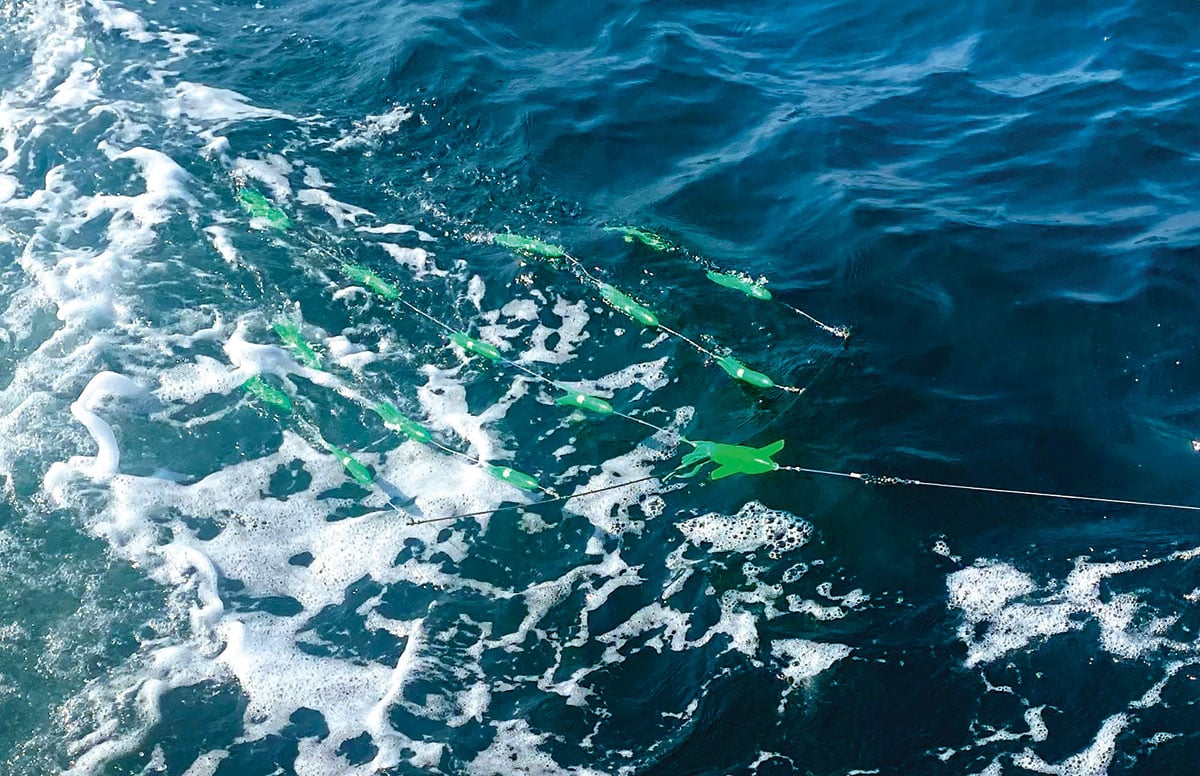
The key ingredient is the Sterling Wide Tracker or ChatterLures squid bar. I’ll deploy 36-inch bars on calm days and switch to smaller 18-inch bars in rough conditions to maintain a consistent flight pattern. Their molded construction withstands repeated tuna strikes, and the wide-tracking action positions the bars outside the wake where passing tuna have a clear view.
I’ve gravitated toward 6-inch bulb squid varieties because they best match the typical inshore forage off eastern Long Island’s South Shore. Foam inserts inside the hollow squids keep them floating when I slow the boat and reduce the chance of the bars flipping over and digging in when I get back on the throttles. I troll one Wide Tracker directly from each amidships gunwale rodholder, usually choosing darker colors such as purple or dark green on overcast days and green/yellow, zucchini or rainbow patterns under brighter skies.
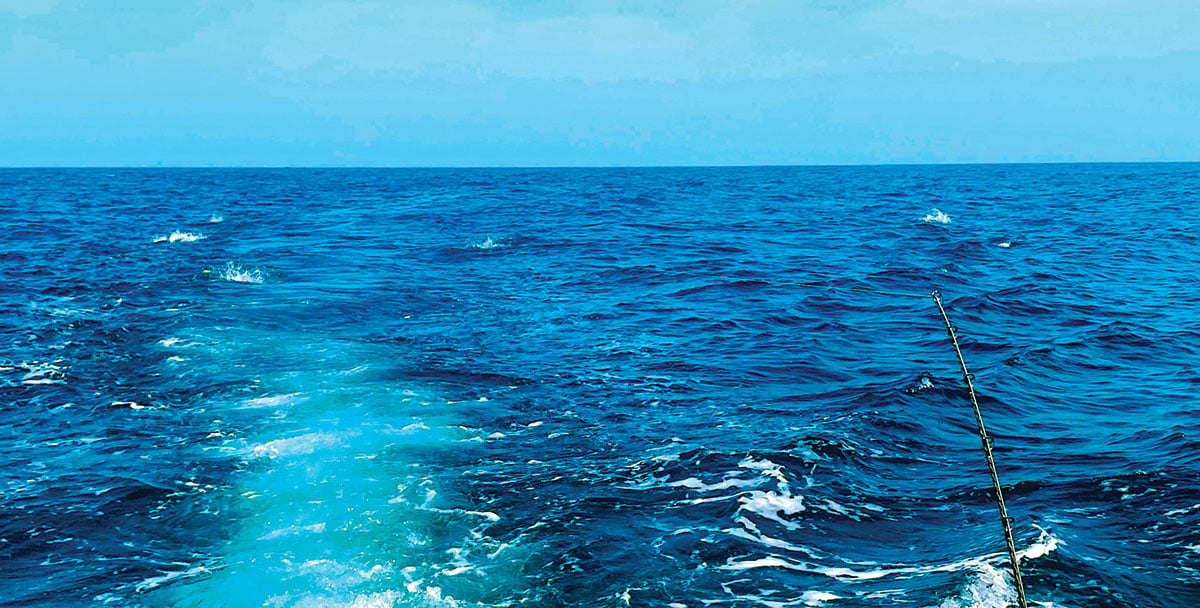
A second pair of smaller, straight-running 18-inch squid bars is deployed from the aft gunwale rodholders and positioned around the third and fourth waves. The fifth lure is a large Yo-Zuri trolling bird combined with either a Green Machine-style Psychobead lure or a daisy chain of bulb squids. This “Lone Ranger” rides 100 to 150 yards behind the boat.
The Five-Rod Spread
My records show that the Lone Ranger accounts for approximately 45% of the strikes in this spread, while the two side-tracking bars produce roughly 50%. That leaves the short straight runners with only about 5% of the actual bites, but that doesn’t mean they aren’t important.
Those short bars create surface commotion and help draw predators toward the boat. Think of it like a lineman blocking for a running back. The back scores the touchdown and gets the glory, but the play might never happen without the lineman making the block. In my five-rod pattern, the short squid bars make the noise and create the illusion, while the Wide Trackers and Lone Ranger are positioned in clearer water where tuna can easily attack them.
The real advantage becomes obvious when we encounter tuna feeding on the surface or intercept the leading edge of a porpoise pod. Tuna frequently travel beneath porpoises, so I’ll reduce the boat to minimum forward headway – roughly 1 to 2 knots – and give the anglers stationed in the bow a chance to cast poppers or stickbaits.
If nothing happens within about 30 seconds, I bring the boat back up to trolling speed and let the five-lure spread pass through the area. Then we rinse and repeat until we either hook up or lose the school and begin searching for another pod.
When a bow angler hooks a tuna on a popper, I keep the boat moving at approximately half speed while the crew retrieves and racks the four closest squid bars. This quickly clears the cockpit and gives the angler room to fight the fish. If the tuna is under control and I don’t need to make radical maneuvers, tight circles or back down to avoid a breakoff, I’ll often leave the Lone Ranger in the water. That long bait can get a strike when you least expect it. However, if we’re battling a tuna of 100 pounds or more on the popping rod, I’ll usually have someone retrieve the long bird and completely clear the spread.
Making The Transition
The key to making a smooth transition from trolling to casting and then fighting a fish is having plenty of open vertical rod storage in the T-top, tower legs or leaning post. Leaving unused rods in the gunwale holders creates unnecessary obstacles when an angler needs to move around the boat. A successful trolling-and-gunning setup should allow you to transform the cockpit from a trolling spread to an open fighting area in seconds. Tuna situations develop quickly, and anything that slows the process can cost you a fish.
Trolling and gunning isn’t a one-dimensional concept. There are several variations that can be deployed depending on sea conditions, bait, fish behavior and the skill level of the crew. One approach works especially well when making repeated 300- to 600-yard drifts over known tuna grounds where whales and porpoises are working concentrated bait balls of squid, whiting or sand eels.
Instead of deploying squid bars, I’ll bump the boat in and out of gear while trolling a pair of RonZ, NLBN, Savage or Hogy sand eel-style jigs near the bottom or through the mid-depths. At the same time, one or two anglers remain stationed in the bow with poppers, sliders or stickbaits, ready to cast at anything that appears on the surface.
One or two additional anglers work the aft cockpit and tend the trolled sand eel lures. If one gets hit, they’re ready to react. If the anglers in the bow suddenly need to make a cast at breaking fish, the aft crew can quickly retrieve their lures and get them out of the way.
This system keeps several options available without turning the cockpit into chaos. You’re covering the depths while still being prepared for a school that suddenly erupts on top.
Sweeping The Wake
Another variation is a relatively high-speed search pattern at approximately 5 to 8 knots while two anglers work lead-head sand eel soft plastics from either side of the aft cockpit. Rather than simply dragging the lures behind the boat, the anglers use a sweeping or rowing motion similar to trolling wire line for stripers with parachute jigs.
This can be done with spinning or conventional jigging outfits using rods from roughly 5-1/2 to 7-1/2 feet long. Sweep the rod sideways from aft to forward, hold it there for a second or two, and then quickly drop it back to the starting position. When the line suddenly goes slack, the sand eel jig darts erratically through the wash.
Keeping the rod tip low helps the weighted jig head stay beneath the surface, where trailing tuna get a good look at it. Unlike traditional trolling, where a lure maintains a relatively steady speed and direction, the angler’s movements make the bait accelerate, stop and dart from side to side. It creates a more natural, lifelike presentation.
One of my favorite combinations for this technique is a 3-ounce NLBN jig head with a 4X hook matched to a 10-inch RonZ eel tail. The three-twist locking mechanism on the jighead keeps the soft plastic securely attached, even at higher trolling speeds, while the long tail creates plenty of action in the boat’s lure channel.
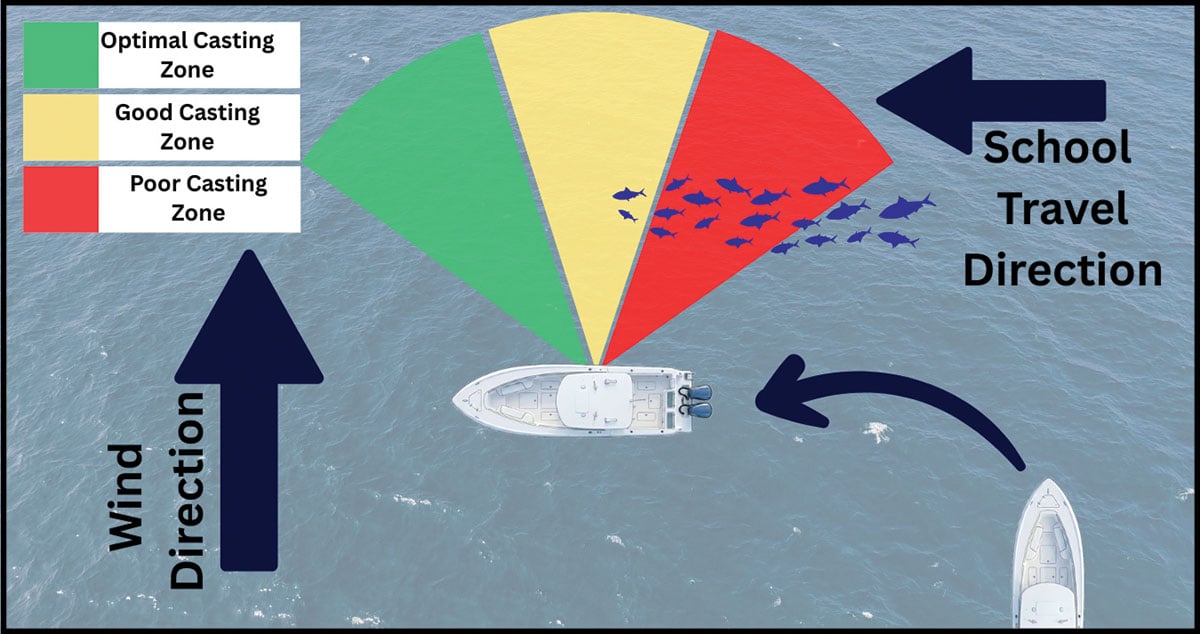
When gunning for tuna, the crew needs to resist the temptation to charge directly into the middle of breaking fish. The better approach is usually to sneak toward the feeding zone and cast topwaters or heavy soft plastics around the perimeter of the action.
Work the lure with purpose. A fast or medium-speed retrieve mixed with sudden pauses can trigger reaction strikes from competitive fish. Whenever possible, position the boat upwind of active slicks, bait concentrations or marks on the fishfinder and allow the vessel to drift naturally toward the action.
Vertical jigs and weighted soft plastics can also be dropped through active sections of the water column. Pay particular attention as the lure falls because tuna frequently strike on the drop. If the line suddenly stops, jumps or produces an unexpected tap, close the bail or engage the reel and come tight immediately.
Signs Of Success
Keeping multiple rods ready for different situations is what makes the hybrid approach so effective. One minute you might be trolling at 7 knots, the next you’re throwing a popper at busting fish, and seconds later you could be dropping a jig to tuna marked 100 feet below the boat.
Success ultimately comes down to locating life. Diving birds, feeding petrels, whales, porpoises, surface boils, jumping fish, flying fish and tight bait pods being pushed toward the surface are all obvious indicators. A large fleet concentrated in a relatively small area can also tell you that something worthwhile is happening.
Your electronics fill in the pieces that you can’t see from the helm. The sounder might reveal bait pinned to the bottom, tuna crushing sand eels, squid or whiting, or predators cruising just above or below the thermocline. Sometimes the ocean appears quiet on top while an entirely different scene is unfolding underneath.
Once you find what you’re looking for, maneuver quietly. Whenever possible, approach from upwind and stay along the outside edge of the activity. Charging full throttle through the middle of a feeding school is one of the quickest ways to put the fish down—and won’t earn you many friends among the other boats working the area.
The biggest advantage of trolling and gunning is that you don’t have to decide how the tuna are going to behave before you leave the dock. You’re prepared to troll until you find them, cast when they come up, jig when they sound and immediately adjust as conditions change.
Tuna fishing is rarely predictable, and the crews that can transition smoothly from one technique to another are often the ones that put the most fish in the boat.