It’s the toughest days that teach us the most valuable lessons.
The day began with a beautiful Cape Cod sunrise, and the unmistakable sound of a boat pounding through the chop. As we worked our way south toward Monomoy point, the horizon glowed in shades of orange and pink, while the first rays of sunlight illuminated the water. It was one of those mornings that reminds you why you get out of bed long before dawn. The ocean looked alive, and there was every reason to believe that we would encounter feeding false albacore.
Understanding The Fever
What I did not realize at the time was that the day would ultimately become a lesson in persistence, patience, and what many of us refer to as “albie fever.” Anyone who has spent time chasing false albacore understands the term. Albies have a unique ability to turn a perfectly rational fisherman into a ‘crazed optimist’. No matter how many miles you’ve already run, how many empty casts you’ve made, or how many times you’ve arrived – seconds late – to a surface feed, there is always the belief that the next flock of working birds, the next bait ball, or the next blind cast could completely change the day. That optimism is what kept us moving, but it is also what created the emotional roller coaster that accompanies a typical day of albie fishing.
Our plan from the outset was simple: cover water until we found fish. In reality, that meant covering water until the birds found fish for us. Throughout the day our eyes rarely rested on the water immediately in front of the boat. Instead, they swept the horizon, searching for the white flashes of terns dipping toward the surface or gulls circling with purpose. Every flock demanded investigation because birds often provide the first clue that predators have pushed bait to the surface. The challenge was figuring out which birds had found baitfish with albies on them.
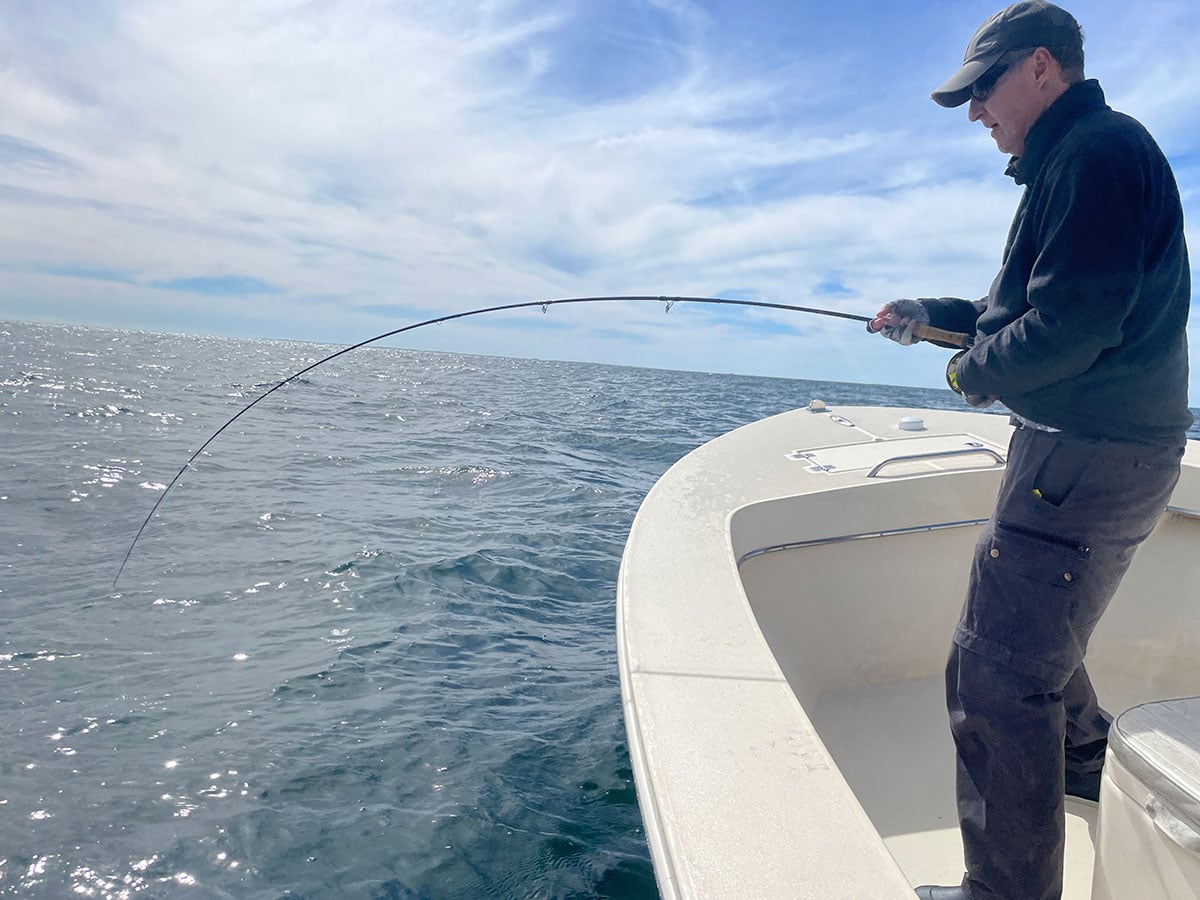
Reports had been scattered, and the fish appeared to be spread across a vast stretch of water extending along the south shore of Cape Cod from Martha’s Vineyard to Monomoy. Anyone familiar with that area knows that searching it effectively requires mobility under favorable conditions. On this particular day, however, mobility came at a price. A persistent chop and bumpy seas turned every relocation into a physically-demanding exercise, and by the time the day was over, we would have covered a tremendous amount of water, while absorbing more than our fair share of punishment from the waves.
Scanning For Hope
Ironically, finding life in the water was never the problem. Bay anchovies seemed to be everywhere, and nearly every area we investigated contained bait, often in impressive quantities. Throughout the morning we repeatedly spotted birds diving over nervous water, and every new flock raised our hopes. We would race toward the activity, and begin planning our approach making sure we did not shut down the feed, convinced that this might finally be the feed we had been searching for.
More often than not, however, the birds led us to bluefish. Schools of small blues relentlessly harassed the anchovies, creating surface feeds that, from a distance, looked similar to albie blitzes. Occasionally, larger chopper blues joined the action, making it even more difficult to tell what we were looking at until we were close to the feed. They also carried a cost. Throughout the day, we replaced frayed leaders and lost flies, retied damaged flies, and checked dulled hooks. None of these interruptions was significant by itself, but strung together, they became another reminder that we were expending tremendous effort without getting any closer to the fish we were trying to find.
Early in the morning, we did encounter a few small groups of albies in the Osterville area. Those brief sightings confirmed they were present, but they behaved exactly as false albacore often do. They erupted beneath a handful of excited birds, pushed bait to the surface for only a few moments, and disappeared before we could get into position. We had a couple of legitimate opportunities but never connected, and each near miss only reinforced the feeling that we were at least one step behind.
Colorful Language
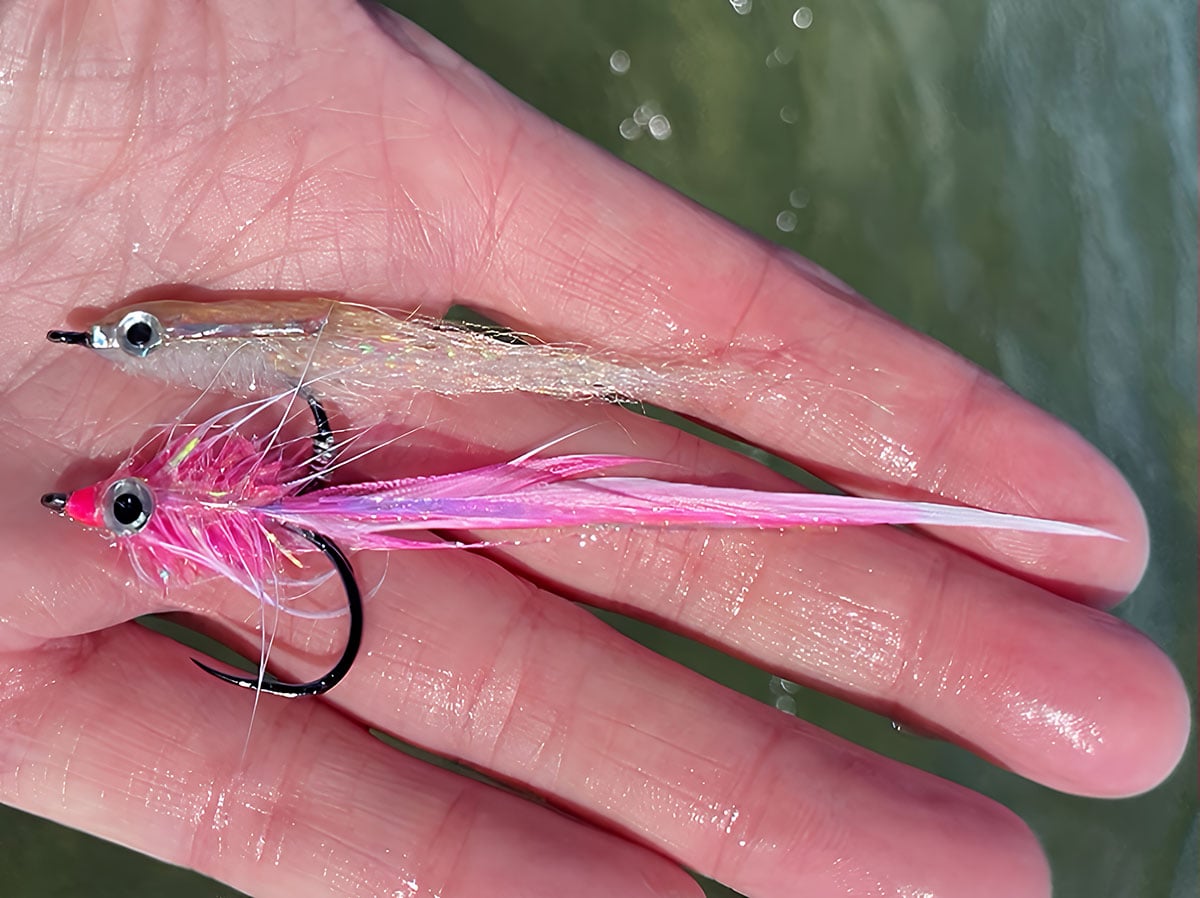
Like most albie fishermen, we experimented with a variety of presentations throughout the day. With bay anchovies present in the water, one idea was to match the hatch as closely as possible—a small, sparsely-dressed fly that matched the baitfish. The alternative was an attractor pattern that stood out. As the day wore on, we gained confidence in the latter. Our fly of choice became a larger, bright pink attractor pattern that, at first glance, seemed completely out of place among millions of tiny anchovies. Instead of blending into a sea of baitfish, the bright pink fly gave predators a distinct target to key in on. Whatever the reason, it consistently drew strikes, and by late afternoon, it was the pattern to be used whenever a genuine opportunity presented itself.
As the hours passed, that pattern continued. Conversation aboard the boat gradually gave way to silence as each of us scanned the horizon. Every distant flock of birds offered renewed optimism. Every course change carried the possibility that this would be the stop where everything came together. More often than not, another school of bluefish greeted us instead.
Last Ditch Effort
| THE ATTRACTOR FACTOR |
| There are two schools of thought when it comes to targeting albies (or really any charged up school of predatory gamefish) you can try to match the proverbial hatch or you can try to stand out from the millions of real baitfish in the school. The hard part is, that both approaches work… some of the time. This is why fly boxes and tackle bags contain such an array of colors: sometimes you really do need something specific. Most albie hunters would say you need to have silver, olive, gray, brown and iridescent offerings to cover the days when realism is key. Most of those same anglers would refuse to leave the house without bright pink, chartreuse, electric chicken and metallic bright green, for those times when standing out takes the win. There is a third option that covers all the bases, solid white stands out, while also being the one color that’s present in nearly every baitfish that swims in the ocean… but even white is sometimes shunned by the highly-particular false albacore. The only answer is to be prepared for everything by packing a diverse selection of both natural and bright colors in an array of sizes to match various fall run baits.
–D. Anderson |
By mid-afternoon, the rough seas, long runs, constant gear repairs, and seemingly endless cycle of hope followed by disappointment, had begun to wear on everyone aboard. At that point it would have been easy to conclude that the day simply wasn’t meant to happen. Logic suggested it was time to point the bow toward home, but logic rarely wins once albie fever takes hold. Instead, in the 11th hour, we made one final move toward the outside of the Monomoy North Cut. At the time, it felt like one more stop among many, but looking back it became the turning point of the trip.
As we approached the area, there was an immediate sense that conditions were different. A more substantial flock of birds was working with purpose over a relatively small area, repeatedly diving instead of merely circling. After an entire day of chasing scattered bird activity, this looked slightly different. The birds stayed over the bait instead of drifting away, suggesting predators were holding the bait near the surface. Before long, feeding albies were spotted along the outside of the cut. Unlike the brief encounters experienced earlier, these fish remained in the area long enough to provide high-quality opportunities. For the first time all day, it felt like we were targeting fish instead of chasing them.
Within roughly 45 minutes we had a few quality shots at actively feeding fish, and after spending nearly an entire day searching, that alone felt like a victory. The mood aboard the boat was now different. Fatigue gave way to focus, and frustration was replaced by anticipation.
Success!
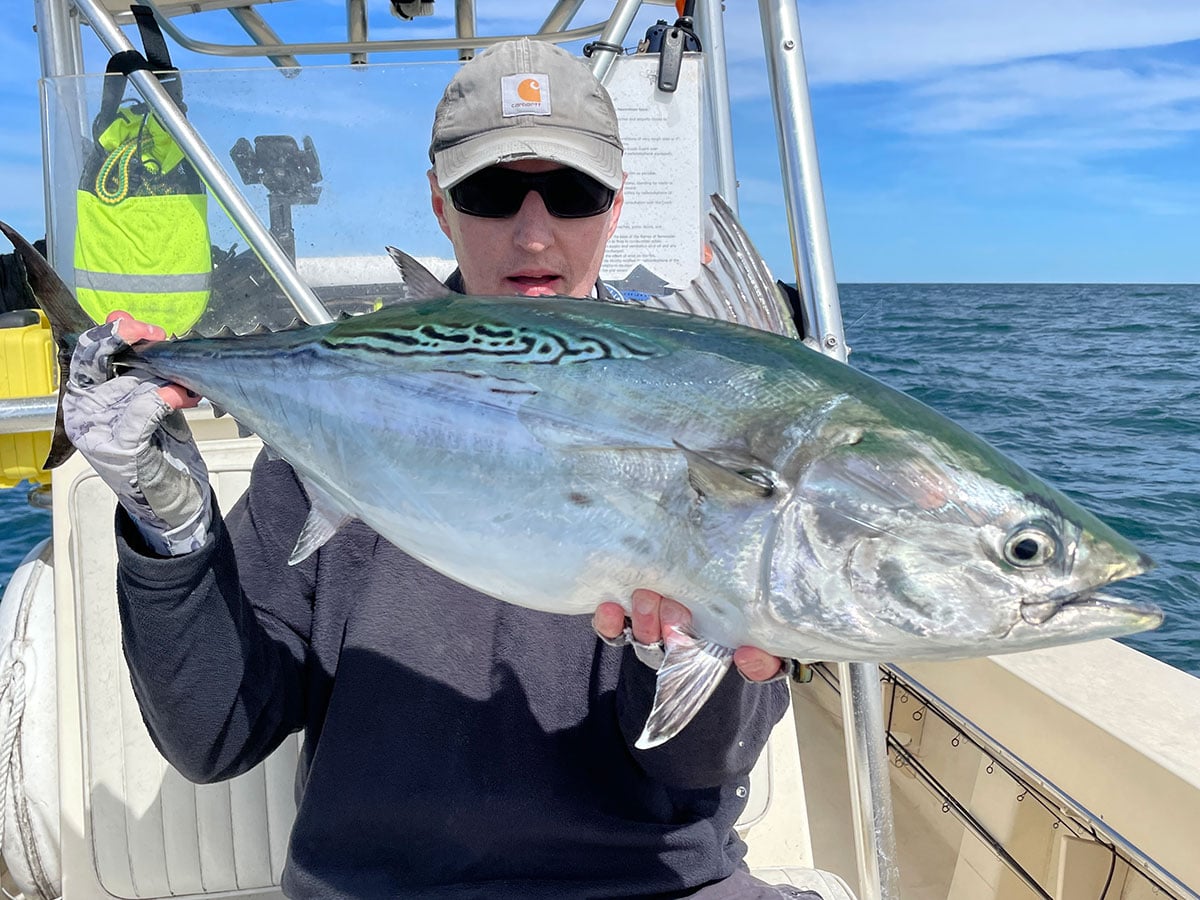
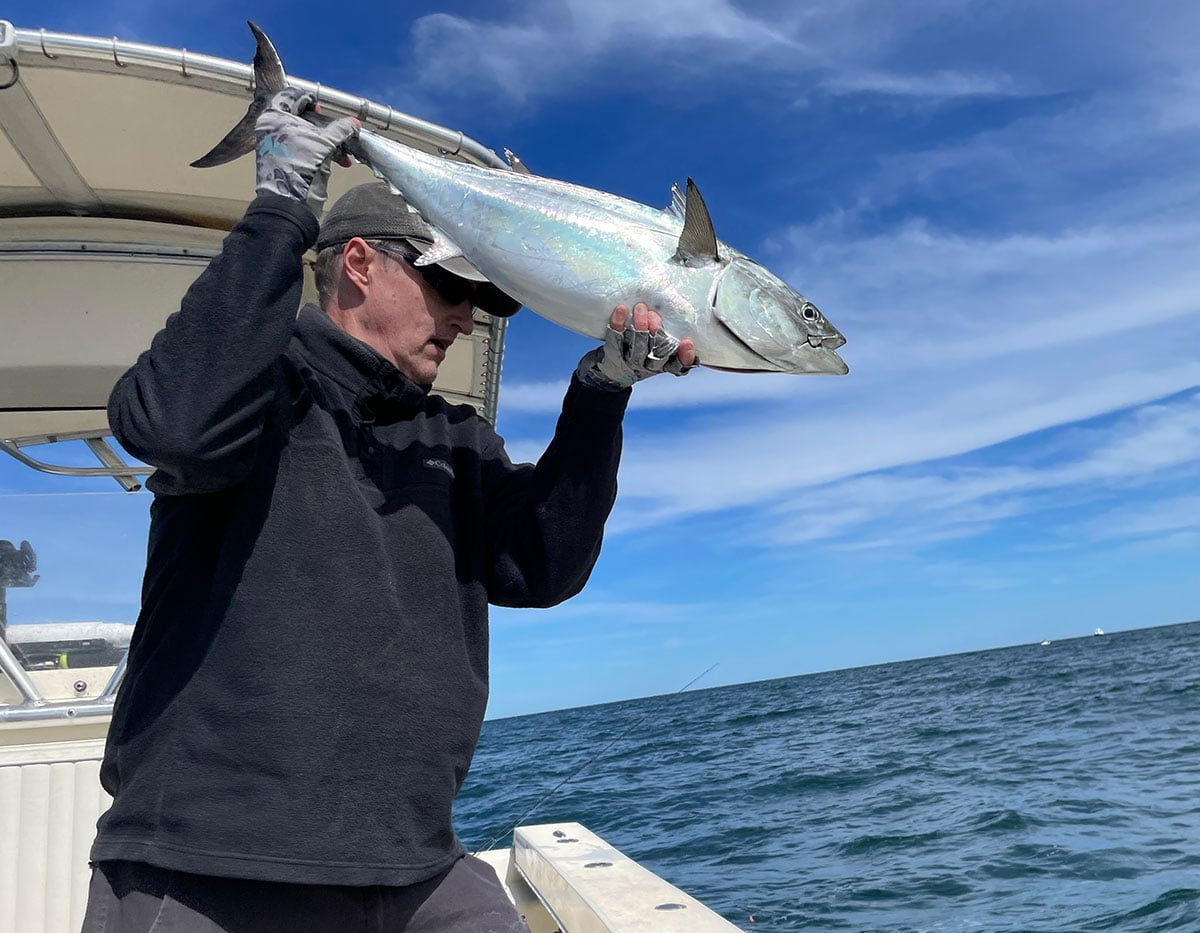
With the bright pink attractor pattern tied on, I cast and positioned the fly ahead of a group of moving fish. The take was lightning-fast and the line went 20 to 30 yards sideways in an instant. Shortly thereafter, the albie was racing away from the boat, peeling line from the reel in a long, blistering run. Every time I thought I had begun to gain the upper hand, it found another gear and surged off again. Nearly 15 minutes later, the runs finally shortened, the circles beneath the boat tightened, and flashes of silver became visible below the surface. Moments later we were able to grab her by the tail. She measured 31 inches, my personal best!
| WHY FLY FISH FOR ALBIES? |
| Over the years, I’ve invested an enormous amount of time and effort into becoming a better fly angler, and targeting false albacore has become one of the best ways to refine my skills. Every encounter demands accurate casting, presentation, line control, and fish reading, and each missed opportunity often reveals something that can be improved. That’s why I keep coming back. For me, the reward of fooling an albie on a fly is the greatest because each fish feels truly earned. Chasing albies isn’t just about catching fish – it’s about constantly refining my fly game, one opportunity at a time. |
Looking back, luck certainly played a part. We happened to intercept a body of actively feeding fish in the 11th hour, but luck alone doesn’t explain the outcome. We had covered miles of water, chased countless flocks of birds, endured rough seas, repaired tackle over and over, and refused to quit when it would have been easy to call it a day. Success in albie fishing almost always requires both persistence and good fortune, and on this particular day, we benefited from the combination of the two.
In the end, one fish changed the entire narrative. That personal-best false albacore made every mile, every cast, every wave, and every moment of “albie fever” worthwhile—which is exactly why so many of us find ourselves chasing birds across the horizon and believing that the next stop might be the one!