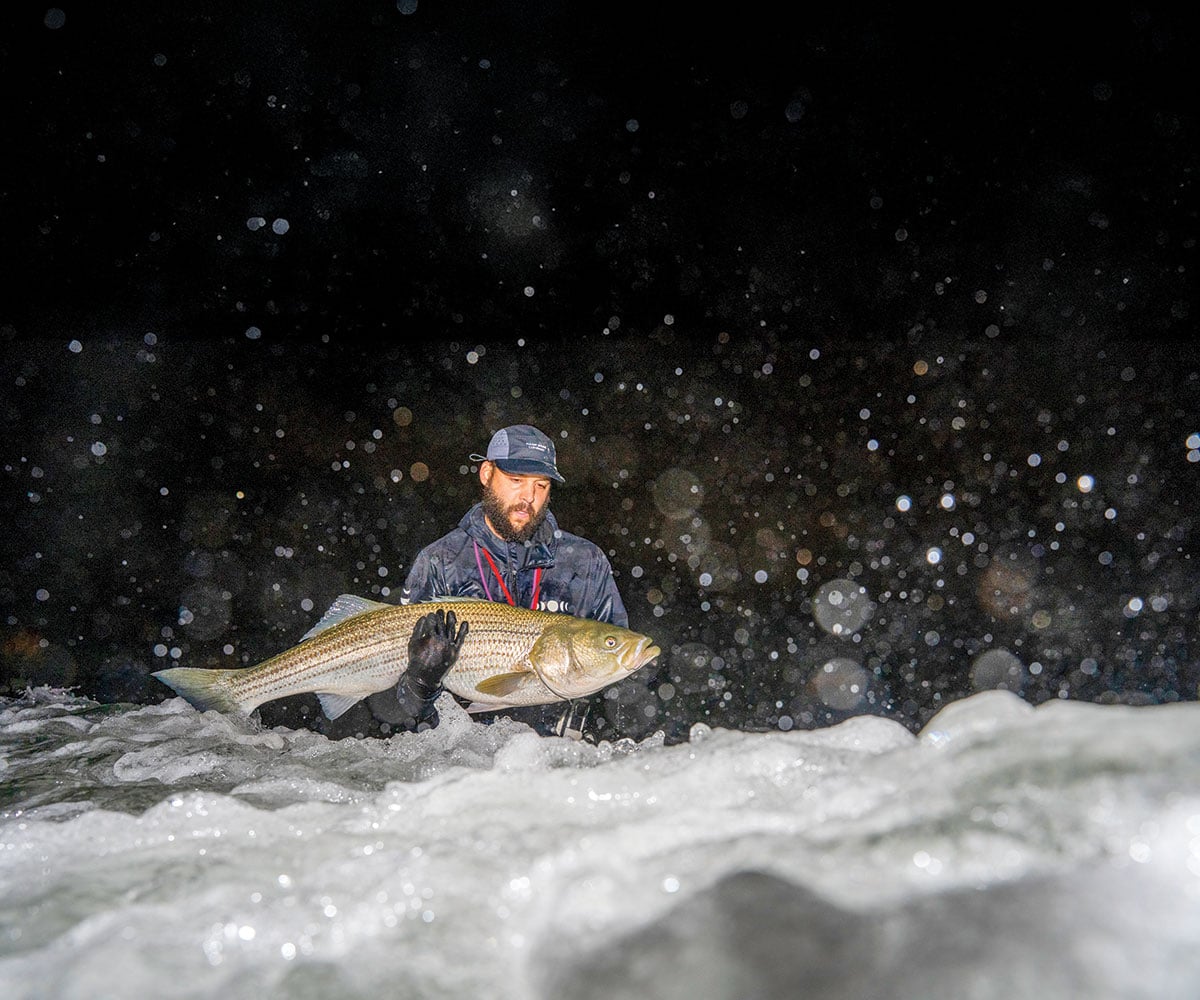
Photos by Jerry Audet
When fall stripers get tight, surfcasters need to loosen up and adapt!
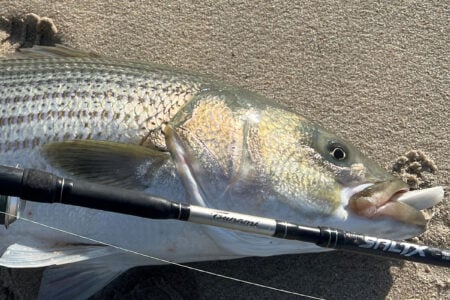
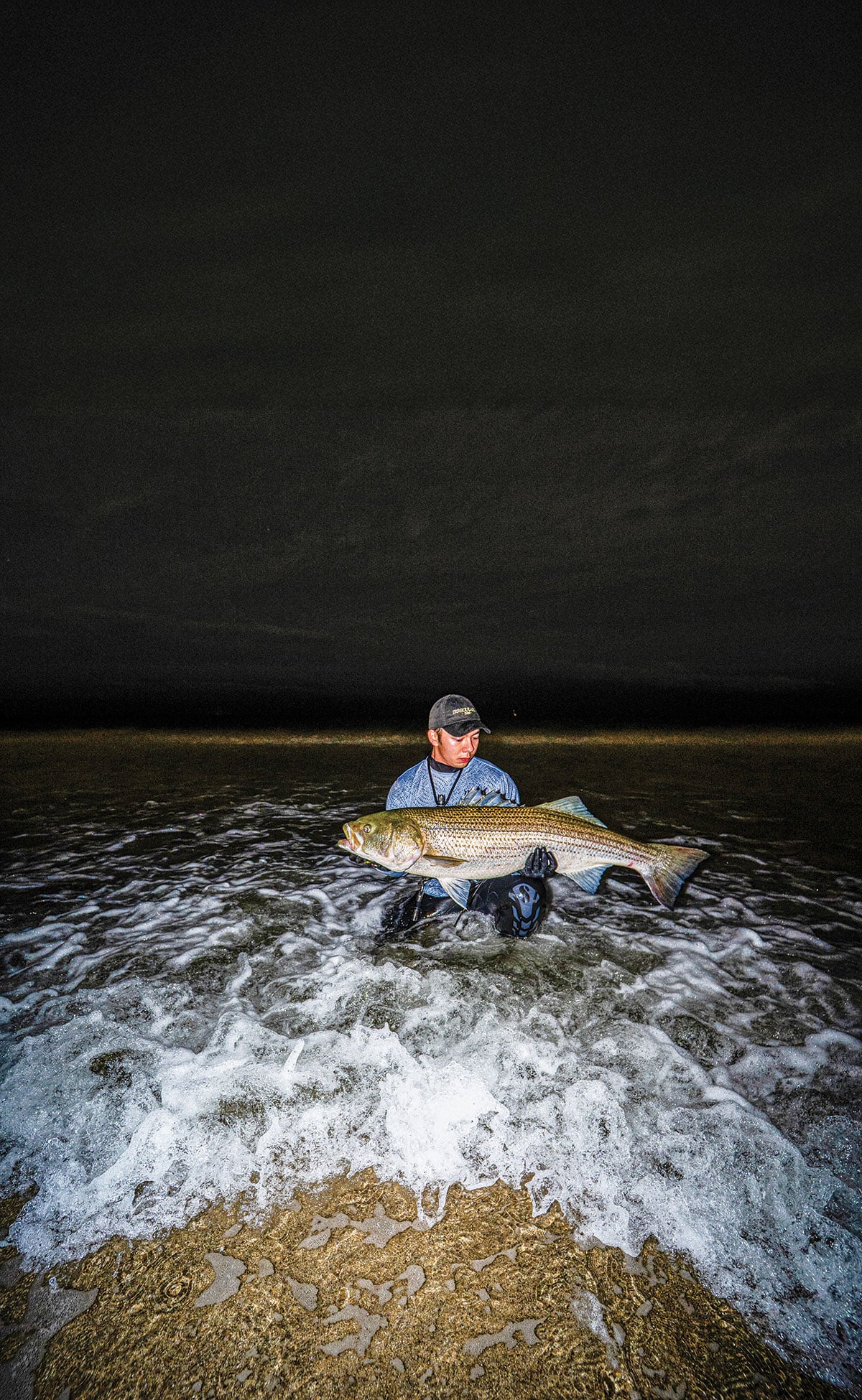
Striped bass are the dauntless villains of the shallows. There is no water too skinny for morone saxatilis, unless it’s dry ground. I have seen stripers slide into water so shallow their eyes were above the surface, and they had to lay on their sides to propel themselves, where they stayed and fed for hours.
I once watched – wild-eyed and with a pounding heart – as a half-dozen trophy-sized fish poured through a boulder field, nonplussed, tails and backs fully breaking the surface as their bellies dragged bottom in pursuit of a small pod of bunker. This is hardly a unique experience, and I’ve heard many-a-tale from striper anglers of all types about “this or that time” a striper took a seemingly suicidal risk, pursuing prey into water only inches deep.
In the fall, these occurrences seem to peak. Bait is moving out front for the first time, and it’s hugging the shore as it mills around waiting to make an epic migrational move. It’s a time of surprises, when striper norms can be supplanted by bizarre, ludicrous behaviors. The fish simply seem to go mad. Charging into the shin-bone shallows seems to be part of that fall psychosis.
This is, on its face, a great thing. Reaching fish with bait, plug, or fly is the blatantly most essential component of fishing, and if they’re close, all the challenges and compromises of plunking something in front of them evaporates. Hell, there are times in the fall where I could underhand a balled up dry sock to the fish. Yet, as so many of us can attest, when the fish get in really tight, it can result in some of the most intensely frustrating fishing of the season. There are numerous reasons for this – from pattern lock to extreme wariness – but I am going to address what I believe is the heaviest lift: proper plug presentation.
When the fish slide up on the slope or plunge into the shallows, swimming and controlling a lure in a precise manner can be the toughest part of leveraging the gift of stripers in the kiddie end of the pool.
Don’t Half-Cast
In fishing, presentation of your lure, bait, or fly is paramount to everything else. The way the lure moves, where it’s moving from, and where it’s headed, are the most important factors in catching large fish across virtually every species, and in striper fishing, it’s so critical, a very large encyclopedia of presentations could (and maybe should) be written. I am an apostle of the study of how each plug, or fly, behaves in each one of my spots, under every condition imaginable. And since the list of both plugs and spots is ever growing, I am confident this monomania will persist for the rest of my life. I’ll never completely check every box.
Keeping this construct in mind – that presentation is everything – I implore you to not default to the short cast if you think fish are close. I have seen uninitiated and more experienced anglers alike – mostly on sand beaches – resort to lobs and snubs to keep their plugs close when the fish were tight. This can work, and does save a miniscule amount of time and energy, but in my experience it’s typically relegated to a daytime blitz method.
When I’m fishing the night tides, or even over small pods of fish cruising during the day, I have consistently and rigorously observed that fish do not respond the same to a quarter-cast as they do a three-quarters or full cast. I’ve stood next to anglers who are essentially flipping and pitching their lures to fish that we absolutely know are just a few rod lengths from our feet, and they blank or catch a few fish as I consistently run up my release count with longer casts.
It’s not universal (nothing in the surf is), but I adamantly argue the danger with a quarter cast is you are not swimming the plug into the strike zone in a natural manner. Your presentation is probably wonky, and that’s the likely culprit. The way the plug moves into and through the shallows often needs a bit of a “ramp.” It has to move into the zone, not just appear in it. This will help it get in the right zone of the water column, and swimming properly. I find it difficult to get it jiving naturally without giving it time and distance to settle down.
I believe another issue specifically related to the quarter cast is that the lure drops into the environment like it just suddenly appeared out of a vacuum. Those stripers that are milling around close to your position are already going to be on slightly higher alert. Even if they’re hitting like a splitting maul through pine, they are still likely to have their defenses up and sensory arrays on overdrive. There are many situations where stripers can be fussy, but when they’re at the edge of the beach or shallow in the rocks, their threshold for rejection just seems to be higher. Start your lure further out and let its vibrational pattern build more slowly in their awareness as it enters the killing field.

Back Up, You Barnacle!
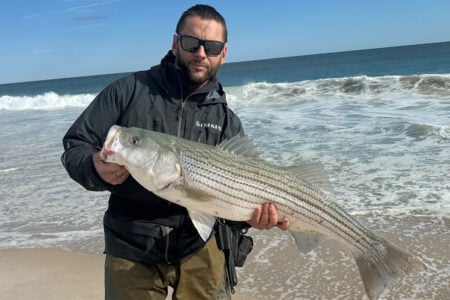
Another way to attenuate any unnatural action or presentation of your lure is to simply move. First, I’ll give credit to Tony Stzeko who impressed on me the importance of just standing further back. Tony virtually always stood 30-or-so feet away from the edge of water on the beaches of Cape Cod. I now regularly do the same, and always take my first handful of casts 30 feet or more from the breaking waves even if I’m later compelled to move forward to eek-out some distance. I’m sure it was the same for Tony, but I do this simply because it maintains my plugs presentation through nearly the entirety of the cast. This primarily boils down to line angle and the physics you’re fighting when you’re in the surf; but it can really matter in a boat too, if you’re too tight to the fish or they’re down deep.
As the lure gets closer to you, the line angle changes. Unless you’re willing to point your rod directly at the lure (and I highly advise you do not) that angle gets more acute (steeper). As this happens your retrieve applies more and more lift to the plug. If the fish are in the suds or first set of rocks and you’re only a dozen feet from them, your plug is going to be rising in the water column by that point, and likely very near the surface as it reaches them. This might not be a bad thing, it might even be the most natural presentation on some nights. However, in my experience, that is the exception, not the rule. Instead, I’m trying to keep my tasty treat of a plug swimming as consistently as possible from splashdown, until it’s bumping into the pitch of the beach or banging through cobble.
Keeping the line angle obtuse- keeping the line from rod tip to lure gradual- is therefore the goal, decreasing lift and giving me more leeway and control over depth and retrieve speed. The simplest way to accomplish this is often to just back up, and make a full cast.
You may have heard this concept before for sand beaches, but it’s rarely discussed for other types of structure: (here’s looking at you, back-bay fishermen). I can’t cover every situation, but I will highlight one that is near and dear to my heart: boulder fields. Anglers fall in love with “their rock”, and become barnacles; fishing from the same footprints every night. The problem is, pattern repetition can breed complacency. If stripers are scarfing bait close to the rocks, which is profoundly common in the early fall, you have to bail out. You just have to move to another position that allows you to present cleanly. Sometimes you can move straight back, and you’ll have to search out a lane that allows it, you may even have to scout in daylight. Being prepared is never being surprised. Hey, jetty anglers; are you taking this all in?
It’s A Lateral Move
One piece of advice that I have read over and over is to cast down the length of the beach or structure when fish are at the lip. This can work, and at times it’s extremely effective, and I teach it in my seminars. When fish have some type of baitfish corralled against the shore, it can be the only way to get them to hit: it’s the right presentation. It’s as simple as that, really. Lock into the right profile, and full-send it down the edge (sand, boulders, rock pile, etc.).
A word to the wise, however: this doesn’t have to mean that the fish are blitzing on a school of boiling peanuts. Fish can be oriented nose-in because there’s something in the shallows they’re interested in, but stay static and in a neutral behavior. You may never know they’re there unless you give it a try. I always give it a whirl in the fall specifically.
Now, I must offer a stark disclaimer: a lateral cast assumes the only thing the fish are looking at is active bait swimming in the (relatively) most dangerous, most violent, slice of the surf. You’re offering them something pretty specific; you’re moving that artificial bait in one linear direction (directly back to you along the edge) and your margin for speed and water column penetration is limited. Even if you’re in the rocks in a wetsuit and some number of yards out, I still believe deeply that drifting and swinging that plug through the tight-zone the fish are locked into is far and away a better tactic than a lateral cast dragged directly along the edge.
I have also found that the plugs that are effective in a tight, parallel cast are more limited; you’re trying to simultaneously not skim the surface, while also not dragging the bottom. So then, my advice remains: back up or change positions. It’s probably going to be more effective than the lateral cast in many situations. It simply offers you the opportunity to swing your plug, lift and lower it in the column, let it settle and start to swim naturally, and work more actively with speed in a way you can’t if you’re casting it at long angles down the shore, the edge of a reef, or the margins of a drop-off. On the shore in waders? Don’t just back up, but walk further away from the fish, and cast at an angle that lets the waves push the lure into that zone.
Bring The Heavy
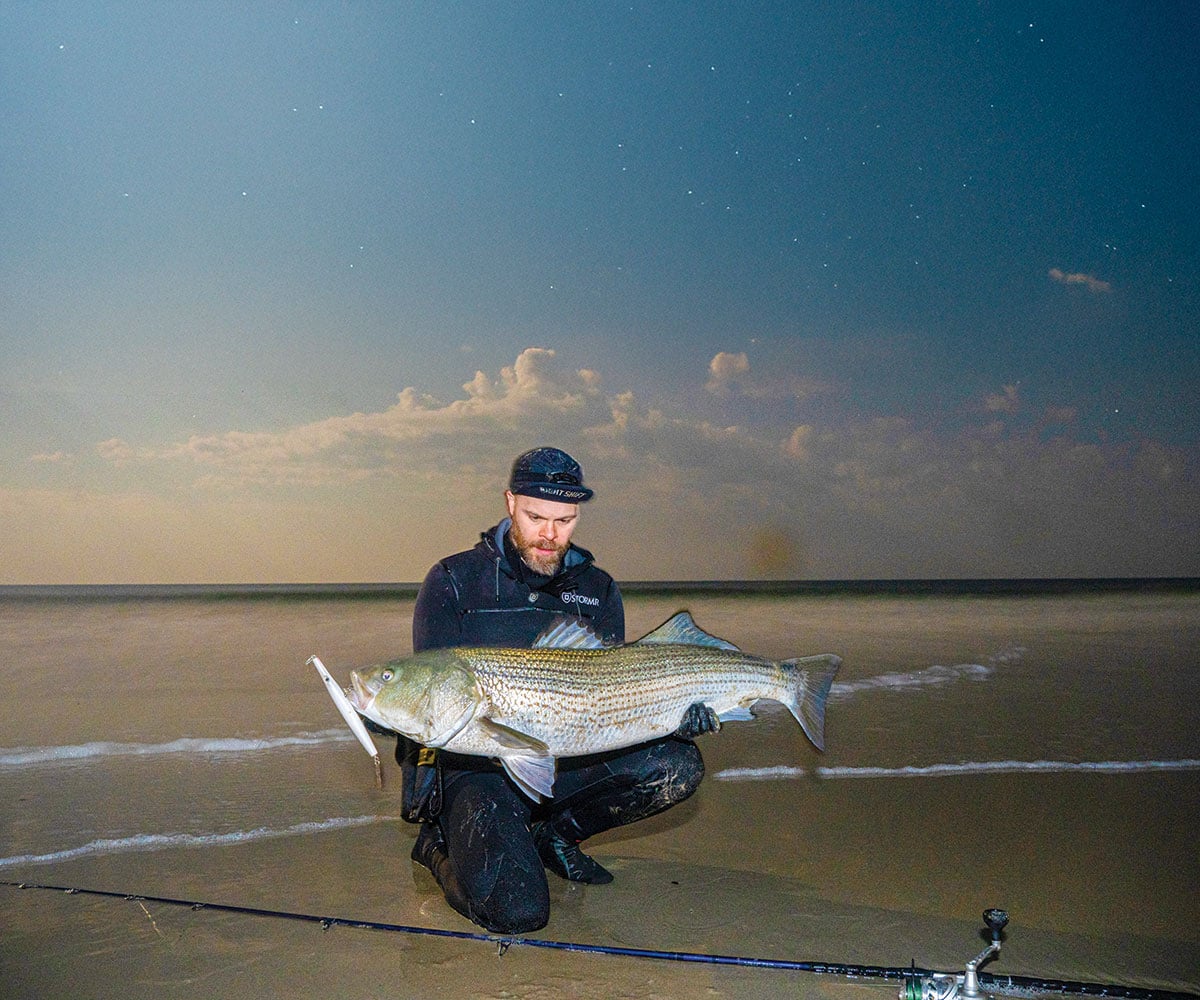
Yet there are times you’re just limited in your ability to do any of this. You’re just stuck trying to present a lure to these fish that are nearly at your feet, no lateral cast possible, you can’t back up, there’s nowhere else to stand. Perhaps the fish are locked into a very small area you can’t access in any other way. This can be tough! I’m inherently careful to suggest I’m the originator of any idea, but I’ve yet to see someone suggesting using a heavier lure tighter to the beach, when the fish are feeding in close. It’s almost always the opposite: if the fish are tight, go lighter to keep it off the bottom is the general advice. The problem with this approach, as you have probably guessed, is when you go lighter, the lure will naturally rise towards the surface. Add in the very acute line angle that naturally occurs as the lure approaches your position, and you’re fighting to just keep the lure off the surface, let alone keep it in the compressed strike zone mid-column or near the bottom.
If you’re stuck in cement boots, I’ve found that keeping the lure working correctly when you just have no other option is much easier with a faster sinking lure. I’m mostly speaking of bucktails, soft plastics on a jighead, needles, gliders and swimbaits; lures without a lip that sink, but this also applies to lures that will dig harder. That is, hypothetically you might typically use a darter, but your only option now might be a Donny metal lip, simply to keep it down when it’s 20 feet off the rod tip.
If I suspect going heavier is going to be required, I will partially break one of my rules: I won’t cast too far out. I still won’t quarter-cast, but I might half-cast. A full cast would likely just mean going faster to keep it off the bottom until I reach the point where the intersection of surf (e.g. waves, undertow, current, etc.) and line angle lift it enough I can slow down- so it’s just wasted time and energy.
The rule I will not break, however, is changing my speed. If I suspect the fish are reacting to a typical slower, natural presentation I’m not going to go heavy enough that that has to change. It’s a bit of a proverbial tightrope wire to walk, and finding the right weight that “holds” but doesn’t drag can be tricky. The easiest way to address this is just skipping plugs and instead using a combination of soft plastics and jigs. This allows you to dial in the presentation at quarter-ounce intervals if needed; though I can never recall a time I had to drill down to that granularity.
Half-ounce changes have always been sufficient, particularly if paired with changes in size, bulk, or body shape; like going from a 9-inch Slug-Go to a 9-inch Big Water Baits Bag Man, both on half-ounce heads, to a sparse half-ounce bucktail with a #70 Uncle Josh trailer.