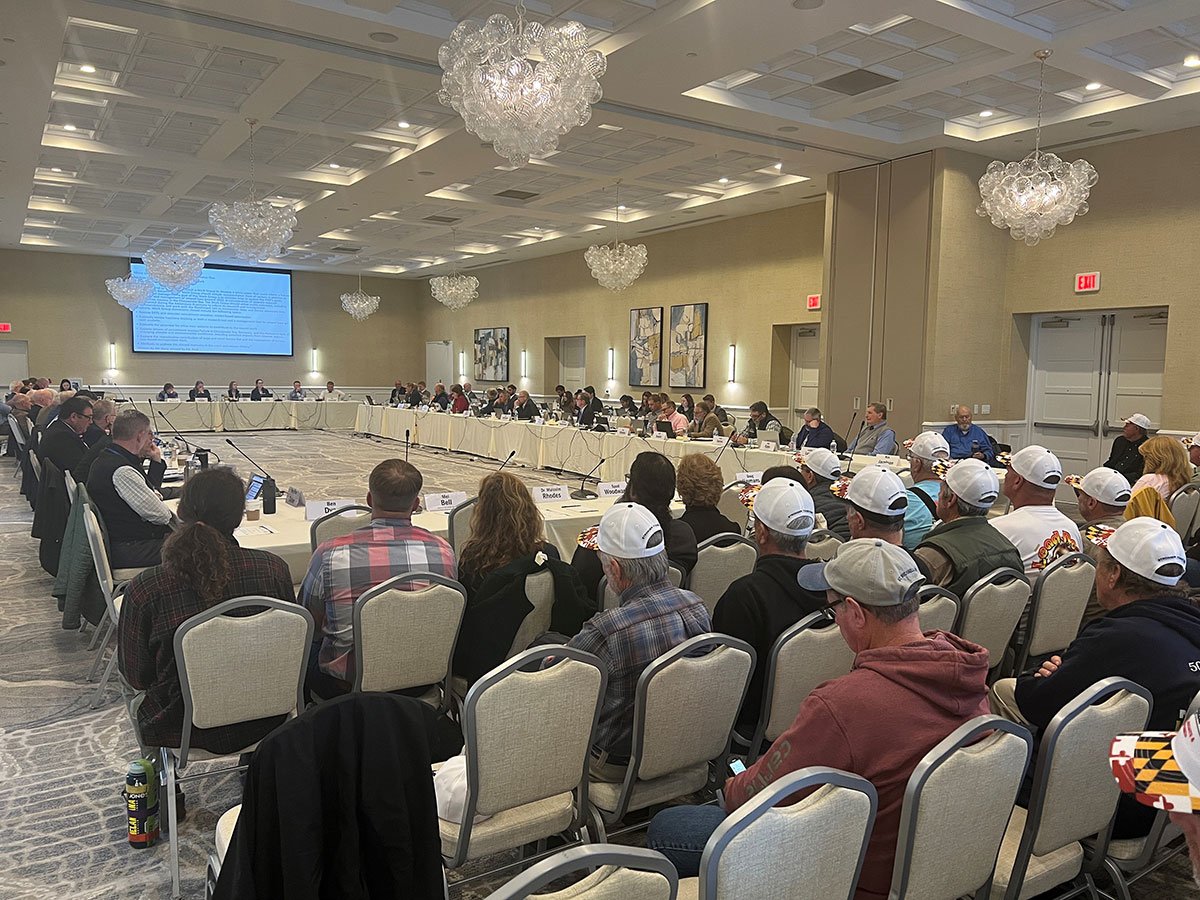
ASMFC’s “status quo” decision on striped bass, from the room where it happened.
On Wednesday, October 29, 2025, the Atlantic States Marine Fisheries Commission (ASMFC) and its 16-member Atlantic Striped Bass Management Board (Board) voted 13-3 in favor of “status quo” striper management, leaving the current striped bass regulations in effect likely until after the 2027 benchmark stock assessment results. The Board’s official vote would also establish a new Working Group comprised of stakeholders, scientists and fisheries managers to look more closely at the health of striped bass, particularly “in consideration of severely reduced reproductive success in the Chesapeake Bay.”
ASMFC representatives from Maine to Florida met for the commission’s annual meeting from October 27-30 at the Hyatt Place Hotel in Dewey Beach, DE. The day prior to the striped bass vote, the commission agreed to a 20% cut to the commercial menhaden quota beginning in 2026. That final 16-2 vote by the Atlantic Menhaden Management Board – opposed by Pennsylvania and Virginia – lowers the total allowable catch for menhaden in the commercial bait and reduction industry for 2026, with a decision on 2027 measures expected at next year’s annual meeting of the ASMFC.
Taking the good with the bad – depending on your own personal perspective of course – the striped bass decision followed a month of public hearings and emotional debate over future management of this iconic species. In the end, it all came down to the Marine Recreational Information Program (MRIP) data, which arguably is more bad than good in terms of adequately assessing and managing recreational fishing effort and mortality.
The MRIP Factor
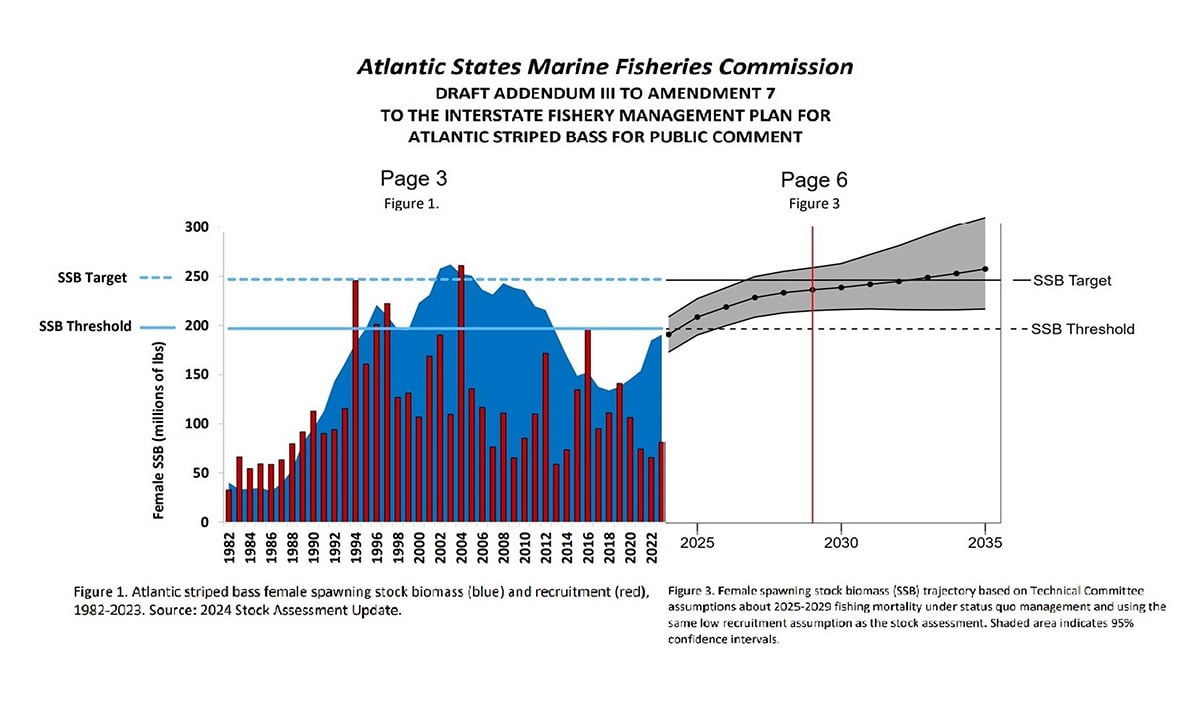
Atlantic striped bass was declared overfished in 2019 because the spawning stock biomass (SSB) level was considered below both the management threshold of 197 million pounds as well as the target of 247 million pounds. As per the ASMFC data referenced in Figure 1, the SSB level in 2023 heading into 2025 is essentially the same as it was in 1995 when striped bass stocks were last declared rebuilt following the 1980s fishery collapse.
“Although below the threshold and considered overfished, female SSB in 2023 increased since the prior assessment and was still estimated to be well above SSB levels from the 1980s, when the stock was considered collapsed,” ASMFC noted in Draft Addendum III to Amendment 7 to the Interstate Fishery Management Plan for Atlantic Striped Bass (Addendum) presented during a series of regional public hearings in September. Striped bass is currently under a rebuilding plan that requires SSB to be rebuilt to a 247-million pound target by 2029.
Based on a 2024 Stock Assessment Update – and using earlier mortality projections from MRIP in 2025 – the ASMFC approved the Addendum for public comment in August, stating “Short-term projections estimate an increase in fishing mortality in 2025 due to the above average 2018 year-class entering the current recreational ocean slot limit combined with the lack of strong year-classes behind it.”
So, while Figure 1 shows Atlantic striped bass female spawning stock biomass (blue) increasing – even as age 1 striped bass in the recruitment class (red) is below average – Figure 3 from page 6 of the full 64-page addendum reveals the Technical Committee’s forecast through 2035 under status quo management. Using fishing mortality assumptions based on earlier MRIP forecasts for 2025 through 2029, SSB would still meet the target of 247 million pounds, but not until 2032, 3 years after the deadline.
As explained at the public hearings, there was a 50% chance of reaching the SSB target and deadline right up until they applied these new short-term MRIP projections for 2025 predicting an increase in striped bass “removals” which is angler harvest coupled with catch and release mortality, thereby reducing the probability of meeting the deadline to 30%. However, as we were about to learn in Delaware, those early MRIP predictions of increased fishing mortality in 2025 would turn out to be wrong in the first half or 2025.
The Game-Changer
At the Dewey Beach meeting, ASMFC was presented with preliminary 2025 MRIP estimates through June showing striped bass removals in the recreational sector were 44% lower than during the same timeframe as 2024. Considering that data from Wave 2 (March and April) and Wave 3 (May and June) typically represents 36% of the annual removals in the recreational fishing season, it dinged the previous ASMFC forecast of increased recreational harvest and release mortality which was the entire basis for the proposed 12% reduction.
New York’s gubernatorial rep at the ASMFC, Dr. Emerson Hasbrouck, asked about that discrepancy between original predictions and new preliminary numbers, specifically whether or not this new MRIP data might impact the 12% reduction scenario. ASMFC’s Stock Assessment Team Lead Dr. Katie Drew responded that in her opinion, based on the actual 2025 MRIP data through June, that indeed perhaps less than a 10% reduction was needed to meet the 2029 deadline, possibly even 0%.
In other words, the preliminary data actually collected by MRIP through June of this year showed that a “status quo” decision by the Board would still meet the 50% probability of hitting the 2029 target. This big MRIP reveal in Dewey Beach was a game-changer at the manager’s table, as the best available science presented a very different outlook on the SSB rebuilding status, which legitimately questioned the conservation need for the 12% reduction.
There were roughly 150 attendees in Delaware for the ASMFC striped bass meeting. During the September public hearings, ASMFC counted nearly 1,100 people who turned out either in person or via webinar, with the commission collecting 2,722 public comments in support of the status quo option, and 1,775 public comments supporting a 12% reduction starting in 2026. There’s also a 24-member Striped Bass Advisory Panel responsible for collecting stakeholder input for ASMFC from Maine to North Carolina. In an official presentation to the Board on October 29, advisory panel chair Dr. Eleanor Bochenek revealed that nine of its members supported status quo, with seven favoring the reduction.
It’s worth noting that the revised 2025 MRIP estimates collected through June weren’t available to members of the public prior to the October 3rd deadline for comment, nor were they collected in time for advisory panel members to review before taking their vote.
The Final Vote
On the day of the final vote, a “status quo” motion was made by New Jersey’s Adam Nowalsky, seconded by John Clark of Delaware. Referencing the “uncertainty” related to the MRIP projections and anticipating a new full-scale Benchmark Stock Assessment on striped bass in 2027, Nowalsky noted “This is a very important decision here for us, this is an extremely important decision in the name of conservation, (and) it’s an extremely important decision in the name of socioeconomics.”
For those unfamiliar, Robert’s Rules of Order – often referred to simply as Robert’s Rules – is a manual of parliamentary procedure created by Henry Martyn Robert and first published in 1876 to adapt the rules and practice of the U.S. Congress for use by non-legislative societies. Robert’s Rules are now used by most organizations, fishing clubs, councils and commissions as a guide for running meetings with a framework for making and approving motions. Thus by Clark seconding Nowalsky’s motion for status quo, it opened initial Board discussion while allowing ASMFC members to offer any amendments or substitute motions.
New York’s Martin Gary offered a substitute motion, seconded by Rhode Island’s Eric Reid, to amend Nowalsky’s main motion with added language establishing a Work Group for striped bass which would include representation from all sectors in addition to scientists and managers. Most notably, Gary’s amendment would address “severely reduced reproductive success in the Chesapeake Bay” which was clearly the elephant in the room during the ASMFC discussion. Gary’s motion to amend passed 14-2 with Rhode Island and North Carolina voting in opposition.
Under Robert’s Rules, with the new main motion now before the Board, Nichola Meserve from Massachusetts offered up another “amended” motion, seconded by Dr. Jason McNamee of Rhode Island, to replace “status quo” with “equal 12% reduction by sector,” while still incorporating the new Working Group language. That motion failed 11-5 with Maine, Rhode Island, Massachusetts, Connecticut, and North Carolina evidently supportive of a 12% reduction. Casting opposition votes were New Hampshire, New York, New Jersey, Pennsylvania, Delaware, Maryland, Virginia, Potomac River Fisheries Commission, District of Columbia, NOAA Fisheries and U.S. Fish & Wildlife Service.
With the Gary amendment, and no additional motions, the following became the main motion for the Board’s final consideration:
Move to approve in Section 3.4 Option A Status Quo and establish a Work Group to develop a white a white paper that could inform a future management document. The Work Group should include representation from all sectors in addition to scientists and managers. The goal of this Work Group is to consider how to update the FMP’s (Fishery Management Plan) goals, objectives and management of striped bass beyond 2029, in consideration of severely reduced reproductive success in the Chesapeake Bay. The Work Group should utilize public comment, including that received during the Addendum III process to inform its research and management recommendations and work with the Benchmark SAS (Stock Assessment Subcommittee) to incorporate ideas to deliver necessary data products. Work Group discussions should include the following topics:
- Review BRPs (biological reference points) and consider recruitment-sensitive, model-based approaches.
- Formally review hatchery stocking as both a research tool and management tool for striped bass w/ cost analysis.
- Evaluate the potential for other river systems to contribute to the coastal stock.
- Explore drivers of recruitment success/failure in the Chesapeake Bay, Delaware, and Hudson in light of changing climatic and environmental conditions, including potential impacts from invasive species.
- Examine the reproductive contribution of large and small female striped bass and implications for various size-based management tools.
- Methods to address discard mortality in the catch and release fishery.
After nearly 3 hours of discussion, the motion carried 13-3 with yes votes by Maine, Massachusetts, New Hampshire, New York, New Jersey, Pennsylvania, Delaware, Maryland, Virginia, Potomac River Fisheries Commission, District of Columbia, NOAA Fisheries and the U.S. Fish & Wildlife Service, with Rhode Island, Connecticut and North Carolina voting in opposition.
The Elephant
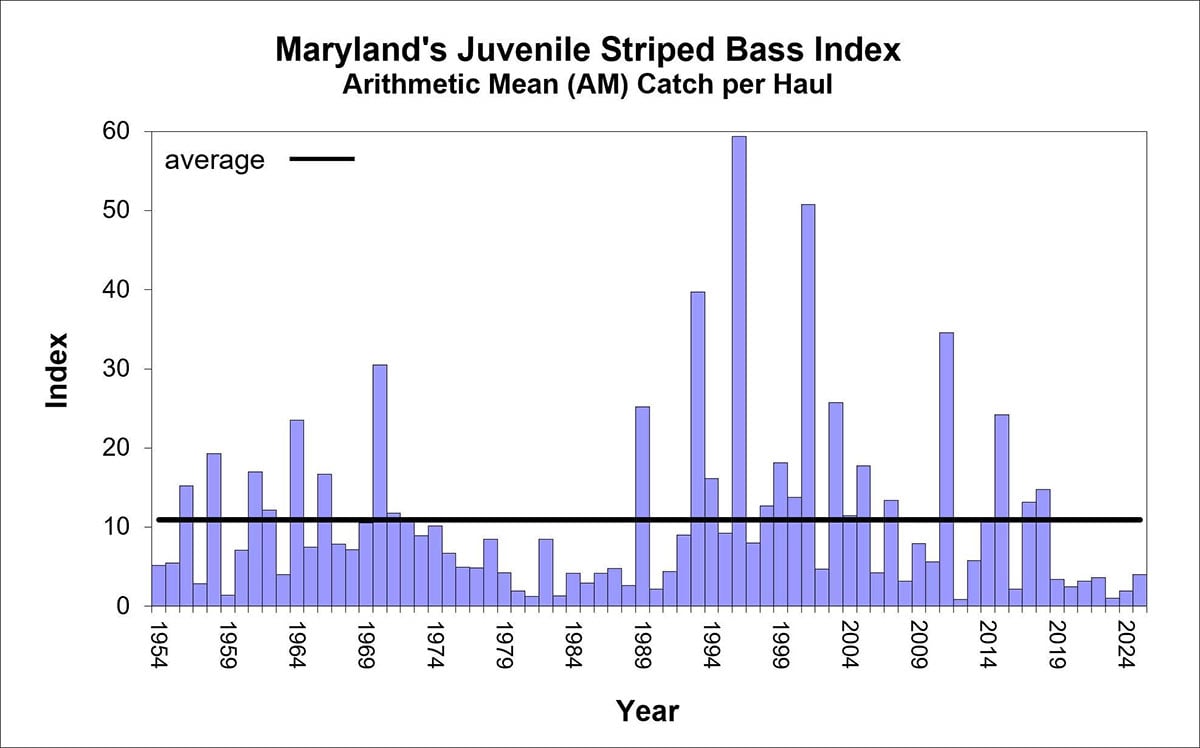
Two weeks prior to the ASMFC’s annual meeting, the Maryland Department of Natural Resources released their annual juvenile striped bass survey for 2025, recording a young-of-year index of 4.0, well below the long-term survey average of 11. While we await final young of the year numbers from the Virginia portion of the Chesapeake, as well as the Hudson River, the rather dismal news out of Maryland has already caused widespread panic among stakeholders and fisheries managers alike.
A week before the ASMFC meeting, I received a Marine Resources Administration Monthly Report from the New Jersey Division of Fish & Wildlife on their Delaware River seine survey revealing a preliminary young-of-the-year striped bass index of 1.373 for August, which ranks 23rd in the 45-year time series and is the highest since 2019 (2.044). That said, during the Board discussions on striped bass, Dr. Drew explained that there’s no measurable direct correlation between current SSB levels and spawning success. “It seems to be driven more by environmental factors,” she noted at the meeting.
Which gets back to what we reported in the November edition of The Fisherman related to the Maryland young-of-the-year number. In a social media post prior to Maryland’s announcement, ASMFC representative Martin Gary with New York’s Department of Environmental Conservation noted five variables that could impact striped bass reproduction including flow rates of key tributaries, water temperature profile with a focus on the 12- to 16-degree (Celsius) window, timing of the spawn based on temperature, zooplankton hatch/timing, and blue catfish predation impacts.
Which is why Gary’s amendment to the status quo motion, in consideration of severely reduced reproductive success in the Chesapeake Bay, may prove valuable in terms of sensible and respectful future discussions about striped bass. The fishing community, along with scientists and the fisheries managers, should be working together to explore the drivers of spawning success and failure, from changing climatic and environmental conditions to the impacts of invasive species.
Striped bass is an emotionally charged fishery, much more so than any other targeted species in our region. In fact, I’d dare say that if we were looking at the same SSB scenario in black sea bass, fluke or porgy, this angry and acrimonious debate would not have happened. And based on the decision to leave striped bass regulations in place, I can say with confidence that someone will eventually scream “I told you so” at the top of their lungs when the 2027 Benchmark Stock Assessment is released, whatever those new findings may reveal.
Look, I’m just the messenger, so don’t blame me. If you don’t like how the vote transpired, blame Henry Martyn Robert and his manual of parliamentary procedure.
You can also blame the best available science.