Invasive species in local ponds, lakes and rivers – go get ‘em!
They are here, and they are not going away. More are inevitably inbound. And it appears they cannot be stopped. Controlled on an extremely limited basis, maybe. Managed? That’s the wide open question.
Such is the reality of the growing invasive aquatic situation occurring in various watersheds in the Garden State. These include fish, mollusks, crustaceans and vegetation, but in this context, it’s all about the fins.
Warmouth and green sunfish were first discovered in a few southern tier county waters just prior to or at the turn of the century, and the consensus was they were angler introduced. Small fry, these. But what I’m describing here are the big three – northern snakehead, flathead catfish, and blue catfish.
And it’s entirely possible that it will soon enough be the Big Four as the freshwater buffalo, recently discovered, continues to spread up the Delaware and no doubt into some of its tributaries.
Across The Border
The subject of invasive species became more than a blip on the radar around 2009-2010 with the appearance of northern snakeheads in several tributaries of the lower Delaware River. These arrived via the Schuylkill River in neighboring Pennsylvania. Right on their slimy tails (and some Delaware River regulars say were in the system a few years prior) were the flathead catfish, establishing residency not only in the Delaware River proper but also starting populations in several tributaries. The conduit for both was the Schuylkill River which empties into the Delaware River at the Navy Yard in Philadelphia.
Most recent is the blue catfish invasion via the 14-mile long Chesapeake & Delaware Canal. First verified in waters on the New Jersey side of the Delaware in 2021, its spread has been rapid but seems to have stalled around Trenton. This could change with rain events that engorge flows and enable them to maneuver over and/or negotiate shallow rapids and rubble.
That these three species offer outstanding angling opportunities is well known, and their respective popularity is spreading, with social media creating a huge push. With the northern snakehead it’s the strike ferocity, fight, decent table fare and increasing availability. With the flathead, it’s more about the size (they’ve been caught in excess of 60 pounds and can approach 100 pounds under ideal conditions), the brutal rod bending encounter, and, properly cared for, not so bad out of the deep fryer. Ditto the blue cat, which while not yet at the sizes of the flathead – at least what’s been publicized – is certainly capable of attaining weights to that and exceeding its shovel head kin. What’s more, it’s said to be quite the palate pleaser.
The impacts on their respective habitats? All three possess voracious appetites, and once established, have the potential to dominate their respective environs.
Northern Snakehead
| READ MORE |
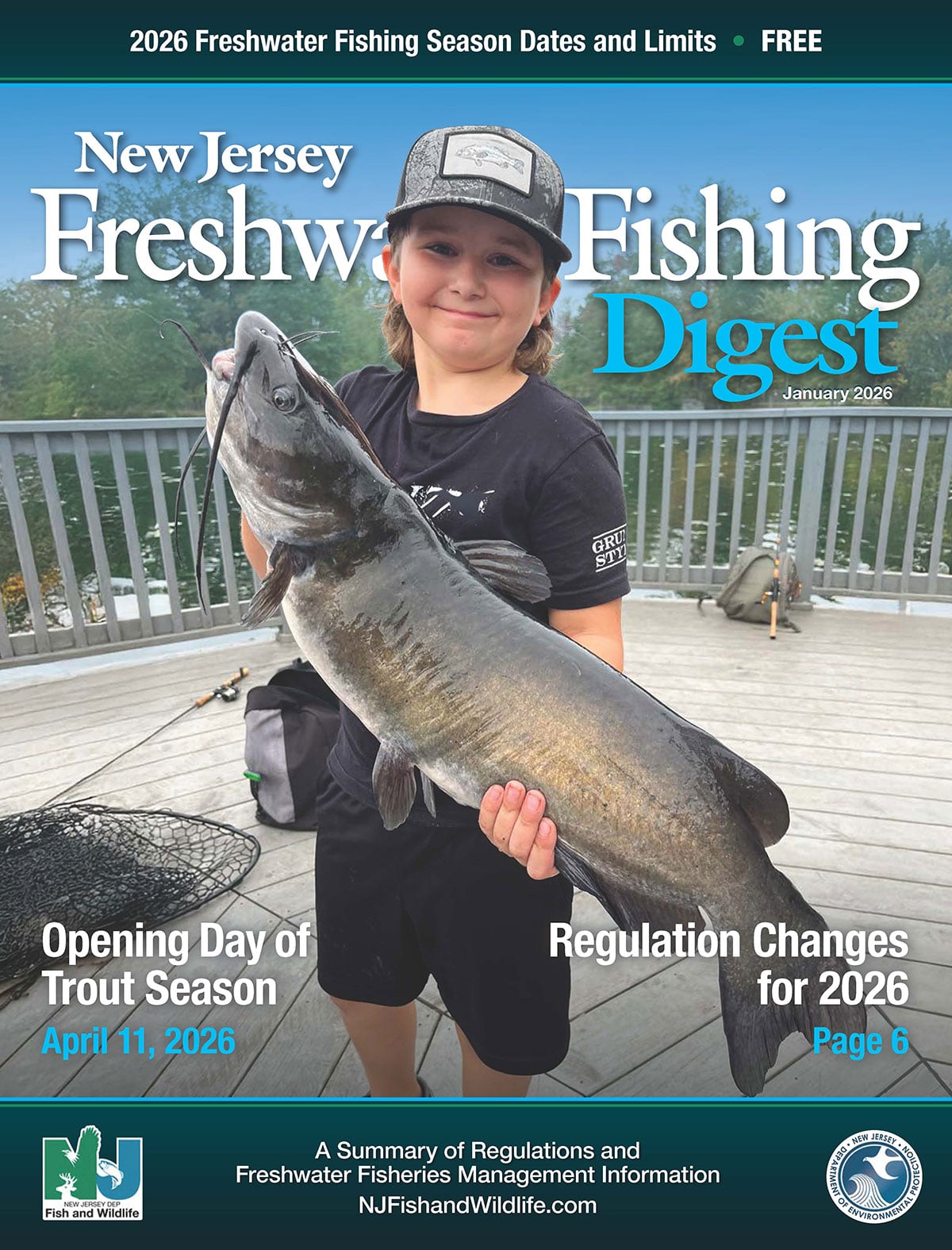
For more information on invasives, look for NJDFW biologist Chris Smith’s article titled New Jersey Aquatic Invasive Species (AIS) Updates on pages 34 and 35 in the 2026 Freshwater Fishing Digest. Pick up this free digest at your local tackle shop or go to the freshwater fishing section of njfishandwildlife.com |
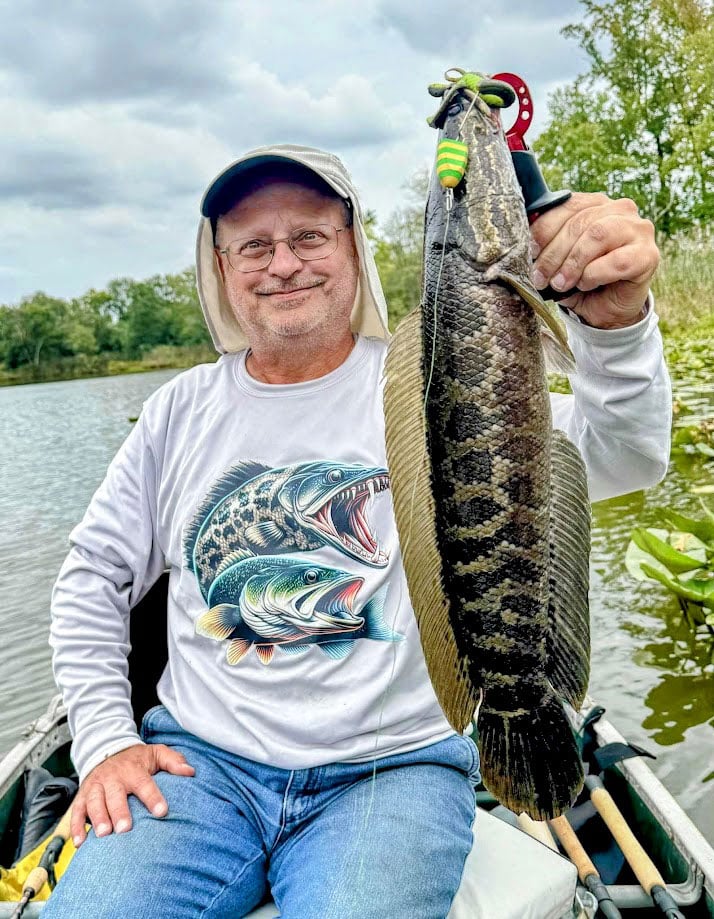
Warmouth and green sunfish aside, this is the species that drew attention to the potential dangers of invasive aquatic predators. First reported in Stewart Lake in Woodbury, the snakehead soon was established in the likes of Mantua Creek, the Salem and Cooper rivers, The Rancocas and Big Timber creeks, to name but a few of many.
“It was simple matter for the snakeheads to swim across the Delaware and eventually settle into the tributaries that provided suitable habitat,” said New Jersey Division of Fish & Wildlife (NJDFW) supervising fisheries biologist Christopher Smith, adding “They are opportunistic, waiting for high water and then moving over spillways or going through tidal and flood gates.”
It has been found as far up the Delaware River as New York. There have been reports of snakeheads being caught in the Rahway River watershed in Union County, but these have yet to be formally verified.
Smith notes that one of the measures being employed to slow the migration is the shutting down fish ladders such as those at Union Lake and Cumberland Pond. The latter in particular is vital as it will halt the snakehead from invading critical Pinelands habitats and decimating the native fish populations therein.
The initial hue and cry regarding the growing snakehead presence came from many in the southern tier counties bass fishing fraternity. An apex predator like the largemouth and thriving in the similar habitats, it was feared the prolific alien would could, and would, out-compete the bass and ruin what were prime fishing venues, especially for tournaments.
So far, all these few years later, the jury is still out. It seems to be a draw. “The long term impact on largemouth bass has yet to be seen because there are so many variables involved and in the scope of things, it really hasn’t been that long a period. Time will tell,” noted Smith.
That this prehistoric predator possesses all the attributes of a gamefish can’t be denied. It readily strikes variety artificial baits, especially surface cleavers, with murderous abandon, fights with a rip-you-face-off savagery and attains double digit weights. So much is the invader now being admired by a cross section of anglers that its popularity is quickly progressing beyond cult like status, and there are several lure makers designing and producing baits catering to the crush.
And herein arises a looming problem, or crime, if you will. It appears that the natural spread of snakeheads isn’t enough: there are instances of purposeful “bucket stocking” to introduce it to new waters. Recently, the Bureau of Freshwater Fisheries completed an incredibly timely eradication of a newfound, albeit small population at the headwaters of the Mullica River, it being determined that the fish were intentionally released. Had the snakeheads been able to progress, it would have eventually wreaked havoc on the watershed.
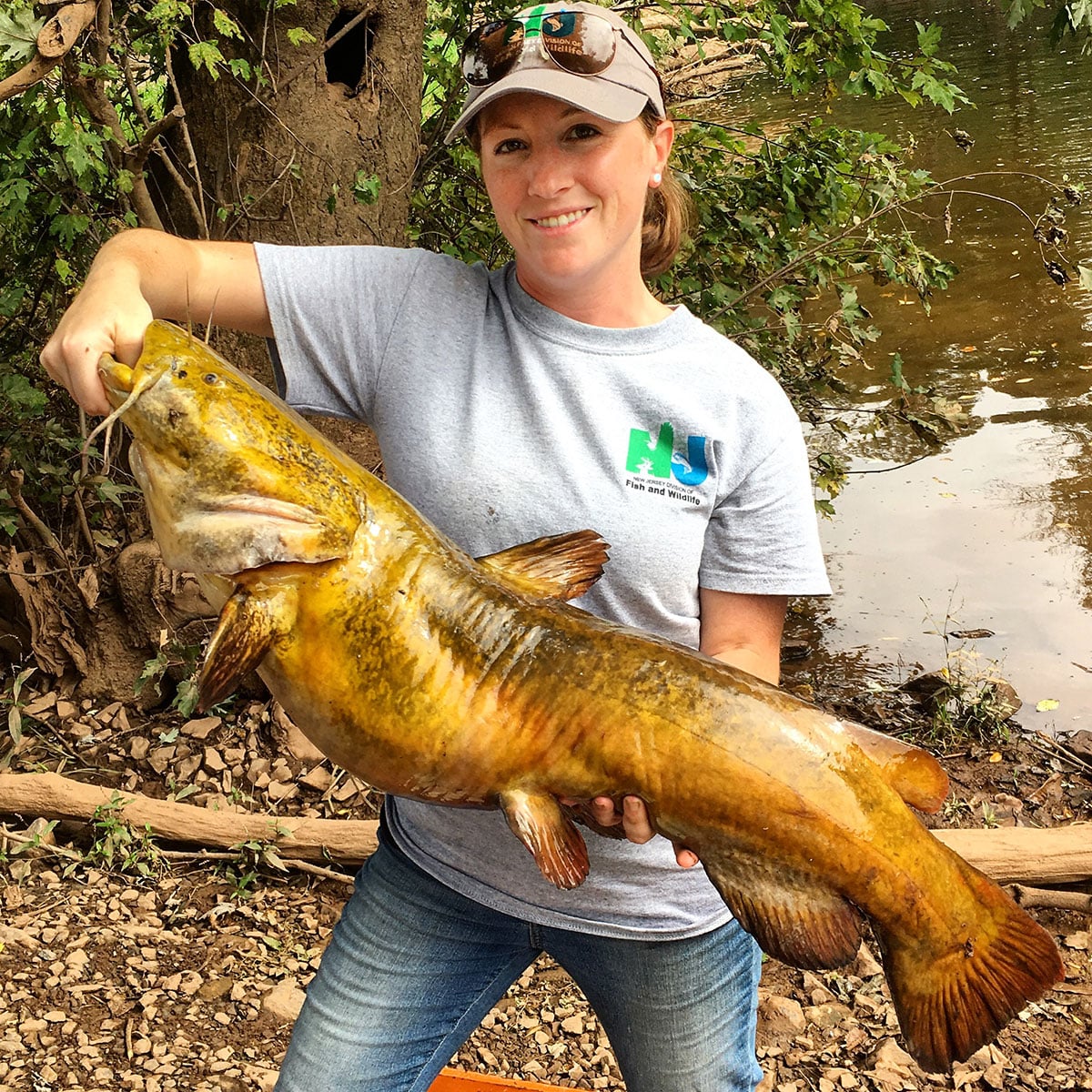
Flathead Catfish
The undisputed heavyweight (for now) in New Jersey’s invasive arena is the flathead, with fish to 50-plus pounds are being caught in the Delaware River. Capt. Dominic Troisi of Full Draw Bowfishing based in Trenton is a longtime Delaware River veteran and has rod and reel catches of flatheads in excess of 60 pounds. He insists there are heavier ones in the flow, and they’re movers too having been caught in the Delaware as far north as the Water Gap.
“They’ll go as far as they can,” acknowledged Smith, noting that they are reproducing naturally in the Delaware and have branched into some tributaries such as the Millstone River to its ingression with the Raritan River in Somerville, most likely via the Delaware & Raritan Canal, where it’s expected they also now inhabit. This being the case, there’s little doubt some are already in the main stem of the Raritan.
“It’s an eating machine, plain and simple,” said Troisi, adding that once it attains a certain size, nothing is safe from the huge maw. “Shad, smallmouth, panfish, suckers, carp, small stripers, herring. Anything goes.” With such a vast menu, it can negatively alter various populations in short order.
These are caught using live bait. A favorite of Capt. Troisi is live bluegills, but suckers and chubs work just as well.
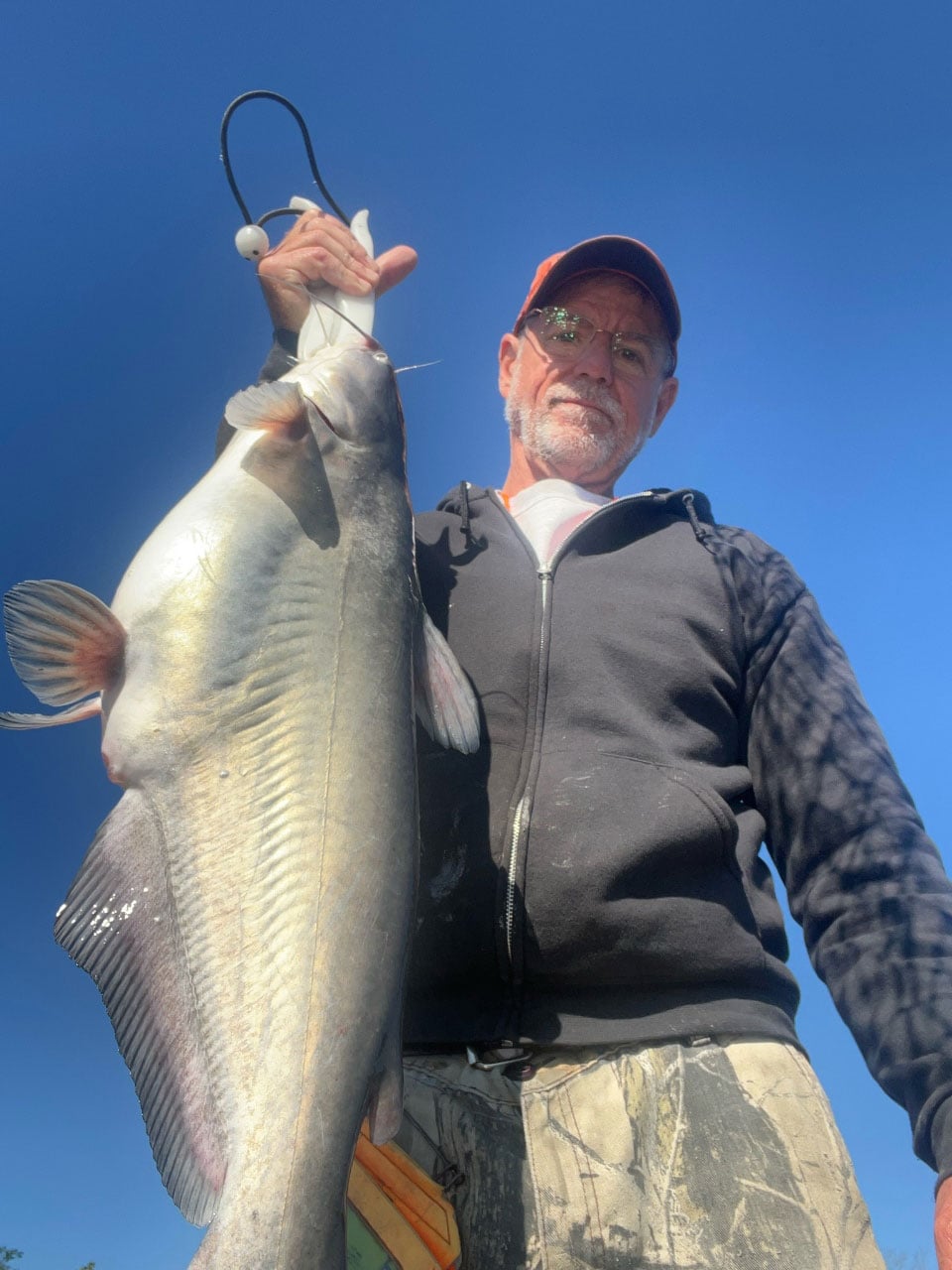
Blue Catfish
The most insidious impact-wise is the fast growing blue cat. Blues can reach weights of 100 pounds and its non-discriminatory appetite makes it a clear and present danger; it’s a highly publicized problem in the Chesapeake Bay and tributaries.
“They eat year-round. Flatheads don’t,” Capt. Troisi said bluntly. The latter enters a dormant period lasting the winter months, whereas blue cats are constantly on the prowl, vacuuming anything edible, live or dead. In the lower Delaware, blue crabs are a blue cat fave; perhaps young striped bass as well.
Troisi opines that the species will likely take over as the Delaware’s apex predator, eclipsing the flathead, muskie and striper, within 15 years.
NJDFW has established a New Jersey Invasive Species Management Plan in 2024. It’s headed by fisheries biologist Samantha MacQuesten (Samantha.MacQuesten@dep.nj.gov), and it’s a high octane work in progress. Last year, and Aquatic Invasive Species reporting form was designed to give anglers a conduit to report any instances of invasive species that will help the state to identify and react to the potential problem. For example, things like shutting down fish ladders.
From this corner, one way to encourage the catching and killing (all invasives must be killed; releasing a fine generating no-no) is to establish state records for invasive species. Why not? It would encourage and increase angler participation and assist with trying to control the spread and proliferation. After all, there is a state record for the common carp, perhaps the most damaging introduced invasive of them all.
Again, just a thought.