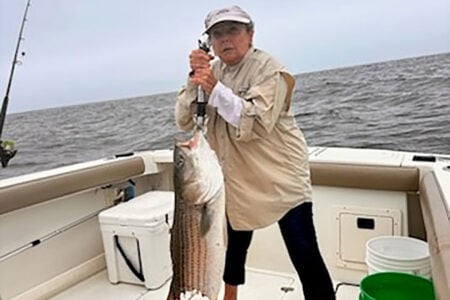
Fool me once, shame on me, fool me twice, it must have been a striper. I was once critiqued for using the term, “hunting stripers”, to which I replied when do fish of that size (41 pounds) come looking for you? We usually have to hunt down those battle scarred predators in their rugged lairs. We took a 54 out of one particular location with me on the rod and Tim uncomfortably at the wheel, backing down to stay out of harm’s way. We were lucky to land that hefty cow who we noticed had instigated a few more successful escapes before she clamped down on the big white jointed Danny Plug. There was the stain from the rusted remains of a hook stuck in the inside of her left jaw and the thin membrane of skin on the inside of her right jaw was missing, leaving a healed wound with thick red scar tissue around the oval tear. She was the epitome of what Charlie Cinto referred to as a “purple heart escape”. For the most part, larger stripers are ambush predators that take advantage of cover to lie in wait for a lobster, scup, sea bass, or sea robin. Yes, over the past 10-years a few New York fish cutters were reporting many more stripers have been feeding on juvenile tog, scup and some big sea robins.
The senior population of cow stripers prefer the larger specimens of groundfish which provides them with more calories per effort. I have lived by the “big bait approach” as the rule rather than the exception. Over a lifetime of primarily striper fishing from Cuttyhunk and the islands, all around the Vineyard, Nomans and the occasional voyage to the dangerous and productive rips of Nantucket Shoals we were seeking the largest striped bass specimens. During that era, I cannot recall ever gaffing or netting a large striper and just dumping it onto the deck or tossing it in the fish box without feeling grateful and admiring those beautiful wild creatures that were an integral part of my life and family’s wellbeing. In those years, striped bass were only protected by a 16-inch minimum size, and we believed we were fishing on an inexhaustible resource. These fish were my livelihood and lifeblood, and myself and many of us who engaged in the commercial fishery during those years considered the striped bass to be the most important fish swimming between Canada and the Carolinas. Since then, my preferences have changed dramatically.
I never believed that their annual migration was a given and from late-fall when they departed Northeast waters until the warmer days of early April, I prayed (and worried) that nothing would go wrong. Most of you have never heard of or seen the “Green Sheet”, which was actually the NMFS free and weekly Fishery Market News federal report on landings along the East Coast, which obtained its name from the bright green paper it was printed on.
Whenever I saw a report that hundreds or thousands of prespawn stripers went to market, I became extremely concerned. With no closed season, large hauls could be made as they gathered before entering their spawning grounds. I thought back through my research of the records of the West Island and other prominent bass clubs of the wealthy in New England that went from catching hundreds of recorded stripers a day to two, three or just a single striper at the turn of the century. It took a while, however the few fish that survived eventually provided the core of yet another remarkable recovery for our seven-striped fish.
Each early spring for the past 55 years, after a long, hard winter I have made my first forays for stripers, usually much earlier than I had any right to expect to catch a fish, but I was driven by necessity as well as apprehension. Those early April trips down our back stairs to the marsh looking for lively water or any sign of life, without the cover of the once tall and waving spartina sea grass having been cut to the nubs by the severing push of winter ice sheets. Oblivious to tides and currents I had to cast until my fingers froze on the reel seat or the pain in my scapula became unbearable. Then, sometime around the 15th of April I would slide a 22-inch striper up onto the bog then feel as though a weight had been lifted from my shoulders. The beautiful fish of a size that once fed my family was admired then quickly nudged out into deeper water, where once upright with a flip of its tail would shoot out beyond my vision. Now it’s not the 30s, 40s or 50s I’m after; nowadays my One Fish is that first schoolie of each new season I am still able to cast to. That is essentially the miracle of the striped bass. How would you feel if the stripers failed to revisit our shores?