Bigeye, bluefin, longfin & yellowfin, the seasonal hunt is on!
When offshore anglers from the DelMarVa to Cape Cod talk about tuna hunting, the big four are typically their main targets – true albacore (aka longfin), bluefin, yellowfin and the often elusive bigeye. Your daily thunnus dance card will depend on where you call home port, the distances you are willing to travel, the species you seek and the time of the season in the annual migration process.
The Northeast tuna season generally runs from late May to early December, with bluefin typically around the longest and the nearest to shore, due to their extreme tolerance for temperature swings. Albacore and bigeye are essentially 100-fathom fish, and deeper. Although longfin will sometimes venture into 50-fathom waters if conditions are just right (something that happened with more frequency back in the 60s and 70s), both species prefer 100- to 250-fathom waters along the edges of the continental shelf.
Yellowfin are the “wildcard” of the thunnus quartet, with some years finding them closer to the coast in 20 fathoms depths, while other years they won’t venture into anything less than 35 to 40 fathoms. Warm core eddies, prevailing winds, bait, time of the season and migration routes all collaborate to determine the geographic whereabouts of the popular yellowfin from week to week during the season.
According to the scientists at NOAA Fisheries, the following is a brief summary of the traits for each of our targeted tuna species:
West Atlantic Bluefin
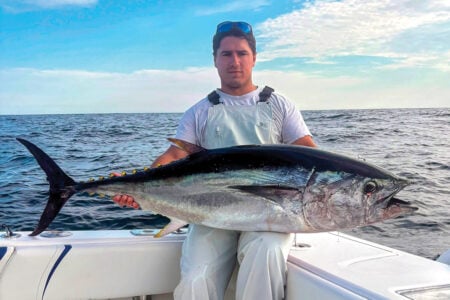
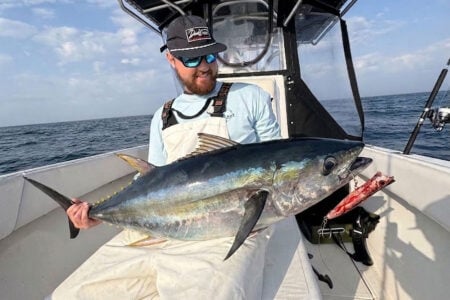
Appearance: Atlantic bluefin tuna have large, torpedo-shaped bodies that are nearly circular in cross-section. They are the largest of the tuna species and can reach up to 13 feet in length while weighing in up to 2,000 pounds. Bluefin have dark blue-black on their back and white on their lower sides and belly. Smaller fish under 60 pounds will frequently show conspicuous “tiger bars” on their sides, looking like silver lines alternating with rows of colorless spots on their lower flanks. The second fin on their back (dorsal fin) is reddish brown, and they have short pectoral fins.
Biology: Bluefin tuna grow more slowly than other tuna. They have a long lifespan, up to 20 years or more and generally don’t spawn until they are about 8 years old. Spawning takes place from mid-April to June, mainly in the Gulf of America, to be a major spawning ground for Atlantic bluefin tuna. Females can produce up to 10 million eggs a year, the eggs fertilized in the water column and hatching in about 2 days. Bluefin tuna are top predators and juveniles eat fish, squid and crustaceans. Adults feed mainly on baitfish such as herring, bluefish and mackerel.
In the western Atlantic, bluefin tuna are found from Newfoundland to the Gulf of America, living near the surface in temperate waters, but have the capability to dive to depths of 1,500 feet and more. A highly migratory species, bluefin tuna can move thousands of miles across an open ocean. Tagging studies have indicated that bluefin tuna move across the east/west boundary in the Atlantic, although the typically return to spawn in the same spawning areas.
I can support this migration thesis with real facts; I tagged a school bluefin tuna on a charter trip estimated at around 40 pounds. Much to the chagrin of the Apex Predator Research folks in Woods Hole, MA, I used one of their shark tags to do this. Seven years later, I received a phone call from the amused director of the Apex program to inform me that one of their shark tags had been returned by a Spanish longliner near Gibraltar that was recovered from a 308-pound bluefin.
Atlantic Yellowfin
| HMS PERMIT |
| If you are targeting albacore, bluefin, yellowfin, bigeye or skipjack tuna, you will need an annual HMS (highly migratory species) permit, which you can easily purchase online at hmspermits.noaa.gov for $26. You can purchase either a recreational or charter/headboat document for an individual vessel, along with a few other commercial types which allows you to fish for highly migratory species like tuna, sharks and billfish.
Generally, all landings of billfish, swordfish, and bluefin tuna must be reported within 24 hours of landing or trip completion using the HMS Permit Shop or the HMS Catch Reporting App. Specific reporting rules vary depending on your permit type, but recreational anglers must report all landed billfish, swordfish and bluefin tuna, as well as dead discards of bluefin tuna, within 24 hours via the app, website, or by calling 888-872-8862. |
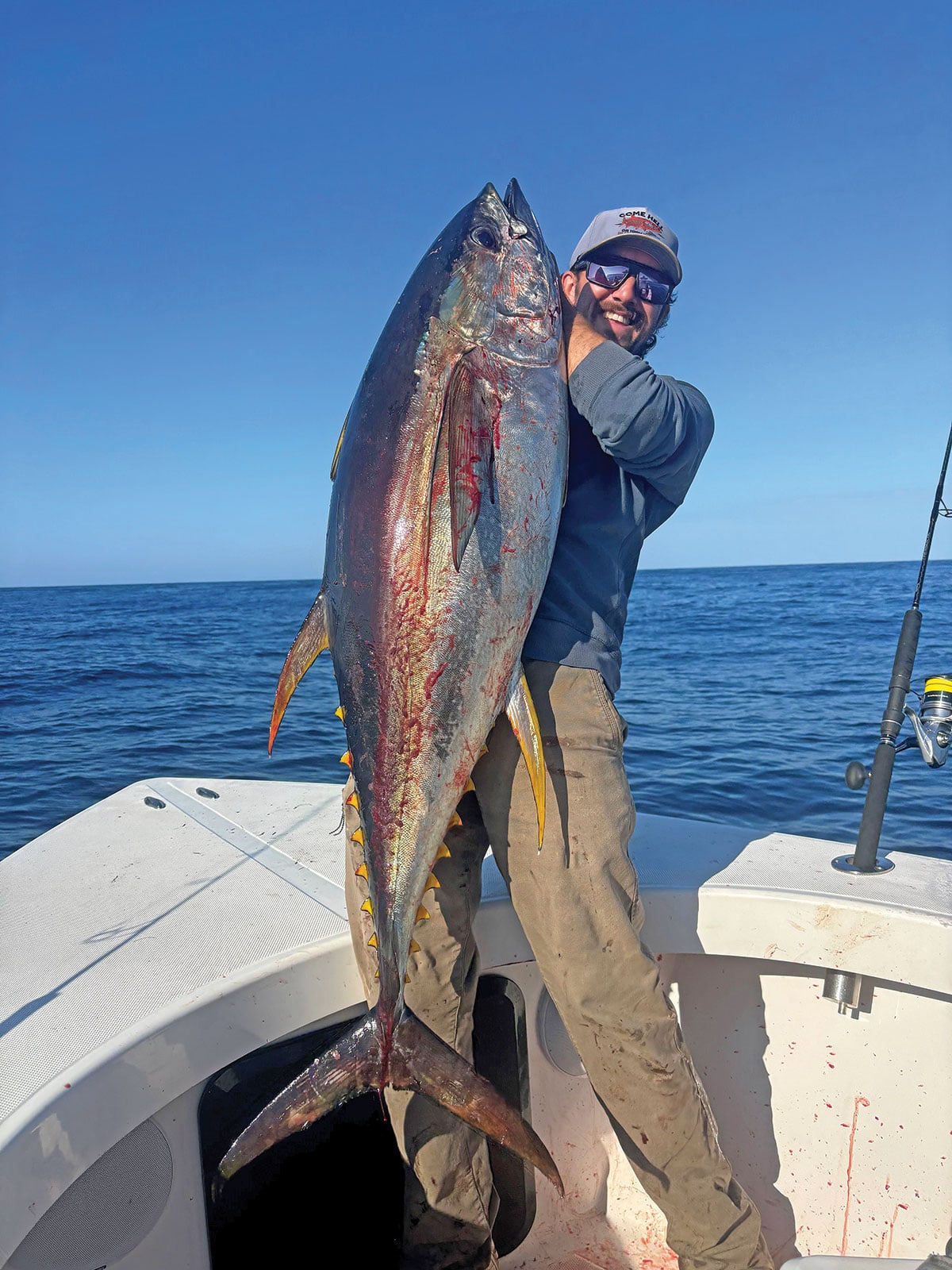
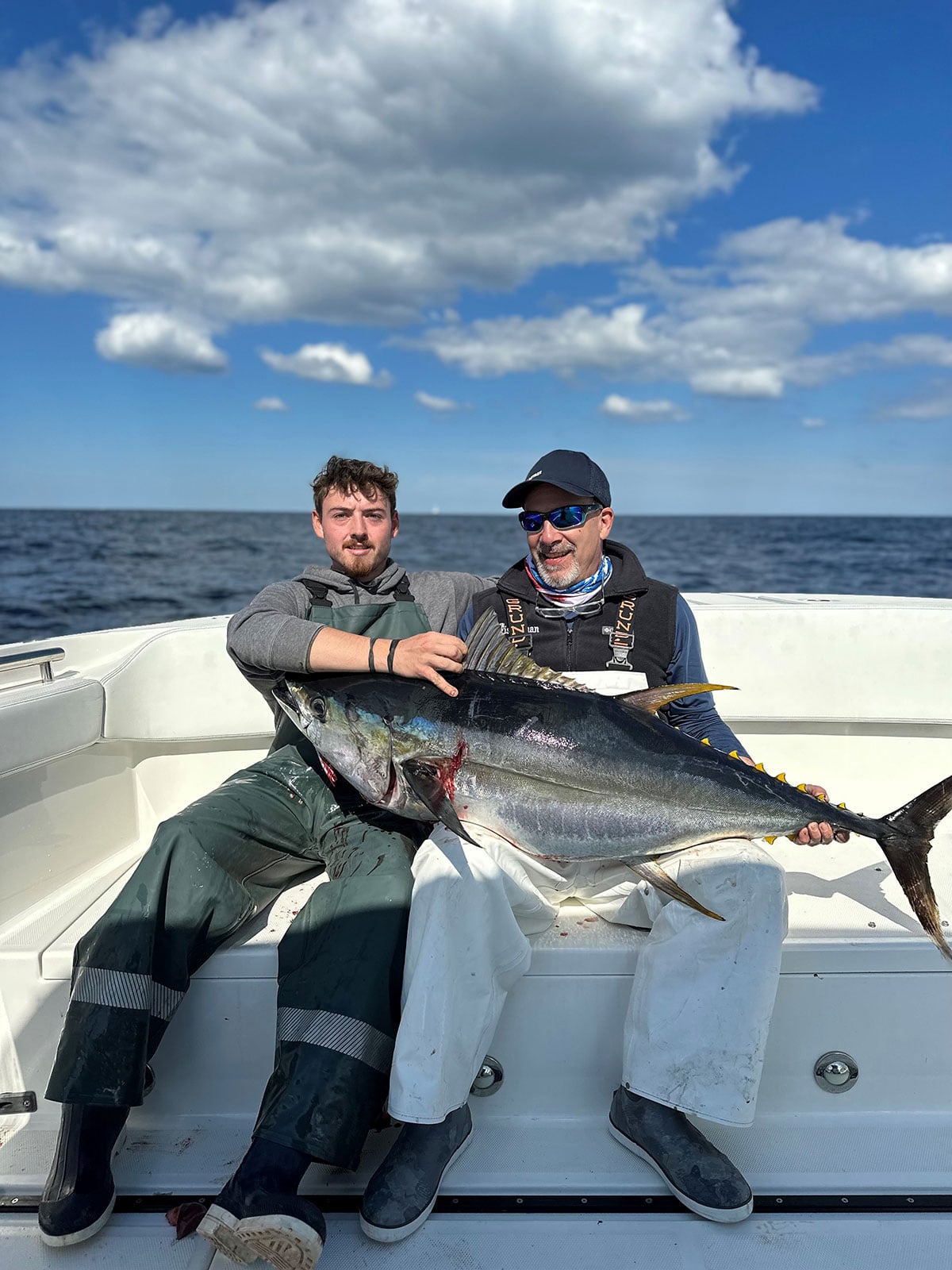
Appearance: Yellowfin tuna are torpedo-shaped, with a metallic dark blue coloration on their back and upper sides, marked by a conspicuous yellow bar that follows the lateral line, which changes from a yellow to silver on the belly. True to their name, their dorsal and anal fins and finlets are bright yellow and can be distinguished from other tunas by their long, bright yellow second dorsal fin. Yellowfin over 100 pounds can have sickle-shaped second upper and lower dorsal fins and are frequently called “allisons”. Yellowfin tuna are more sleek and slender than bluefin tuna. Smaller yellowfin under 60 pounds can exhibit silvery spots and “tiger bars” on the lower flanks of their bellies, similar to bluefin, but can be easily distinguished from their cousins with longer pectoral fins that reach back just before the second dorsal fin and fold neatly away into recessed pockets on the sides of the tuna.
Biology: Yellowfin tuna grow fairly fast, with a top weight of up to 400 pounds and a somewhat short life span of about 7 years. Most yellowfin tuna are able to reproduce when they reach age 2 or 3. In the western Atlantic, they spawn from May to August in the Gulf of America and from July to November in the southeastern Caribbean. Females spawn about once every 3 days during the spawning season. They produce an average of 1 million to 4 million eggs each time they spawn.
Yellowfin tuna feed near the top of the food chain on fish, squid and crustaceans. When surface water temps are to their liking, or when massive quantities of bait like sand eels, bunker or whiting are in an area, yellowfin tuna will venture inshore in 66- to 70-degree temps and 15- to 20-fathom waters. Generally speaking, yellowfin prefer 72- to 75-degree Gulfstream eddy waters.
Yellowfin tuna are found near the surface of tropical and subtropical oceans around the world. They are highly migratory and can swim across an entire ocean. Juvenile yellowfin tuna travel in schools with skipjack and juvenile bigeye tuna.
Longfin/Albacore
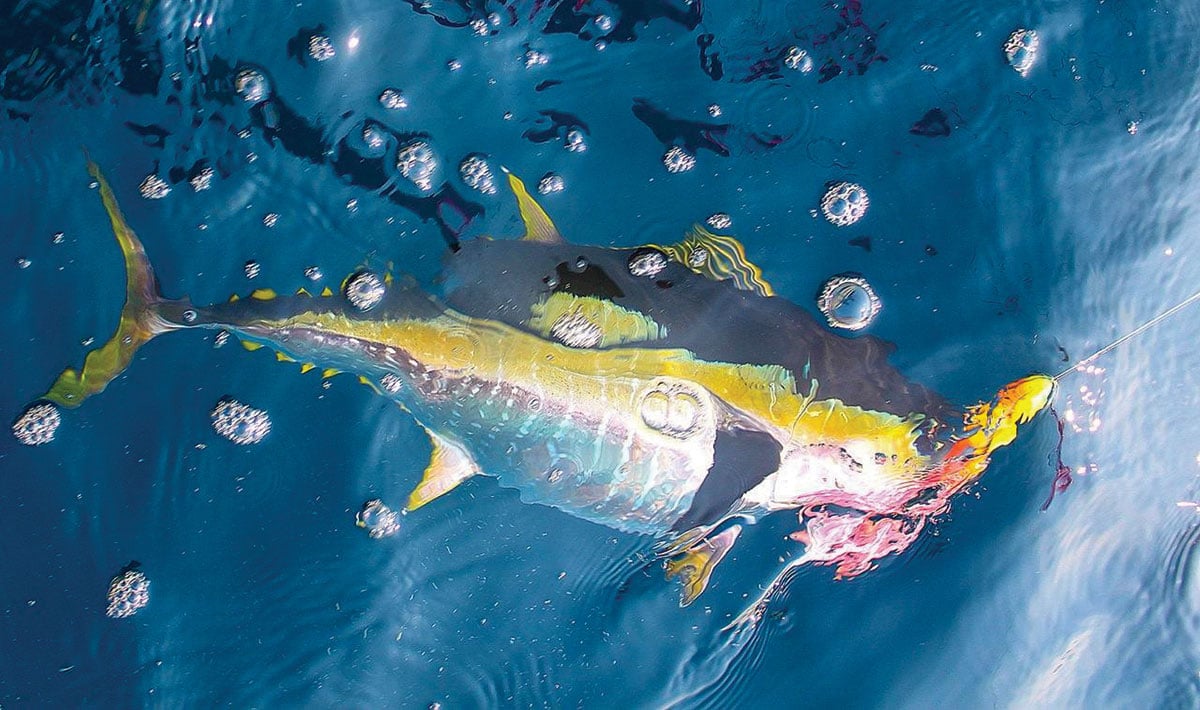
Appearance: Albacore tuna (aka longfin or true albacore) are metallic, dark blue on their back with dusky to silvery white coloration along the sides of their belly. They have torpedo-shaped bodies, smooth scales and exceptionally long pectoral fins, which are nearly half the length of their bodies. The edge of the tail fin is white.
| LITTLE SISTERS |
| Also members of the tuna/mackerel family – but maybe a step or two removed – are the three little sisters, the skipjack, little tunny (aka false albacore) and Atlantic bonito (aka green bonita). Of this trio, the skipjack is actually a bona fide member of the tuna family, one of the candidates for “chunk light tuna” in the cans on the grocery store shelves. The little tunny is a step removed on the family tree and the green bonito is more of a mackerel than it is a tuna, but is still a regular on the inshore and near offshore scene from the DelMarVa and all the way up through New England waters. As with the big four, if you want to target skippies, you’ll need to have the HMS Permit for your vessel. These speedsters will definitely pull some drag off your spinning reels and medium weight conventional outfits, but will not really strut their stuff if you hook one on a 50W trolling outfit, so keep it light if the three little sisters are on the agenda. |
Biology: Albacore grow relatively fast, up to more than 4 feet in length and 88 pounds. In the Atlantic, they live up to 13 years and are able to reproduce by age 5. They are a highly migratory species, found around the world and can travel long distances. In the spring and summer, albacore spawn in subtropical waters of the Atlantic and throughout the Mediterranean Sea. Depending on their size, females have between 2 million and 3 million eggs per spawning season.
Similarly sized albacore travel together in schools that can be up to 19 miles wide. Schools of albacore also sometimes include other tuna species such as skipjack, yellowfin and bluefin. Albacore constantly swim with their mouths open in order to breathe because they lack the structures needed to pump oxygen-rich water over their gills. Their unique biological characteristics enable them to swim at speeds over 50 miles per hour and cover vast areas during annual migrations. The albacore’s highly evolved circulatory system and high metabolism regulates body temperature and increases muscle efficiency.
Albacore tuna feed near the top of the food chain, preying upon a variety of fish, crustaceans and squid, but are also prey for many top predators, including sharks, rays, larger tunas and billfish. Albacore tuna live in tropical and warm temperate waters in the Atlantic, Pacific and Indian Oceans. In the Atlantic, they’re found from Nova Scotia to northern Argentina and from Ireland to South Africa. They are a temperate (cooler water) species but spawn in warmer tropical waters. Juveniles prefer warmer surface waters, while adults like cooler, deeper waters, like those found on the edge of the continental shelf.
Atlantic Bigeye
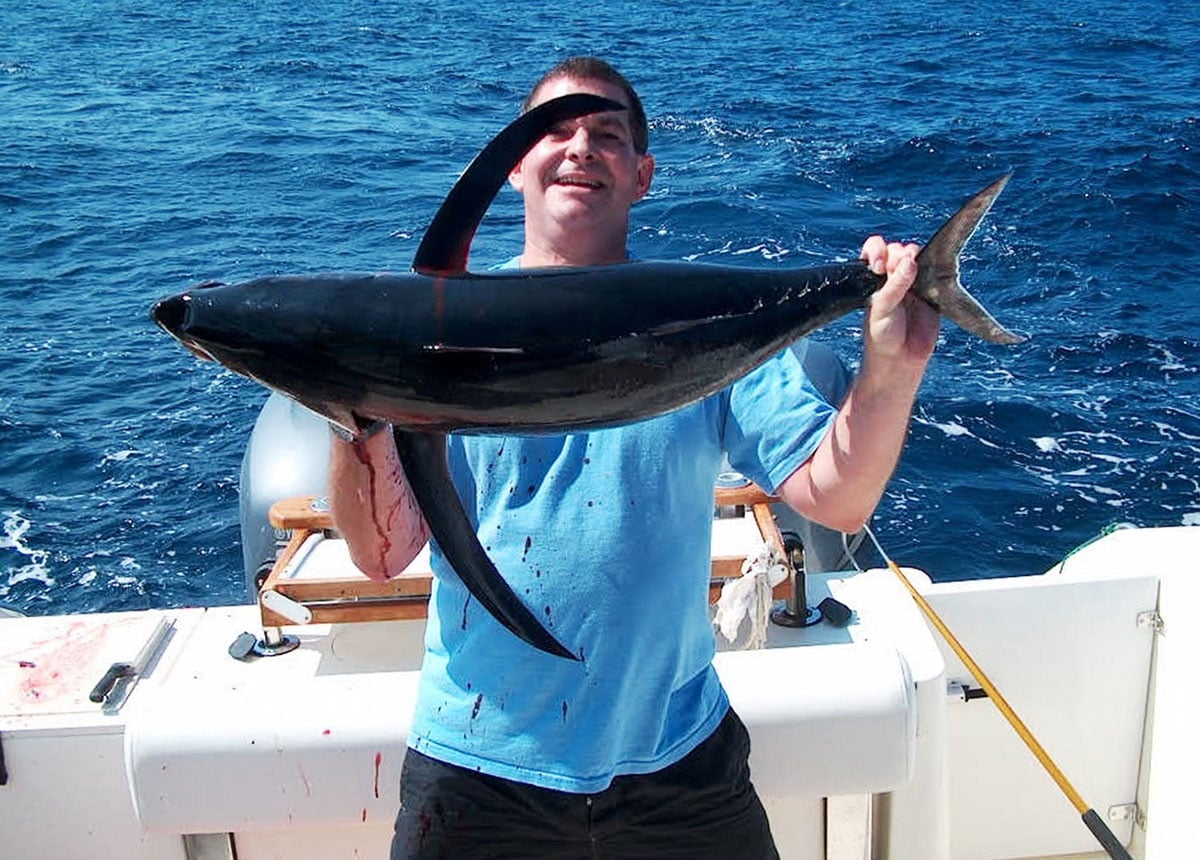
Appearance: Bigeye tuna are dark metallic blue on the back and upper sides and white on the lower sides and belly. Bigeyes feature a rotund body shape. The first fin on their back is deep yellow, the second dorsal and anal fins are pale yellow and the finlets are bright yellow with black edges. Bigeye and yellowfin tuna look fairly similar and it can be challenging to distinguish the two species when they are under 100 pounds. Among other characteristics, the bigeye’s eyes are larger than the yellowfin’s and their finlets have black edges.
Biology: Bigeye tuna grow fast and can reach about 5-1/2 feet in length weighing up to 300 pounds or more. They can live up to 9 years and are able to reproduce when they are 3 years old. Bigeye tuna spawn throughout the year but most often in the summer, with spawning events taking place two or more times a year. Females release between 3 million and 6 million eggs each time they spawn.
Bigeye tuna feed near the top of the food chain, preying on fish, crustaceans and squid. Although bigeye tuna prefer to patrol the mid-depths (200 to 400 feet) near the edge of the continental shelf, they frequently come up to the surface to feed at dawn, dusk and low-light/overcast conditions. Bigeye tuna live in the tropical and warm temperate waters of the Atlantic, Pacific and Indian Oceans. In the western Atlantic, they can be found from Southern Nova Scotia to Brazil.
Bigeye tuna are a highly migratory species, swimming long distances in the open ocean. They often swim in schools and live at or near the surface but dive into deeper waters (to about 800 feet, deeper than other tropical tunas) during the day. Larvae are found in tropical waters and as juvenile fish grow larger they tend to move north into temperate waters. As juveniles, bigeye often school with yellowfin and skipjack tunas at the surface, especially in warm waters.
If I had to mark specific calendar dates as a general guideline for the peak activity of each of the big four tunas, based on my 50 years of coastal and canyon tuna fishing experience, bluefin are available from May through December; yellowfin activity is part of the mix from July through mid-October; albacore and bigeye typically share similar geography and calendar schedules, with peak action being from July through September.
| SIZE & BAG |
| As you might anticipate, once you purchase this permit and fish for these HMS tuna species, you will be restricted by certain size and bag limits for each species. As of this writing (mid-July), the size and bag limits for tuna for recreational HMS permit holders are as follows:
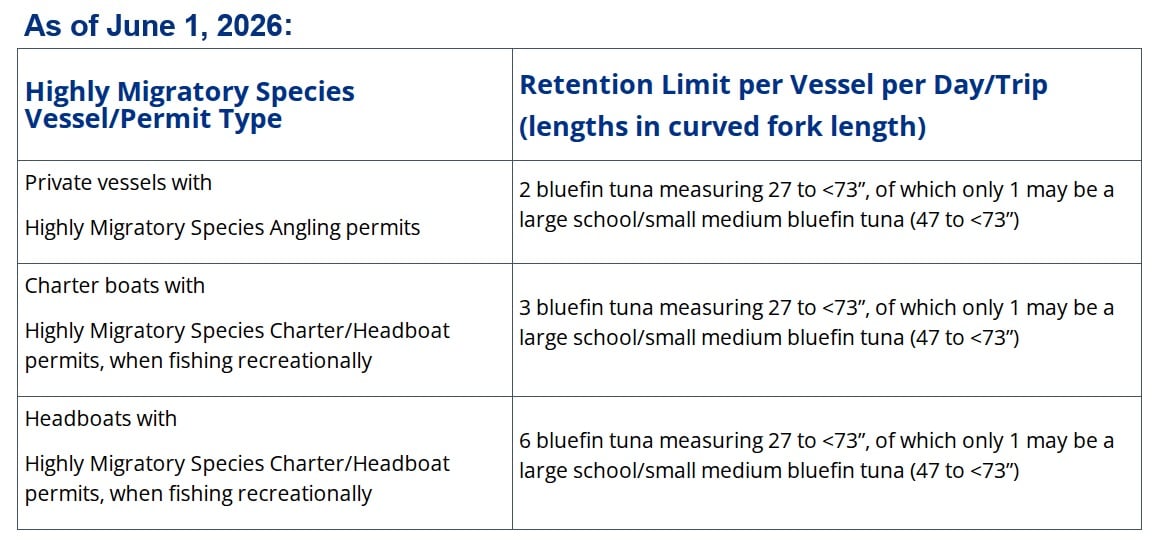
Albacore/Longfin No minimum size, no bag limit Bigeye 27” minimum size limit, no bag limit Bluefin (see chart below) Skipjack No minimum size, no bag limit Yellowfin 27” minimum size, three per person After an emergency closure in 2025 prematurely ended our recreational bluefin fishing along the Atlantic, a May 27, 2026 email blast from NOAA Fisheries to HMS Permit holders came as welcome news to start the season. “NOAA Fisheries is adjusting the Atlantic bluefin tuna daily retention limits for recreational fishermen,” the alert stated, explaining how these adjusted limits take effect as of Monday, June 1, and extend through December 31, 2026, “unless modified by later action.” While the “trophy” subquota for bluefin 73 inches or greater was met and thereby closed in the Southern New England Area effective July 3, the breakdown of recreational bluefin limits for private vessels, charter boats and head boats continues to keep rods bent and bluefin on ice.
|