August comes with a quiet transition to fall, and if learn how to time it, you can reap the rewards in secret solitude.
I married a teacher, so I am constantly reminded of how fast the summer is going by or how close we are to September. Adding afterburners to my lightning-speed summers is the fact that I work on deadlines that have my mind riding a month ahead of real time; so when you’re lamenting the summer doldrums in late-July I’m already bathing my brain in the adrenalin of albie season and the fall striper migration. It’s a double-edged sword that has me prepared ahead of time as seasons and bites change, but can also lead to quitting too soon, if I’m not careful. But I am careful.
One month where this collision of writing into the future and my wife’s mounting panic chatter has really worked in my favor, is August. Practically everything I’ve ever read on summer surfcasting talks about August being the toughest month, all the old school legends talk about it; Daignault, Coleman, Golofaro etc. and in my early years of surfcasting obsession, I nearly fell into the trap of just ‘keeping it honest’ in August while waiting for September to save my sanity. But in 2007, that attitude was slapped into submission and I started paying attention.
Falling Into Place
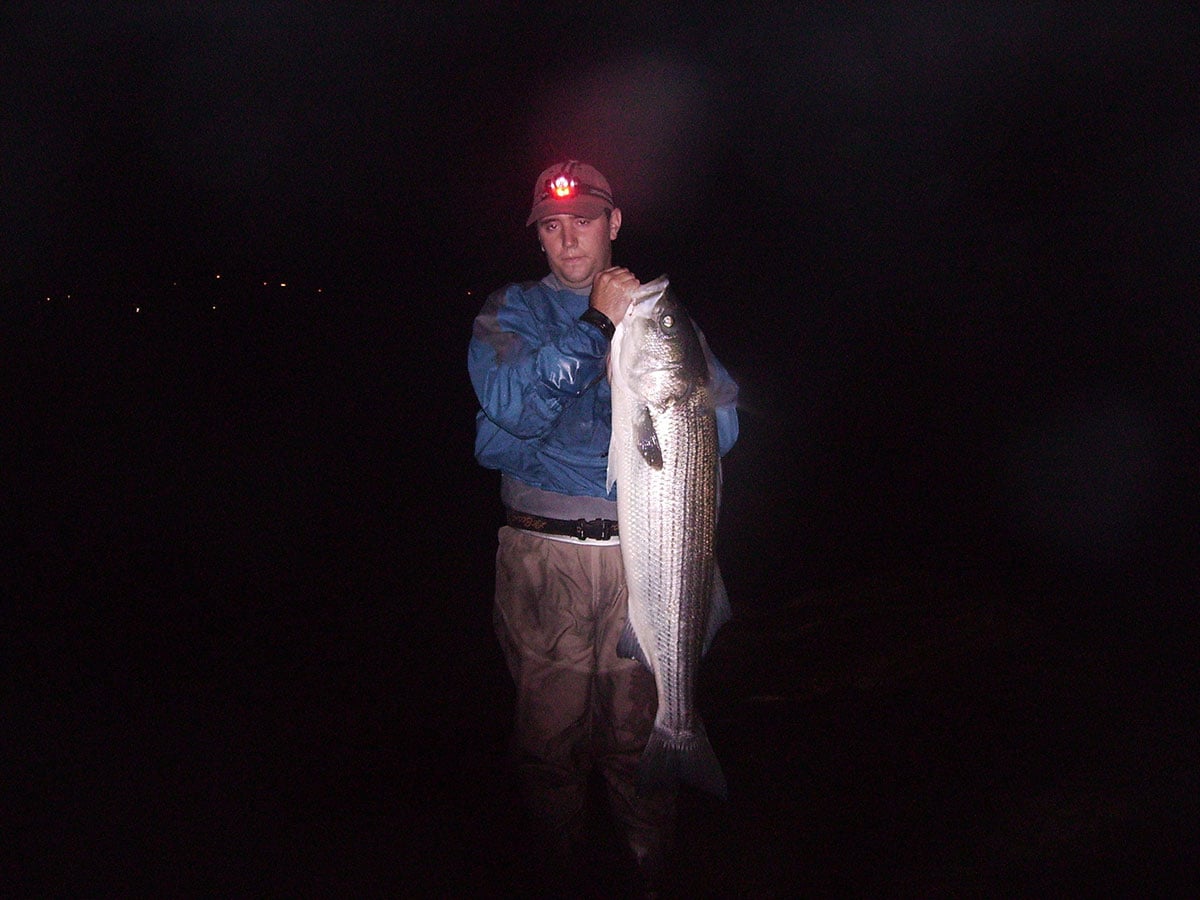
It was early-August, just a few days off the full moon (July 30), I was fishing with a really great friend who I’ve since lost touch with, Mike Ludlow. We were spot-hopping around Rhode Island and catching almost nothing when he got a late-night text from his friend Josh, the message read something like “I found a ton of fish tonight, all of them over 30 pounds with the biggest going 48 inches.” I didn’t hear from Mike for 10 days after that and then he finally called me and basically said, “Dude, you have to get up here, we’re crushing giant fish every night!” That began a string of nights that put me on the best bite of big fish I’m likely to ever experience in my life, and this is coming from someone who experienced many of the wildest blitzes the Canal had to offer from 2008 to present.
While it didn’t land immediately, that incredible blitz started a slow-burning fire of revelation that took several years to piece together. It started there and was then fueled by the reliable August bites of big bass that invaded the Canal each year. As time wore on, there were indicators that would foretell the beginning, crystalizing moments that signaled that it was time to fish like it was September, even though it was supposed to be the middle of the summer doldrums. I began to realize that the fish were telling me what I should have already known, the first day of September is meaningless to a species that has no concept of time, and I should have known that it would be environmental factors that came together to kick the pre-migration into gear.
Even the concept of a ‘pre-migration’ was foreign, it wasn’t talked about in books, I’d never read an article about it. But when you think about it, this idea makes perfect sense. Striped bass have an ingrained and instinctual impulse to migrate when something we can’t feel, tells them that it is time. The feeding frenzy that traces the coast the each fall, widely referred to as ‘the fall run’, has been accepted as a ‘bulk up’ period where migrating stripers are stockpiling calories for their long journey home. Knowing that stripers react to instincts and seeing how they will bulk up ahead of a major storm, it seems only natural that that they’d ‘pre-game’ before beginning their actual migration and that’s probably what we were experiencing on those August nights in 2007.
Indication #1: A Big Rain
As this pre-game theory began to sink its roots in my brain, I began to notice patterns that seemed to hold the power to set the migration into motion. One of these indicators first became apparent when we saw an incredible run of big stripers in the Canal in August of 2014. The blitzes at this time had been going on since mid-July, but they really caught fire in August and we were starting to see things firing off at all times of the day and sometimes during tides that weren’t typical for clashes of bait and bass. These flare-ups would sometimes happen with no apparent change, but one thing that was just about automatic was a thunderstorm. And I don’t mean during the storm, I mean sometime within 2 to 24 hours of a good old summer soaker.
The reason hit me like a handful of glitter thrown in my face one afternoon. A real gully-washer had run through the area early that morning, and I was arriving ahead of an afternoon west turn, because those first few hours of west tide had been bringing piles of mackerel in from the east end and the bass were intercepting them every day around the power lines. I was early so I could get a good spot and before I passed the herring run, I stopped and looked into the water. First of all the run was absolutely puking water after that morning’s heavy rain and millions of glittering herring fry were being ushered into the Ditch by the heavy outflow. Looking toward the east end, there were herring fry running the bank in that east tide as far as I could see. So of course the mackerel were rushing into the canal when that tide switched, they wanted to keep feeding on the herring fry!
This phenomenon is not solely confined to the Canal, nor does it only apply to young of the year river herring. Estuaries are the nursery grounds for many of the baitfish species that fuel our fall run fishing each year. From mummies and silversides to peanut bunker and mullet, a prolonged downpour and the resulting washout can flush these baitfish out of smaller backwaters and set off clashes with stripers or other late-summer gamefish. I can’t say for sure if it’s the just the increase in water leaving the estuary, or if the salinity drop brought on by the sudden influx of fresh water has anything to do with it, but a good soaker in August, especially during a drought year, can signal the beginning of good surf fishing for striped bass.
Indication #2: A Cold Snap
I think it would be hard to find anyone that loves the outdoors that hasn’t walked out of the house on that first cool evening of the summer (usually in August) and uttered the phrase, “Ooh, it feels like fall tonight!” These moments land with real weight, just like those rogue 70-degree days in April get you fired up for the spring run, a cool evening in August should stand out as a good reason to step up your surf patrols.
String together three days or a week of sub-average temperatures and some observable movement is likely to begin happening along the oceanfront. Those same herring fry and other backwater baitfish species will begin to feel that drop in temperature as these estuarine waters transfer their heat to the air striving for thermal equilibrium. A few degrees of drop over the course of a couple days can be all that’s needed to send the first schools of bait scurrying out of the inlet to meet a rush of predators they couldn’t dream of in their backwater homes.
Your first indication that this might be happening is likely to be increased bird activity, unless you happen to see schools of bait exiting an estuary or running along the beach. Luckily for us, these temperature drops almost always come with a wind change which typically kicks up the surf and that combination of bait activity and wave action is usually enough to send a few stripers in to find that bait. And once that fuse is lit, some kind of explosion usually follows. In other words, keep your finger on the pulse of that action until you have a good reason to stop!
Indication #3: Coastal Storms
As a homeowner, you can bet your left big toe that I am not praying for a hurricane or tropical storm to take aim on New England. But when a hurricane swings just south and east of Nantucket sending in a low ceiling of gray clouds and day of massive swells; or when a spent tropical system barrels up the coast and gives us ‘just a little taste’ of tropical weather, I feel myself fill up with cautious optimism. I say ‘cautious’ because sometimes these systems just mess things up for a few days and then the fishing goes back to late-summer ‘normal’ or, sometimes another factor has already touched things off and few days of heavy swell shuffles the deck.
I find the best way to get the most out any storm-driven advantage is to make yourself a slave to monitoring forecasts. I split my attention between the NOAA Marine Forecast and one of the many phone apps geared toward surfers like Windy, Magic Seaweed or, my personal favorite, Wind Finder. I’m also a religious Weather Channel guy, so when Jen Carfagno or Jim Cantore tell me that there’s a tropical system that might affect the Northeast, I begin monitoring these apps for timing.
The trick is to get out there just before the conditions really deteriorate. And, of course, to stay safe in the process. I’ve seen it happen many times, where a short period of swell turned summer into fall run fishing weeks ahead of flipping the calendar page. But sadly, I’ve also seen a great bite killed by the same conditions. But it’s that in between period, when the swell begins to get nasty, that seems to always produce increased action.
Indication #4: The Moon
In years where the August weather remains more or less stable, the moons often serve as a turning point for that pregame bulk-up period. One thing I have noted over the years is that this possibility goes way up when the tide heights feature a particularly steep difference. An average moon tide along the oceanfront in Rhode Island is around 4 to 4.4 feet, but if I see that number climbing up closer to or past 5, I tend to get giddy. The same goes for low tides, typically in Rhode Island we see low tides listed at 0.1, but if we start getting into negatives, my excitement peaks. The disparity between these numbers can be read as how much water is going to move over the 6-plus hours between high and low tide, the more water that moves, the more likely it is that you’ll be fishing that first tide of the pregame.
Since I am such a big believer in the moon’s power to move fish, I don’t have a burning urge to know exactly why, but one thing I will say about strong tides at the very start of the fall run pregame is that they push a lot of water into the same backwater nursery areas and then, that water has to come back out and it comes out in a powerful surge, bringing those yearling baitfish out with it. And if you stack the power of a bigger tide with one of the other factors, a big rain for instance, the chances of lighting that fuse increase by a lot.
Other Items Of Note
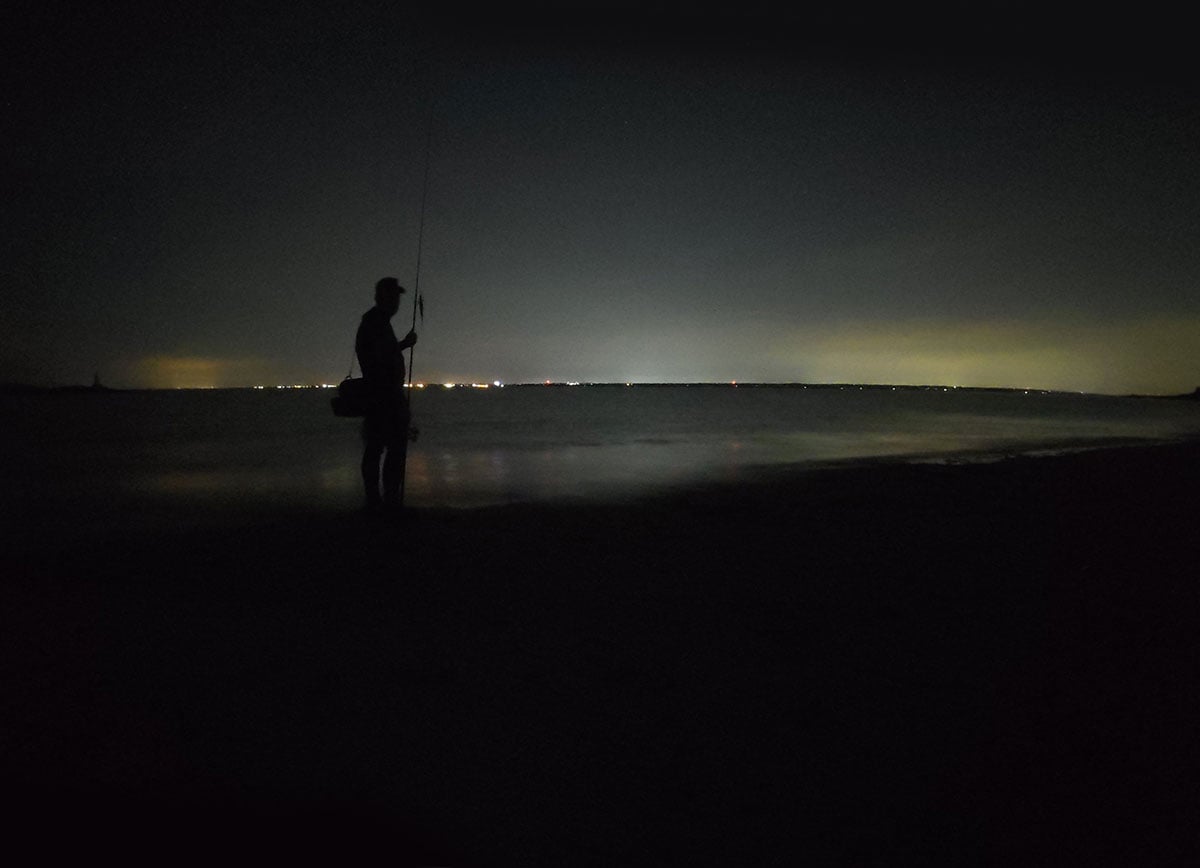
When the weather is the factor that you believe might turn things on, don’t talk yourself out of fishing on a gloomy summer day. While I would urge you spend most of your fishing time plying the surf in the dark, a snotty day might produce some great catches, especially if you target some rougher water spots within close proximity to an inlet nursery area. Or, you might not catch anything but you might be able to spot activity under birds or surrounded by boats that will signal to you that the weather has moved some fish and their daytime location, even if it’s way out of casting range, might help you make a better-informed decision after dark.
Another thing to pay close attention to is the size of the baitfish the bass are feeding on. You can find this out by watching fish blasting bait in daylight, shining your red light into tide pools at night, checking the throats of landed fish for tails or walking the shoreline and looking for baitfish washed up on the beach. Even though we’re flipping that switch from summer to pre-fall pregame, the fish can still be “summer selective” and matching size and profile is often the gateway to getting more bites.
As much as we like to follow hard and fast rules and set concrete boundaries, like the start of a new month, the natural world just doesn’t work that way. The stripers and the baitfish they crave are keyed in on natural cues that tell them when to bulk up, when to move and when to make that inshore swing that sets up that season-making meeting with you in the surf. August is not a lazy month of keeping the surf honest, it’s a time when the first phase of the fall run kicks into gear and most surfcasters miss it because they’re laser-focused on the calendar.
Don’t let that be you!