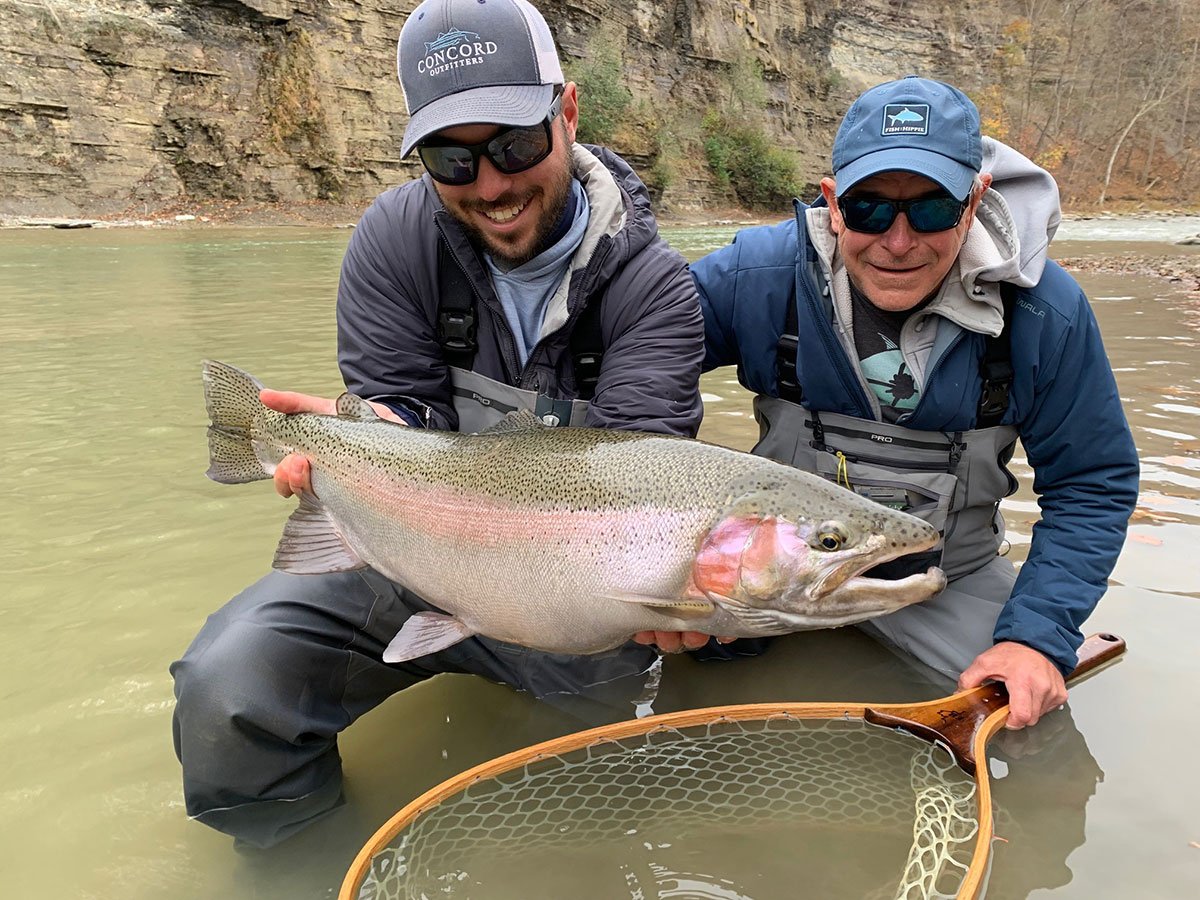
Get your steelhead fix on New York’s picturesque Cattaraugus Creek.
Most anglers consider flyfishing for steelhead to be a high-end affair, involving cross country flights and luxury lodge accommodations in the Pacific Northwest or Alaska. But surprise, there is excellent steelhead fishing far-closer to home – within driving distance – that’s both accessible and affordable. It also takes place in some rugged, truly beautiful country.
I am talking about the November lake-run steelhead fishing of western New York State. The water is cold, the air is crisp, and the fish are strong and abundant. But it’s the scenic beauty of the area that unexpectedly steals the show.
I made the trip to Cattaraugus Creek (the “Cat”) 2 years ago and the striking landscape nearly outshone the fishing. The memories remain strong – a swirling mix of deep canyons and late autumn colors and the morning smell of pine. The fish are there too, but set into the scene as an element of it. Spectacular and strong and each one special, but not more so than the natural setting they inhabit.
The Fish
Put simply, steelhead are rainbow trout that are anadromous, meaning they are born in freshwater and spend part of their lives in the ocean, returning to rivers and creeks where they were born, to spawn. Just like salmon.

Unlike salmon, steelhead do not die after spawning and make the journey to the sea and back repeatedly. And because of the ocean’s rich food sources, they get very large, sometimes reaching 20 pounds and over 3 feet in length. Named for their metallic hue, traditional sea-run steelhead migrate from the Pacific up the rivers of the northwest, from California to Alaska. With names like the Deschutes, Umpqua and Rogue these steelhead rivers are legendary.
Lucky for us, in 1876, a man named Daniel Fitzhugh Jr. had the idea of seeing if sea-run steelhead might treat the Great Lakes as an “ocean” and mimic their instinctive migratory behavior. Smolts from California were brought east and introduced into the upstream gravel beds of the Au Sable River in Michigan and it worked!
Soon “wild” populations of steelhead established themselves across the Great Lakes and their drainages, including Lake Erie and Cattaraugus Creek. Just like their saltwater cousins, they returned from the depths of the lake each year to swim up the river or creek where they were born. Once lake-bordering states realized the economic impact of steelhead fishing, highly-successful hatchery programs sprung up to augment fish taken for the table and sub-par upstream spawning conditions.
Lake-run steelhead are typically smaller than their bruiser oceangoing western relatives, but the volume of fish and the accessibility make them well-worth the trip. A 4-year-old New York steelhead can weigh 10 to 12 pounds and measure over 30 inches. Once in the river, they take on the stunning iridescent pink and red and green mosaic that gives rainbow trout their name. And these fish are really strong! For most, hooking and landing a steelhead this large on a 6-weight fly rod is a once-in-a-lifetime sort of event. On the “Cat’ and other nearby rivers, it is a fairly common occurrence.

Location & Access
About an hour south of Buffalo (or 8 hours from Boston), Cattaraugus Creek is the northeastern-most of a string of over a dozen steelhead-holding rivers and creeks lining the southern shores of Lake Eerie, all the way to Cleveland, Ohio. Called “Steelhead Alley”, this area is famous for the sheer numbers of fish available and relatively easy accessibility.
What makes the “Cat” stand out is the topography of the region – the land itself. The river cuts through soft, white Gowanda Shale, forming the stunning Zoar Valley Gorge. Boasting 14 miles of steelhead-holding pools and riffles, the Zoar Valley impacts most anglers profoundly, with its 400-foot cream-colored cliffs, bald eagles soaring overhead, and second largest stand of old-growth forest in the state. The multiple use public area that contains the Zoar Valley is huge, at nearly 3,000 acres and yes, a river runs through it.
In total, there are 43 miles of excellent steelhead water on the “Cat”, from Springville Dam to Lake Eerie, with an average depth of 2 to 6 feet and up to 100 feet of width. Because steelhead are always moving up-river, every day is different, with new fish moving in and “drop back” post-spawn fish sliding downriver. A pool might be empty one day and hold a dozen huge steelhead the next morning.
Wading the “Cat” is done by researching/locating public access points along the river and hiking in. Be sure to check for and respect private property signs on the banks and remember there is a lot of walking involved, as you will want to move up or downstream constantly to find where fish are holding. A section of the river is Seneca Nation tribal land, so be sure you know where you are. A special permit can be obtained locally to fish these waters.
Nearby Fredonia, NY is where most anglers who fish the “Cat” stay and there is the usual assortment of hotels, restaurants and grocery stores. Lodging is very reasonable and the Ellicottville Brewing Company is the top spot in town for an excellent burger and a cold craft beer after a day on the river. Very close to Canada, this is Tim Horton’s territory, so don’t bother looking for a Dunkin for your early morning coffee and breakfast sandwich.

The Gear
Most flyrodders use a 6-weight, 9- or 10-foot setup, employing the “Alaska egg” technique of nymphing using an egg-imitation bead with a small hook trailing an inch or two below it. Indicator fishing. While some scoff at this method, it’s very effective and harder than it sounds, as the slightest drag on the line usually means no takes. Better have your mending game dialed in tight. The extra foot of a 10-foot rod can make a big difference when high sticking a pool or deep run.
Swinging a leach pattern can also produce well, and Spey rods can be an efficient way to reduce the effort it takes to double haul a 6- or 7-weight fly line across a wider part of the river over and over. While the fish are technically not interested in feeding as they migrate upriver, they will strike at something near them on instinct, especially if that something looks like a tasty salmon egg or fat leech.
Because you will be walking in and the November weather can change fast (and there’s always the chance of an accidental plunge), a waterproof “drybag” style pack is key. Load it with a backup base layer, a winter hat, lunch and water, sunscreen, and whatever else you might need. A headlamp for the hike out is also a good idea. Walking all day requires solid, high-end breathable waders and sturdy, proven wading boots. You will trash cheap gear fast, as this is rocky, rugged terrain. On top, I wear layers of synthetics, with a waterproof breathable wading jacket and a thin down “poof” under it.
Leave your little brook trout landing net at home and be sure you have all the usual fly gear like forceps, lots of patterns/egg beads, split shot, leaders, tippet, etc. There are no facilities or trash cans once you are down in the Zoar Valley, so pack in and pack out is the rule.

The Fishing
Obviously, conditions can change due to weather and other factors, but generally speaking this is an excellent fishery. I am pretty decent at mending, but no expert, and I caught two steelhead in the first or second pool I tried. I was alone on the river and took a photo that I treasure of a male (“buck”) at my feet in the current. My first steelhead. Over the course of the next two days, I landed at least ten really nice fish and some of the people I was with caught some true giants. While I think you are allowed to take some for the table, everyone I saw was practicing CPR (catch, photograph, and release).
Before you make the trip, check the weather and online water level/flow reports. Due to the area’s soft sandstone, flow and turbidity (water clarity) are key factors and rains can quickly make the “Cat” unfishable. A moderate flow between 150 and 300 cubic feet per second is the ideal range for most Lake Erie tributaries, as this allows for comfortable wading and active steelhead. Remember, even if the “Cat” is not fishing well, there are a lot of other options in the vicinity.
| DIY OR GUIDED? |
| The biggest benefit to hiring a local guide on the “Cat” or another river in the area is that they typically have permission to access private water. A guide will also know “how the Cat is fishing” and can take you to other options if conditions are not ideal. Obviously, they will also net the fish for you, re-tie your fly if you break off, and provide tips and guidance that can make a big difference. Reel Action Flyfishing seems to be the top outfit in the area and you can contact local Paul Jacob and his guides via www.reelactionfly.com. Or, you can explore on your own. Better yet, get a flyrodder pal to join you and explore the area together. Guided or DIY, I promise you will never forget your first steelhead on the fly. Remember to purchase a New York State fishing license online prior to wetting a line and know your regs. |
As previously-mentioned, the constant movement of the fish upriver means the pools are “refreshed” all the time, so you can hook the steelhead of a lifetime on any cast, even on pressured stretches. Also, I quickly learned that, just because there are people fishing a hole upstream, does not mean they hooked the fish in it. In fact, if they were poor at mending or generally novice flyrodders, they might not have hooked any.
Normal fishing decorum should be observed, which means going around anglers already fishing a pool or hole, or waiting for them to move on. While the Cat and the Zoar Valley can be popular spots (especially on weekends), the sheer size of the river and the scale of the landscape keep it feeling remote and relatively uncrowded, at least in my opinion.
The fish tend to hold in deep pools, usually at the head or the tail end. Because the water is usually a bit off-color, you do not have to be stealthy and sight fishing opportunities are rare. Just watch for that indicator to pause, set in a downstream direction and hang on!
Cold Steel
Now you know. Big, beautiful, strong steelhead are within driving distance of Boston. The pure power of these Great Lakes-run rainbows is hard to beat on any gear, but they are really special on a 6-weight flyrod. And the rugged beauty of the landscape is an unexpected bonus. While they are not quite the sea-run giants of the Pacific Northwest, these introduced cousins are just as colorful, far more plentiful, and pull every bit as hard.
I made a canvas print of my first steelhead, in the water, at my feet and for reasons I still do not fully understand, my wife agreed to let me hang it in our kitchen. I look at it every day and think of the wild, unexpected beauty of Cattaraugus Creek and the Zoar Valley and the special fish that make their annual late fall run up its riffles, to hold in its deep pools. I’ll be headed that way again this November and hope to see you on the river.
Wilson Kerr lives in Concord, MA and is an avid outdoorsman and amateur naturalist. He writes a monthly Time Outdoors column for The Concord Bridge, is a member of the New England Outdoor Writers Association and has contributed articles to The Fisherman Magazine, the MV Derby Souvenir Booklet, Vineyard Style Magazine, The Concord Journal and other publications.