Great fishing awaits those who keep fishing Long Island Sound into November.
While November might signal the ‘beginning of the end’ for striped bass and many other species inside Long Island Sound, flipping the calendar to the eleventh month still promises many opportunities ahead and for multiple species! In fact, on some of our best November trips we’ve been able to catch striped bass, bluefish, tautog and even false albacore on one run, if that doesn’t tell you anything else, at the very least it should tell you that if you’re quitting before November, you’re giving up to soon!
Stripers & Conditions
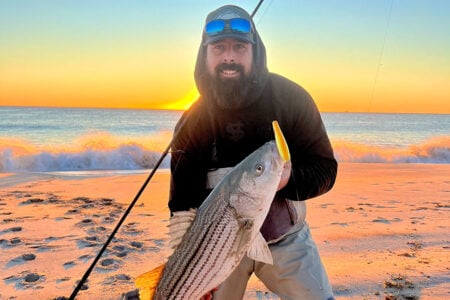
We see stripers throughout most of the month during ‘typical’ years, meaning relatively stable weather and water temperatures The final push of stripers in November will be dependent on water temperature, bait, and the weather. There have been many seasons where we have had good pushes of stripers, through mid-month and even into late November. The past two season we’ve had great striper fishing in Eastern Long Island Sound up until the end of November.
But, if water temps take a hard dive, these fish can disappear as if someone threw a switch; vanishing overnight, in astonishing fashion. When a body of stripers vanishes like this, don’t assume that the season is over, fall back to a Plan B like chasing tog and wait for the next push of stripers to arrive. I typically wrap up my chartering season around November 20th, but some years the fishing has been good enough that I’ve run a few trips into early December. You just have to keep your eye on the conditions.
Find The Bait
One of the major factors when it comes to staying on stripers is to locate the bait, specifically the peanut bunker. In an ideal late-season scenario, the peanut bunker will be out along the beaches and the stripers will be marauding these schools of peanuts. If you experience this, expect the action to be fast and furious. Small lures that mimic peanut bunker are ideal, such as 5-inch topwater lure like the Jumpin’ Minnow or small 4- to 6-inch soft plastics such as a Slug-Go or Fin-S Fish. When the stripers are not showing on the surface I located dense schools of peanuts using my Humminbird Side Imaging sonar. Sometimes you’ll see the bass with the schools of peanuts, sometimes you won’t, but they’re always worth making a few exploratory casts.
As the stripers migrate through Long Island Sound you can find them on the many reefs like Bartlett’s, Hatchet’s, Long Sand Shoal, and Six Mile Reef. These fish are taking advantage of other baits that are using the structure for cover. If we have a mild November with calmer winds, you can expect this bite to last all month long… but cold, rainy and windy conditions can get these fish moving. In 2018 we had a great bite in and around the mouth of the Connecticut River during the first week of November, then overnight we had heavy rainfall and the water temperature plummeted from 56 to 46 degrees, and all the stripers left overnight. After a little searching to the west, we were able to find those fish again along the adjacent beaches, and we enjoyed good action for another week, before things tapered off.

Gearing Up
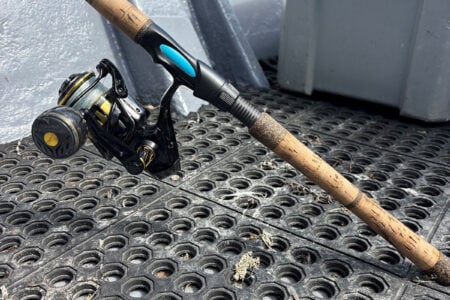
Smaller stripers are more temperature tolerant than large ones. The bigger 20 plus pound stripers will be the first to migrate south. Stripers under 20 pounds make up most of the action at the end of the season. Because of this, the majority of the stripers caught in November will typically run between 18 and 32 inches. This means scaling down your tackle to cast small lures. My go-to setup is a light-bodied 3000 or 4000 series spinning reel like the Shimano Twin Power XD or Vanford spooled with 10- or 15-pound Power Pro Super Slick V2 paired with a rod rated for 3/8 to 1 ounce such as a G Loomis IMX Pro Green 843S or GCX 843SF. These setups will perform well when throwing small topwaters, unweighted soft plastics and will also get the job done when fishing deeper with jigs.
When fish are suspended on a reef or in a channel I fish a 5-3/4-inch Lunker City Fin-S Fish on a 3/8- to 1-ounce Titan HD jighead. These work very well in the current, when fish are near the bottom and not willing to come to the surface. If the fish are on shallow flats or hanging below the surface, a 5- to 7-inch unweighted Slug-Go will often draw strikes. If you come across stripers blowing peanut bunker out of the water then 4- to 6-inch “walk the dog” style topwater lures or poppers will shine, creating some exciting and visual action. If the fish are stacked up on the deeper side of the reefs, in 30 to 60 feet of water then vertical jigging an 80-gram Shimano Current Sniper Jig (or similar) can be very effective. I have also had some late season success drifting live eels in the daytime.
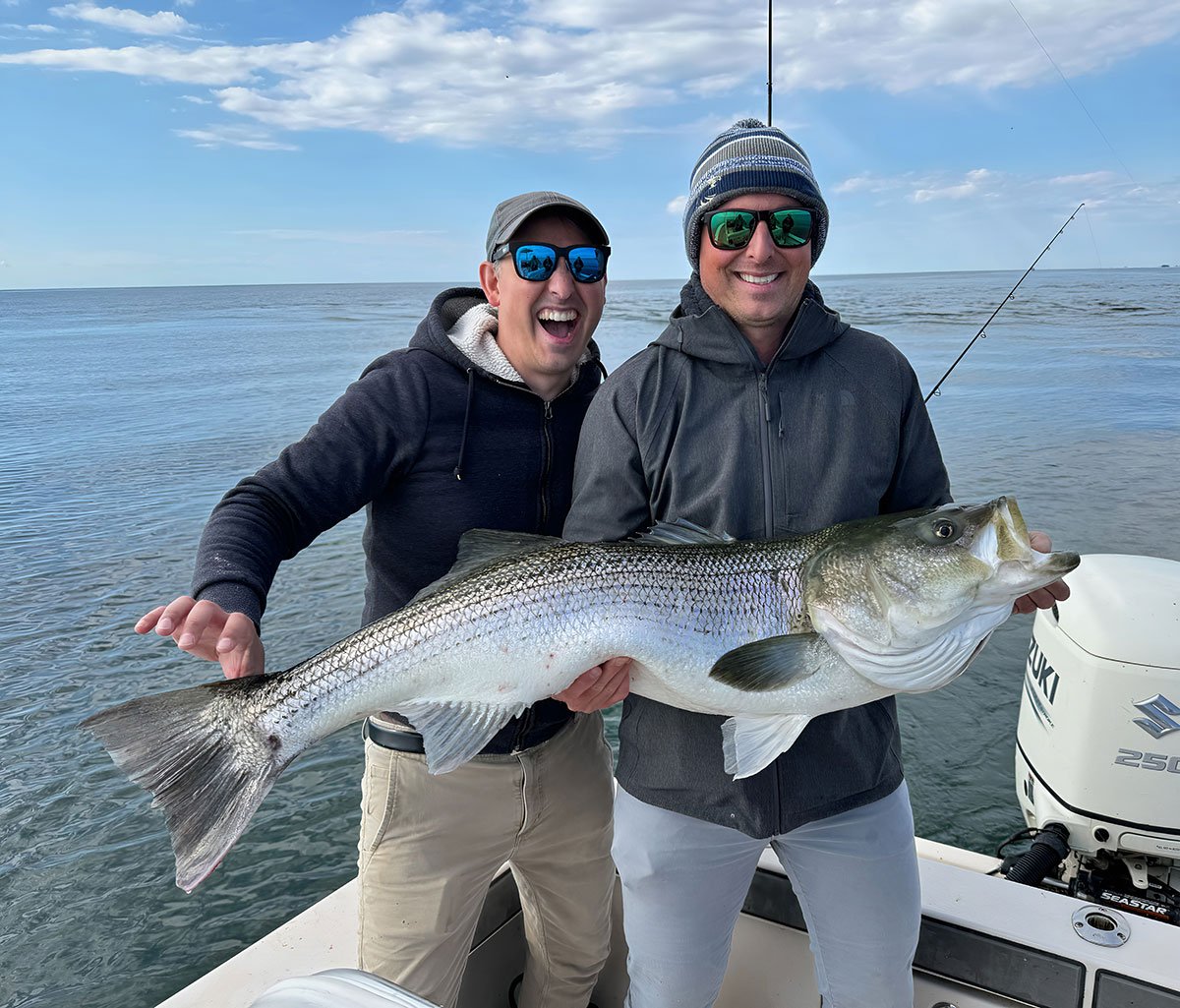
With all that said, not all of the stripers you’ll find in November will be on the smaller side. Back in 2016, for example, the adult bunker stayed in the Connecticut River until the end of November. As a result, we found a great late season striper bite in Eastern Long Island Sound. This incredible action lasted for about a week (ending on November 10th) and we caught many stripers in the 20- to 42-pound range on live bunker. These big stripers made a pit stop because of the amount of adult bunker holding in the area and we were there to cash in. When adult bunker are present, using large topwater lures like the Shimano Splash Walk, large soft plastics like the 10-inch Fin-S Fish and other large swimming plugs like a Danny, Atom 40 or 7-inch Red Fin can make for great alternatives if you don’t have or can’t get live bunker.
More Possibilities
| GREAT TIME FOR THE FLY |

This is a great time of year to catch fish on the fly and I have had clients that have been successful casting 8-weight fly rods, rigged with an intermediate line and a Clouser minnow. This setup works well for schoolie stripers and hickory shad. Shad are common in the rivers and along the beaches this time of year and they willingly eat small flies. They are a fun bonus that put on an acrobatic fight. |
It might come as a surprise to some that we often see albies as late as November 15th, but this is a fact and it pays to be ready for them to show up. Last season (2024) was a very poor year for albies, but so far in 2025, things are looking good so – fingers crossed – we may have a shot them in November this year. This month, the albies will usually be near the schools of stripers as they are both following the same bait schools. You can often find them in the well-known albie spots such as Montauk, Watch Hill, and the Race but it is also common to find them chasing bait balls along the beaches. The tactics for catching them during the eleventh month are the same as earlier in the fall run, small soft plastics such as Albie Snax work well, along with tins and resin jigs like the Current Sniper or the wildly popular Exo Jig. The basic mode of operation is to go out looking for bass but make sure you’re rigged and ready in case the albies or bonito pop up.
Throughout the month of November there will be “waves” of slots and schoolies migrating east to west through Long Island Sound. I believe many of these fish eventually end up holding over in winter holding areas like the Housatonic River. It’s not uncommon for the stripers to be gone one day, only to be replaced by a new push of fish within a few days. On the days when the stripers are sparse we fall back on tog fishing which gives us a solid backup plan.
I always have a bucket of green crabs in the boat during this time. Tog fishing is also a great option when the tide slows and the bass stop biting. Tog inhabit bottom structure, look for any rocky bottom, muscle beds and wrecks. Anchoring with my Minn Kota Instinct Quest is a breeze as you simply push a button to engage spot lock and hold the boat in position. The boat can also be move in 5-foot increments. Sometimes making a small move can make a big difference as being precisely positioned on structure is critical. In November, the tog are typically deeper – say 30 to 60 feet – so a traditional single-hook tog rig and sinker works best. We basically just run a paper route of rocky reefs trying looking for a spot that’s giving up keeper-size fish. They’re challenging to hook, fight hard and are great to eat, too.

Bottom of the Ninth
As the season winds down and we close in on December, there are striped bass that run up into several of the tidal rivers throughout the Sound. This period of backwater migration is a great time to take advantage of these over-wintering striper populations. Early December is prime time to target these late-running stripers that will hold over in local rivers before it gets cold and they become lethargic. The 5-¾-inch Fin-S Fish on a half-ounce Titan HD jighead is the prime bait. We have also been successful using paddle tails in the same size. Cast the jig cross current let them sink and work the lure in the bottom third of the water column, the hit will often be soft so set hard on anything you feel. This is another situation where your electronics can really pay off big, so use your sidescan to cash in.
November is not the end, it’s just the beginning of the end and how you go about fishing this month may dictate your sanity as the winter wears on. Hopefully this timeline will keep your rod bent all month long. And who knows, maybe you will find yourself out there on one of those perfect late-season days where you land stripers, blues, albies, bonito and tog, all in the same trip. The only prerequisite is that you get out there and fish!