How staying flexible with tackle and techniques can lead to incredible mixed-bag fishing opportunities in Smithtown Bay during June.
There’s a lot happening in Smithtown Bay during June. Anglers have their choice between porgies, fluke, striped bass, bluefish, and even the occasional weakfish. Most fishermen focus on fluke this time of year, others dedicate their trips to porgies, while a smaller group leaves the dock in darkness to diamond jig the rips or snag bunker for live-lining striped bass.
Regardless of the options, fluke remain the primary focus in June, and for good reason. Aside from being one of the best-eating fish in local waters, fluke are close to home, the recent fishing has been consistently productive, and there are enough legal fish around to justify the effort. Add in the appeal of fishing light tackle and it’s easy to understand why so many anglers commit to drifting for fluke all day long.
I’m no different, but I also keep an eye open for other opportunities, especially jigging for stripers. In June, the bay can change quickly. One minute you’re drifting a sandy flat for fluke and the next there are birds diving over bass feeding on sand eels. If you’re prepared, those moments can completely change the course of a trip.
The Commitment To Jigging
Most anglers who jig for stripers in June commit fully to the program. They leave early and run toward Eaton’s Neck, Mount Misery Shoals, or the Middle Grounds to work the rips for bass of mixed sizes. Success depends on several factors including the stage of the tide, the drift selected, and the presence of bait concentrated in the moving water.
The runs from the harbor are manageable, but the process still takes time. Anglers need to locate bait schools, set up proper drifts, and adjust to changing current conditions before finding a productive pattern. While it’s possible to both jig and drift for fluke on the same outing, it’s difficult to serve two masters effectively.
Usually, this means fishing both tides and spending most of the day on the water. An angler might jig early in the morning before switching over to fluke in the afternoon. Because of that, most fishermen tend to specialize. Fluke anglers stick with fluking, while dedicated jiggers stay focused on striped bass. Still, in recent years, it’s become increasingly possible to encounter both species in the same general areas.
Being Prepared For Anything
My son Drew and I have developed a philosophy over the years, both in the surf and aboard the boat: never gear up for only one species or a single scenario. Conditions can change quickly, and if the fluke aren’t cooperating, we want to be ready to pivot immediately toward whatever opportunity presents itself.
As a result, we carry fluke rigs, porgy rigs, leaders, diamond jigs with and without tubes, soft plastics, bucktails, chum, clams, and plenty of Gulp aboard our 23-foot boat. In the surf it’s difficult to cover that many bases, but on the boat we have enough room to stay prepared for nearly anything.
That approach has paid off repeatedly over the past few years. More than once, we’ve started mornings jigging bass near the flats off Crane’s Neck before transitioning directly into productive fluke drifts later in the day. Having multiple rods rigged and ready has allowed us to capitalize on opportunities many anglers simply pass by.
The Old Guard Approach
The old guard often commits to one species and one set of tackle for the entire trip. There’s nothing wrong with that approach, but it can limit an angler’s ability to adapt when conditions suddenly change.
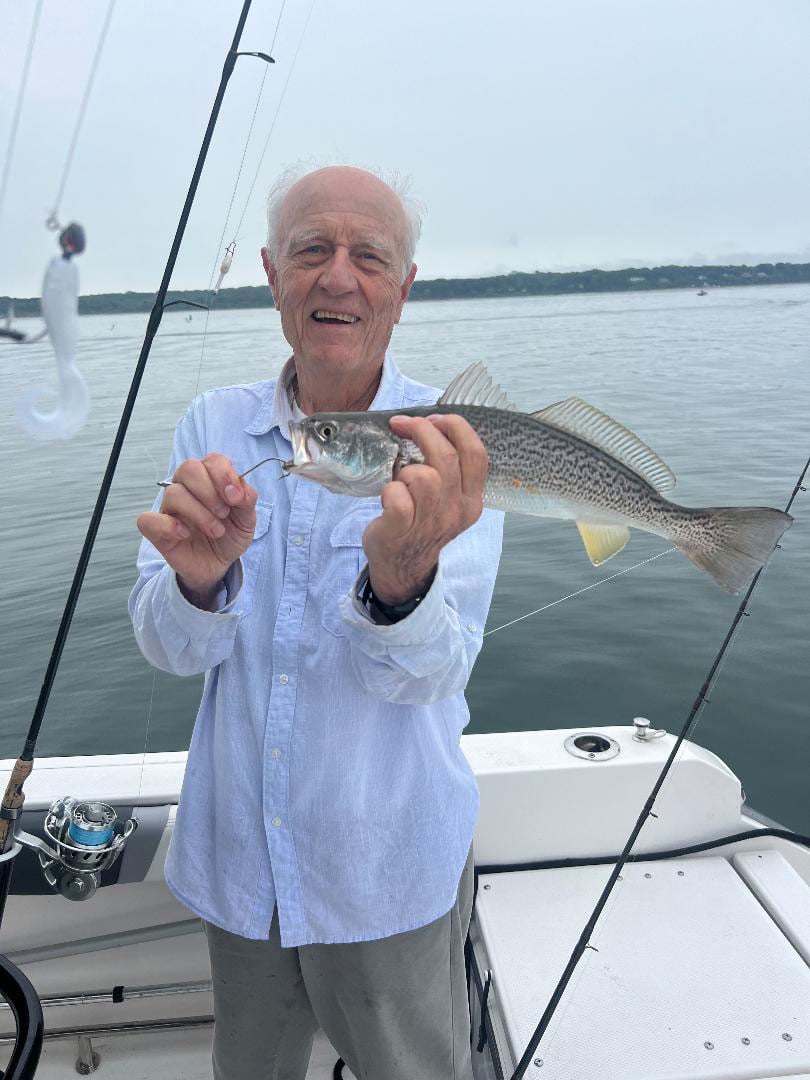
In June, surprises happen regularly in Smithtown Bay. Schools of bluefish may erupt near the mouth of the harbor, weakfish may begin crushing fluke rigs, or giant porgies may suddenly move across a drift. We’ve even encountered blowfish invasions while targeting fluke. Limited tackle limits your options and, ultimately, limits the fun.
Our inventory of diverse equipment allows us to switch gears instantly. If bass suddenly begin feeding on sand eels nearby, we can stop drifting, pick up jigging rods, and join the action within seconds. That flexibility has become one of the biggest advantages we have on the water.
Chasing Breaking Fish
One morning in the end of May 2025, Drew, Rich, and I followed the buoys out of Porpoise Channel and into the bay only to find birds wheeling in every direction and fish breaking sporadically across the surface. While dozens of boats continued drifting quietly for fluke, seemingly uninterested in the activity, we headed directly for the birds.
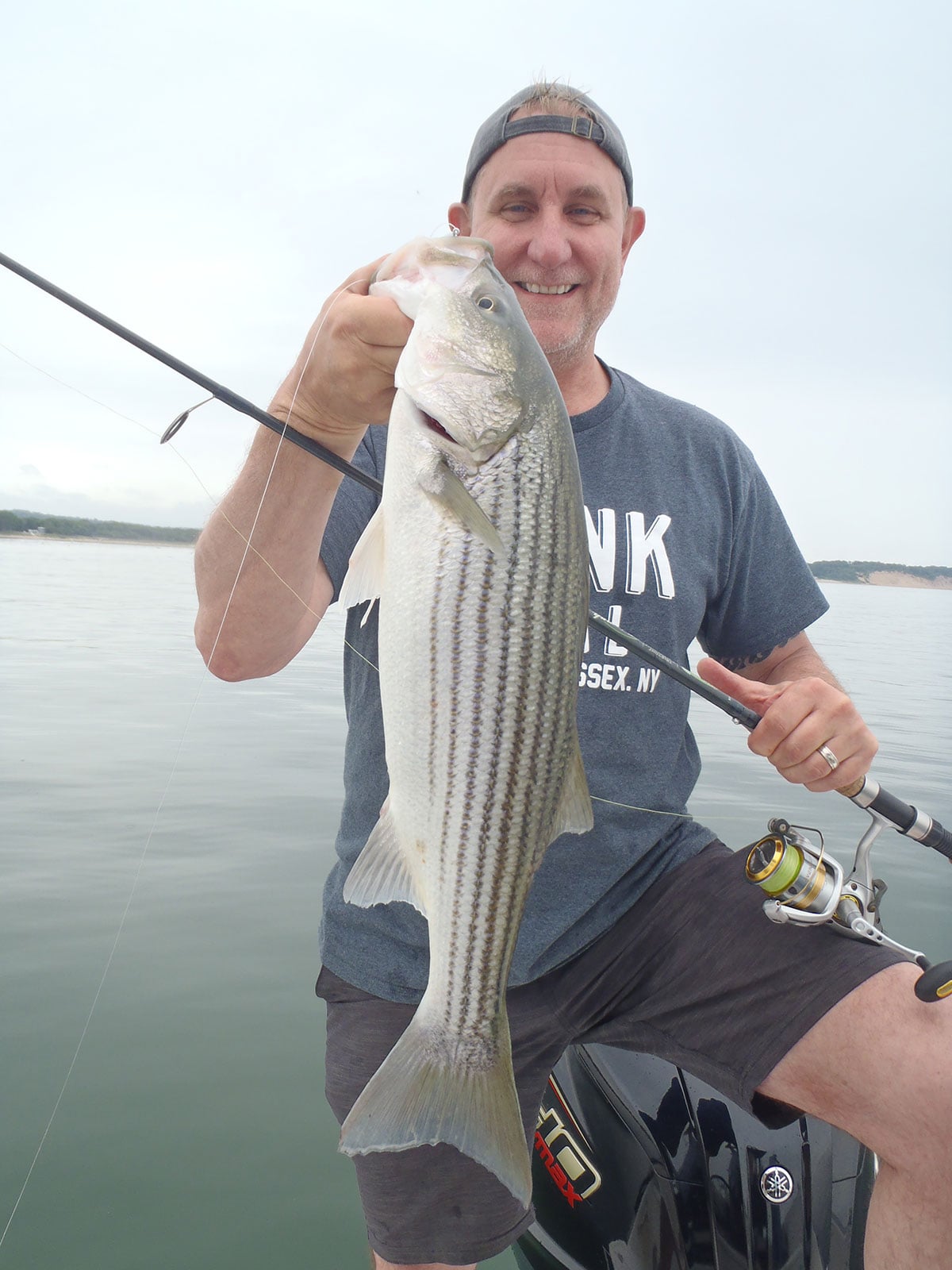
The bass were feeding aggressively on sand eels, but it wasn’t a stationary blitz. The fish moved constantly. One moment gulls would gather in a screaming frenzy and bass would erupt on the surface, and moments later the bait would scatter and the entire school would pop up a half-mile away.
I stayed at the helm while Drew and Rich fished because mobility was critical. We would race toward the latest surface activity, drop jigs to the bottom, and work them back quickly through the water column. If we arrived in time, we hooked up immediately. If we were late, the fish had already moved on.
At one point the fish surrounded the boat long enough for all three of us to hook up simultaneously. Watching Drew and Rich battle fish while I maneuvered the boat was exciting enough on its own. As someone who enjoys fast-paced action, I didn’t mind sacrificing a few hookups in exchange for keeping us on the fish.
Adjusting To Shallow Water
Traditional diamond jigging spots like Eaton’s Neck often require heavier tackle due to strong current and deep water. Anglers commonly fish A27 or A37 diamond jigs or large bucktails paired with heavy sinkers.
On the Smithtown Bay flats, however, we often found fish holding in only 10 to 20 feet of water. The relatively shallow depth and lighter currents required a different approach. To compensate, we downsized significantly and used 007 and A17 diamond jigs, light bucktails, and 3/4 to 1-ounce leadheads rigged with paddletails.
Drew used an A17 with a bright orange tube, Rich fished a pearl-colored paddletail, and I worked a white bucktail. In the shallow water, these lighter offerings reached bottom quickly and stayed in the strike zone effectively. Since the fish were spread throughout the water column, we worked the lures all the way to the surface instead of focusing exclusively near bottom like we often do in deeper water.
We also scaled down our tackle. Instead of heavy jigging outfits, we used 7-foot medium-power rods paired with Van Staal 150 reels loaded with 20-pound braided line. The setup was light enough to make school bass exciting while still providing enough power to handle larger stripers or bluefish when they showed up.
A Surprise At The Drop-Off
The Smithtown Bay flats gradually slope upward toward the south, but near the outer buoys the bottom suddenly drops off into 45 to 60 feet of water. On one particular trip, the birds and bait pushed north over this steep edge, and when I looked at the sonar I saw large concentrations of bait stacked tightly near bottom with gamefish positioned around them.
Fortunately, I had already rigged a heavier outfit with an A27. I grabbed it and dropped immediately while Drew and Rich struggled to get their lighter lures down fast enough in the deeper water. Before we drifted off the spot, I hooked up instantly.
Surprisingly, the fish turned out to be weakfish. Judging by the size of the marks on the machine, I’m convinced there were larger stripers mixed in as well. It reinforced the importance of staying prepared for changing conditions and carrying multiple setups aboard the boat.
I wanted to make another drift over the drop-off and rotate the heavier setup between us, but I was out-voted. Rich had no interest in slowing down to probe deeper water, and surprisingly Drew preferred continuing to chase the fast-moving schools on the flats.
Not For Everyone
We continued chasing fish for another hour until the rising sun finally shut the action down. The bass ranged from 20 to 30 inches, and while we had an incredible amount of action, I couldn’t stop thinking about those larger marks holding deep along the drop-off.
Drew and I love the constant movement involved in this style of fishing. There’s nothing passive about it. You locate birds, race toward breaking fish, drop jigs, hook up, and immediately move again when the school shifts position. The pace keeps you completely engaged from start to finish.
Rich, on the other hand, hates the chase. He finds the constant repositioning tedious and prefers a slower, more relaxed approach. When I fish aboard his boat and birds suddenly appear nearby, he’s reluctant to pursue them because he assumes the fish will disappear before we arrive. Everyone enjoys fishing differently, and that’s part of what makes these experiences interesting.
Over the years our shallow-water jigging adventures have produced stripers, bluefish, weakfish, sea bass, fluke, and giant porgies. The key has always been preparation and adaptability. Nature rarely follows a script, especially in June, and anglers who stay flexible often experience the best fishing of all.