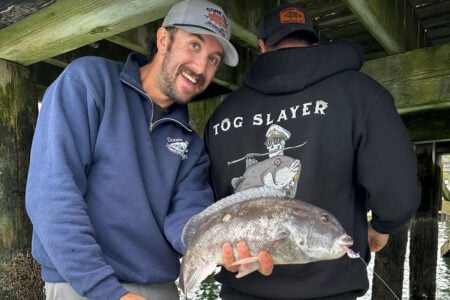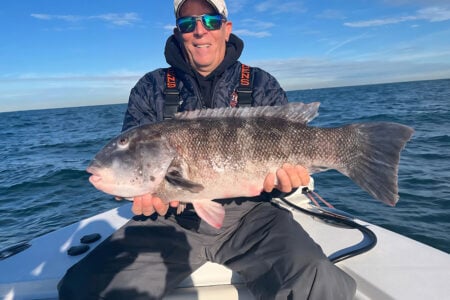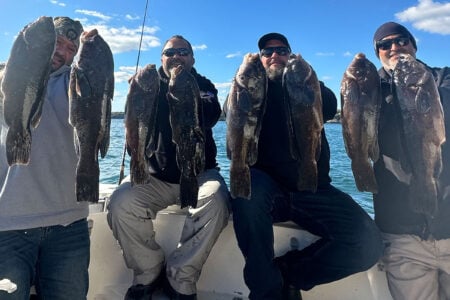
With proper precautions and technique, the kayak can be the perfect weapon for November blackfish.
The blackfish has quickly risen through the ranks to compete for the top position among fall-season inshore species across southern New England. Many would agree that the epicenter would be my home state of Rhode Island. Targeted from shore, boat and, my preferred mode, by kayak, these fish are available from April to December (within the scope of local regulations), but the real fire starts in the fall and, as water temps drop and weather deteriorates in November… the urge to take advantage of the ‘good weather days’ supersedes everything else, late-season togging is always bittersweet, but that factor increases when you do it from the kayak.
Fishing for tog from a kayak presents both unique opportunities and unique challenges. My goal is to share what I have learned about targeting tog from kayaks over the past six years. As the fall season is moving into its final stage, I hope these takeaways help kayak anglers of all experience levels to have a more productive end to the fall season.
Understanding Tog
Tautog, commonly called blackfish, or tog, are a slow-growing member of the wrasse family. They inhabit structure and use their human-like teeth to feed on crabs, mussels, barnacles, and any other small bait they can crunch. These fish live in and around the gnarliest structure, which may include reefs, wrecks, rock piles, pilings, and humps—study these carefully on your down and side imaging to build an understanding of what to look for and to learn to spot tog hunkered down in the rocks. A basic rule of thumb: the nastier the structure, the more tog you will find.
Water temperature is a major factor when deciding where to look for blackfish; if the water is under 60 degrees, you will typically need to look deep – figure 30- to 60-feet of water but as the month nears its end you may have to look as deep as 100 feet, or even deeper. When water temps are above 60, these fish will move into the shallows and can be found as shallow as 5 feet, but typically settle in 10 to 20 feet of water. As we cross over into November, we’ve usually seen water temps drop into the 50s, meaning we’ll have to look deeper.
Gearing Up
The battle with a big tog is won or lost within the first 10 seconds after the hookset, these fish are stubborn and powerful fighters and they will bury themselves in structure to break you off. Both spinning and conventional setups will get the job done. Some favor conventional rigs for the ease of dropping a rig to the bottom and their low-gear power. I like spinning rods for their crispness and the ability to put a lot of line on the reel quickly when trying to keep a determined tog out of the rocks. Choose whichever you are most comfortable with and confident in for making a quick hookset and pulling your fish away from structure.
The setups I use feature 5000 or 6000 class spinning reels (Stradic, Saragosa, etc.) spooled with 40-pound braid and a 6- to 8-foot leader of 30-pound fluoro. The longer leader increases abrasion resistance against structure. Many big fish are lost when they bully their way back into their “caves.” For rods, a 7-foot class stick with enough backbone to handle 2 to 6 ounces works best. At times, when fishing areas where I know extra-large fish lurk, I have used heavier setups (60-pound braid, with 50-pound leader), but the tradeoff is difficulty breaking off snags, which can be a real challenge in a kayak!

Rigs vs. Jigs
Decisions, decisions. I always have them both on hand and, earlier in the fall, when the fish are shallow there is nothing like pitching a crab on a 1/4-ounce jighead into the wash and waiting for a runoff. But as the fish start to go deeper, like they do in November, that’s when I start to drop rigs with heavier weights depending on current, depth, and wind. When it comes to rigs there are many types, single hook, double, snafu… etc. I prefer a double hook rig, to a TA clip, usually of the snafu variety. The goal is to keep the line as vertical as possible, if the fish are in 30 feet of water, you might only need 3 ounces, but if there’s a stiff wind, good current and the fish are in 55 feet of water, you will need to go heavier and figuring out the perfect weight takes some trial and error.
Green crabs are my go-to throughout the fall. Whole crabs tend to draw bigger fish, while halves or quarters work well for steady bites. It is important to hook the crab through a leg junction so that the barb keeps the crab on the hook as long as possible. I will also add Fishbites crab strips to keep getting hits after the bait has been stolen.
Togging Strategy
One of the most important elements when you are togging is patience. When you setup on structure you need to present enough bait to gather an interested school. If you are setting up alone vs. fishing with a group, it may take longer to build the bite. I find that tog tend to bite better when there is current around them. Slack high and low can be a tough bite but once the water starts moving the fish will fire up. By using a dual hook rig and presenting two crabs versus one you are showing the fish double the bait with every drop. Typically, when you get nibbles, that first wave is smaller ‘nuisance’ fish. As their activity disperses scent and you continue dropping new baits, tog and eventually bigger tog will show up, you just have to give it time. My rule of thumb is to give a spot a solid 10 to 15 minutes. If there is no bite move to the next spot. Another way to build the bite is to use a chum bag filled with cut up crabs. Tog tend to nibble at bait until they take the last portion where the hook is. When you feel the line starting to pull away, then you set the hook hard. If you set too soon, it’ll be a swing and a miss.
When presenting bait, you always want to make sure you can keep the line as vertical as possible and that you are not drifting. From a kayak this means using your spot lock or pedal drive to keep you directly on top of the structure where the bites exist. Tog are not as apt to follow a drifting bait like sea bass and fluke will. Tog typically stay close to their home structure. To stay right on top of the desired structure adjust your weight to account for depth, current, wind etc. To do this, I typically carry various sizes of weights, between 2 and 6 ounces. Another, unwelcome, side effect of drifting is that you will snag more often as your sinker and hooks drag through the structure.
Why The Kayak?
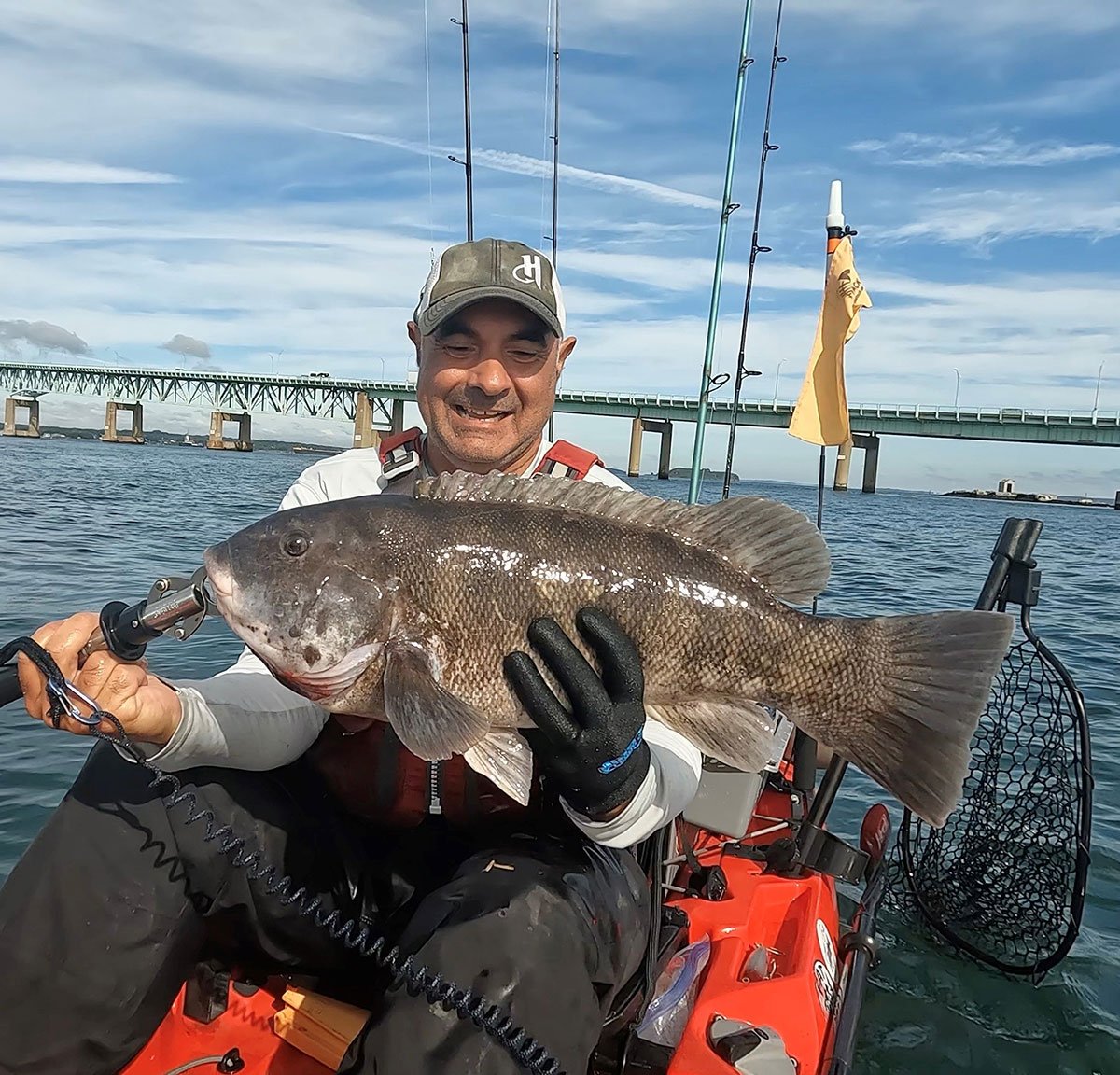
I have fished from a boat and kayak for blackfish and there are certain advantages that come with targeting them from a kayak. One of the biggest is being able to put yourself directly on pilings, under docks, in tight structure or even in whitewater that boats simply cannot fish without risking hull damage. My Hobie Outback has battle scars all over its bow from rubbing against pilings. If you are not bumping off a piling you are likely not on top of the tog.
I also find that with a spot lock motor or even with a pedal drive or anchor system you can keep yourself directly on top of fish in tighter spaces than you can with a boat. Boats certainly will win the distance game, but when fishing docks, bridges, or nearshore structure, a kayak can be a huge asset. On top of these advantages, togging from a kayak presents a unique challenge that makes it more fun than doing the same thing from a boat. And it’s 100% individual, you are responsible for your own success and preparedness.

Safety First
I want to wrap up with some important words on safety. With water temps dipping into the 50s and angry weather as fall gives way to winter, it is more important than ever to pick your days and pick your spots. You never want to get into a dangerous situation in a kayak, but the danger level increases quickly when the water is cold. So err on the side of caution when checking the forecast and make sure you have all the necessary safety gear, including a VHF radio (use coast guard channel 16 to report any marine emergencies) and a PFD. In fact, it is now mandatory in Massachusetts, Rhode Island and Connecticut: anyone using paddlecraft must wear a USCG approved PFD.
Another key item to consider once the water temperature drops below 50 is wearing a drysuit. The “120-degree” rule is what I typically use determine when it is time to put on the drysuit. Simply, put if the water and air temperature are less than 120 when added together, its time for a dry suit.
In late November of 2024, during the final days of the Coastal Kayak Clash, I had the opportunity to witness firsthand just how critical safety gear can be. It was a 50-degree day—windy and overcast—with water temperatures in the upper 50s. I was wearing my drysuit and fishing at a popular tog spot in Newport Harbor. It was a typical day until I heard someone calling for help. A man had fallen out of a nearby dinghy and couldn’t get back in. If I wasn’t prepared with a radio to call the Coast Guard, a knife to cut their anchor line and my dry suit to give me enough confidence that I wouldn’t become part of the emergency, that situation could have had a very different outcome.
Hopefully you now have a sense of how to effectively target late-fall tog, and how you can safely extend your season until the last fish vanishes in early December. Whatever the fall may bring, stay safe and stay Hook’d out there!