Dial in Smithtown Bay fluke with a simple formula—stay on the bait, make short drifts and fish light tackle for more hookups.
We’ve been very lucky in recent years to enjoy excellent fluke fishing in Smithtown Bay in May and June. Sadly, other spots along the north shore haven’t been as fortunate. For example, my friend Rich Lazar, who usually gets a solid run of fluke in late August and early September around Manhasset Bay, never had a run in 2025. Instead, he came out to fish with us in Smithtown Bay.
The flatties tend to gather wherever the bait is, so although we often fish the flats on the west side of Crane’s Neck, the fish may follow bait elsewhere. Two years ago the fishing was hot about a quarter mile off the Nissequogue River. In other years the best fishing was on the slope off Crab Meadow Beach, and at times along the east side of Eaton’s Neck. Several years back we spotted a cluster of boats off Northport fishing the drop-off from 40 to 65 feet, and we hustled over there.
It was calm, and in spite of the depth we were able to fish with light tackle by increasing lure weight to 1-1/2 ounces tipped with Gulp. That year the flatties were large and were attracted by hordes of 6-inch mantis shrimp. The fish were bunched up and it was difficult to make short drifts through the maze of boats, but we stuck to our guns and did well. Deep water or shallow, the philosophy remains the same: make short drifts, stay with the bait, and try to duplicate the drifts.
Short Drifting
The above highlights my main point. Namely, wherever we drift for fluke we follow a key basic doctrine that says “stay with the bait.” We often watch anglers make long drifts that take the boat briefly into bait, but then out of it into a mile of barren bottom. Typically, sand eel schools are isolated in specific areas because predators round them up, they collect around structure, or plankton food attracts them. Therefore, long drifts between sparse bait schools tend to be less productive. There are always exceptions, and in years of abundant bait with many bait schools, a long drift not only makes sense but can be more efficient.
However, that hasn’t been the case in recent years because sand eels haven’t been as abundant. That’s why we’ve been making short drifts through the bait, quickly repositioning the boat for another drift, and trying to find the same bait school. The shorter the drift, the easier it is to relocate the same bait school.
Evolution
It’s not just short drifts that increase success, although that is the major part of the plan. It’s also about matching tackle to conditions, using the boat effectively, and adjusting to weather and currents. Drew, Rich, and I continuously evolve the recipe for how we blend all of these elements.
It’s difficult to change habits—that’s why they’re called habits. Fluke anglers have their favorite baits and rigs that over the years have produced well for them. We’re no different, but at the same time we’ve been open to change. At different times, in different decades, we evolved from “drop and drag” with heavy sinkers and long leaders, to bucktails and squid, to what we use today: leadheads with Gulp.
Actually, it was Rich Lazar who introduced us to light leadheads with Gulp, and it opened new vistas of fluking enjoyment. The leadhead/Gulp combination has allowed us to use a greater range of presentations from aggressive to finesse, catch more fluke, and also helps us make short drifts.

Our Tackle Choices
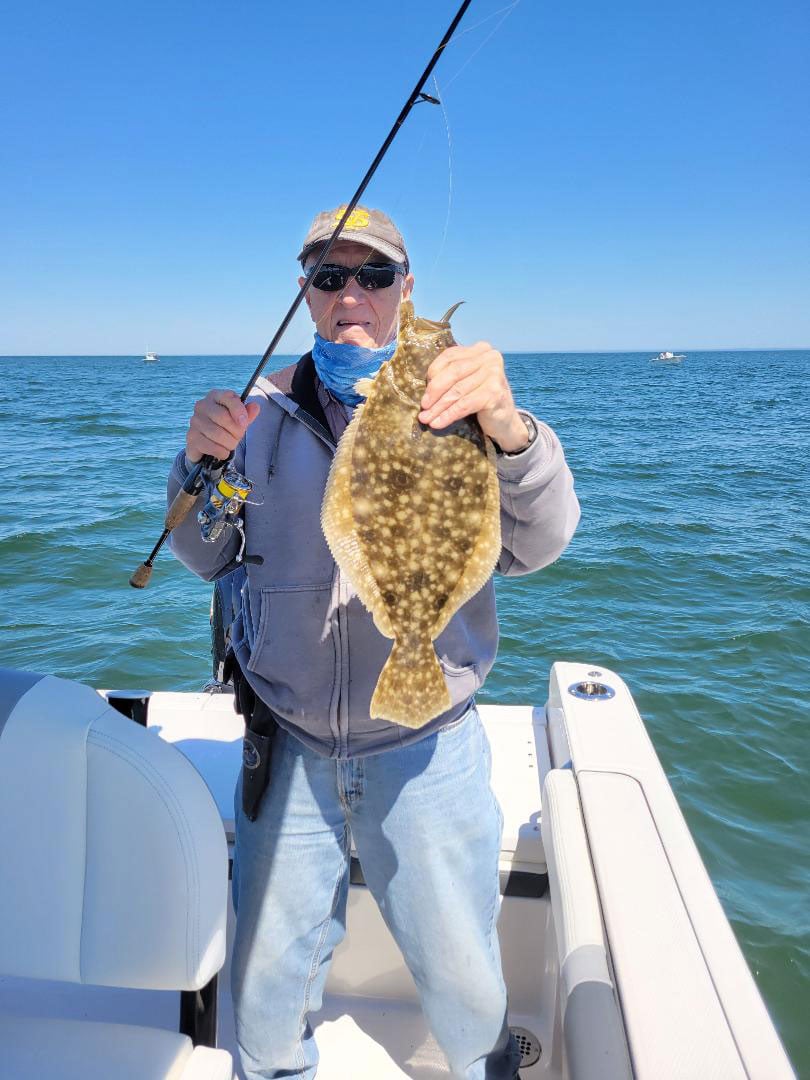
I’ve noted before that we basically fish with freshwater tackle for fluke. I admit we wouldn’t use this gear on the south side of Montauk or its rips off the point, but we can use it in most places in Long Island Sound from the Throggs Neck Bridge to Petty’s Bight. Six-and-a-half- and 7-foot rods with small reels and 10- to 15-pound braided line in Sufix Braid or Daiwa J-Braid are the setups. The finesse approach we use demands braided line since so many hits aren’t detected with monofilament line. We add a leader of about 18 inches of 20-pound-test monofilament to the braid with a Spro 50-pound Power Swivel and tie the leadhead directly to the leader.
Although conventional heavy “drop and drag” gear is sometimes necessary to manage current, depth, and drift speed, in calm water heavy gear can actually interfere with the ability to stay with the bait, repeat accurate short drifts, and make focused presentations. Still, many anglers cling stubbornly to previously successful methods, ignoring new technologies that improve success.
Technological Advances
In recent decades the rate at which new lures, lines, reels, rods, and depth recorders have improved has never been faster. For example, we once used tarred cord with big hooks for blackfish, but that seems absurd today. Surf rats once used split bamboo rods and linen line, but wouldn’t be caught dead doing that now. There is no doubt that better technology has facilitated the ability to stay with the bait and catch fluke because it allows us to respond faster. Since we have these technologies, why not use them?
Technology has made light-tackle finesse fishing for fluke not only possible but more productive as well. That’s why open-minded anglers have come to favor these advances in gear and technique. First, it’s a lot more fun than dragging. It’s also more interactive because the angler is always in touch with the bait and can sense the slightest pickup. Dragging with heavy tackle means the sinker trundling along the bottom produces most of the sensations. With a light leadhead and Gulp, the contact is much less about the leadhead and more about the subtle changes in “feel” that happen when fluke take the lure gingerly. Many fluke hits are either not detected or missed with heavy gear, but the subtlety of a finesse approach permits detection of the lightest hits. Finesse fishing means we employ subtle small movements that don’t spook fish and allow us to entice and cajole fluke into committing.

Coping With Conditions
Staying with bait schools becomes more difficult when the wind is stronger because it increases the speed of the drift. The same problem arises in a current or in deeper water. When necessary, one of us manages the drift speed with the engine, and once the bait is off the screen we make a quick about-face back to the bait. Some anglers deploy a drift sock, but we don’t use one because of the time needed to deploy and retrieve it. The time spent playing with the drift sock moves us away from the bait and prevents us from making short drifts.
At times the fishing can be fast-paced, similar to chasing birds when jigging. If you’re slow, you lose. That’s why we keep a close eye on the recorder as we fish, and the second the bait is off the screen we reel in and double back. I don’t rely only on the depth recorder. I also take ranges—three in fact—so I can triangulate. Without shore ranges it is very easy to be off by a small amount and miss the bait. Drew is very good at ranges and when we fish together I count on him to get us straight.
It’s also important not to go too far ahead of the bait before beginning a drift, since the bait may move before the boat drifts into it. It doesn’t take a lot of time to reach bottom in most places, so as soon as we’re on the bait I put the boat in reverse to stop the boat and begin fishing.
It’s obvious from above that a precise plan works best with good teamwork. Even on the calmest days there are slight changes in gentle currents and little puffs of wind that push the boat a little this way or that, and off the bait. We take turns on the motor, keep it running, and adjust the drift when needed. Sometimes forward, sometimes reverse, and sometimes a tweak right or left. We also take turns netting the larger fish and quickly switch positions at the wheel if the motor man is into a fish.
Patience Wins
What’s the hurry? It’s the fight that’s fun, not the strike, so be patient. Since more hits are felt by the angler with light gear, there is often more action onboard, but the angler needs to remember that many of the hits felt are very light. That means the fluke may have the Gulp in its mouth, but not the hook. So it’s important not to strike and to be patient. I like to hold my rod a little high, and when I feel a bite I simply slowly lower my rod tip toward the water and then lift the tip an inch or so very, very slowly. If I feel weight I continue to raise the rod tip. If the fish falls off, I immediately drop to the bottom and often the same fluke will quickly hit again.
Fluke are predators and are usually persistent in an attack, albeit often with less enthusiasm than a bluefish. It’s easy to understand why keeping an angler at the helm improves the hook-up ratio. Without boat adjustments, the lure could be dragged away from an interested but unenthusiastic fluke.
It isn’t rocket science. Instead, it’s about using a few factors carefully. These are good weather, a moving tide, schools of bait, short productive drifts, finesse tackle, boat handling, and patience before setting the hook. Combine these in a positive way and you’ll not only catch more fish, but have more fun as well.