
The October playbook for hunting giant blues!
There’s something nostalgic about getting blues in the fall, like history says it should happen. These days, blues are harder to come by, but I see some of the biggest fish of the year right around the time the tautog bite is really kicking off. Big blues are especially known for their “here today, gone tomorrow” tendencies. But that’s why I like them. A fish that is hard to pin down is a fish worth thinking about.
All the fish we target, from stripers to fluke to bluefin tuna, have certain character traits that we muse over, often endlessly. It could be an adaptation like the thresher shark’s long tail or the striper’s ability to feed in very dirty water, sensing what can’t be seen. It has do with ecology, the relationships of this to that. I don’t think I would fish if I didn’t find fish interesting. With big blues it’s their oceanic tendencies, how they wander, and how very few of us know where they wander to. Their bodies built to swim, their jaws designed to kill.
Years ago, I used to work on squid trawlers out of Point Judith. In the winter we’d fish out in the canyons. It was pretty common to catch winter blues out on the edge of the 100-fathom curve. These blues had a different look to them, they were big, stuffed with squid, and had colors reminiscent of a bigeye tuna; dramatically counter-shaded, black on top, silver on the sides, white on the belly. I reasoned that they had spent so much time at sea that they changed their colors to match it. My younger fish brain marveled at these fish, so different than the fish I’d caught in Narragansett Bay.

Respect The Blues!
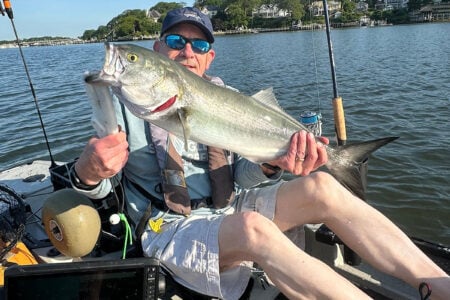
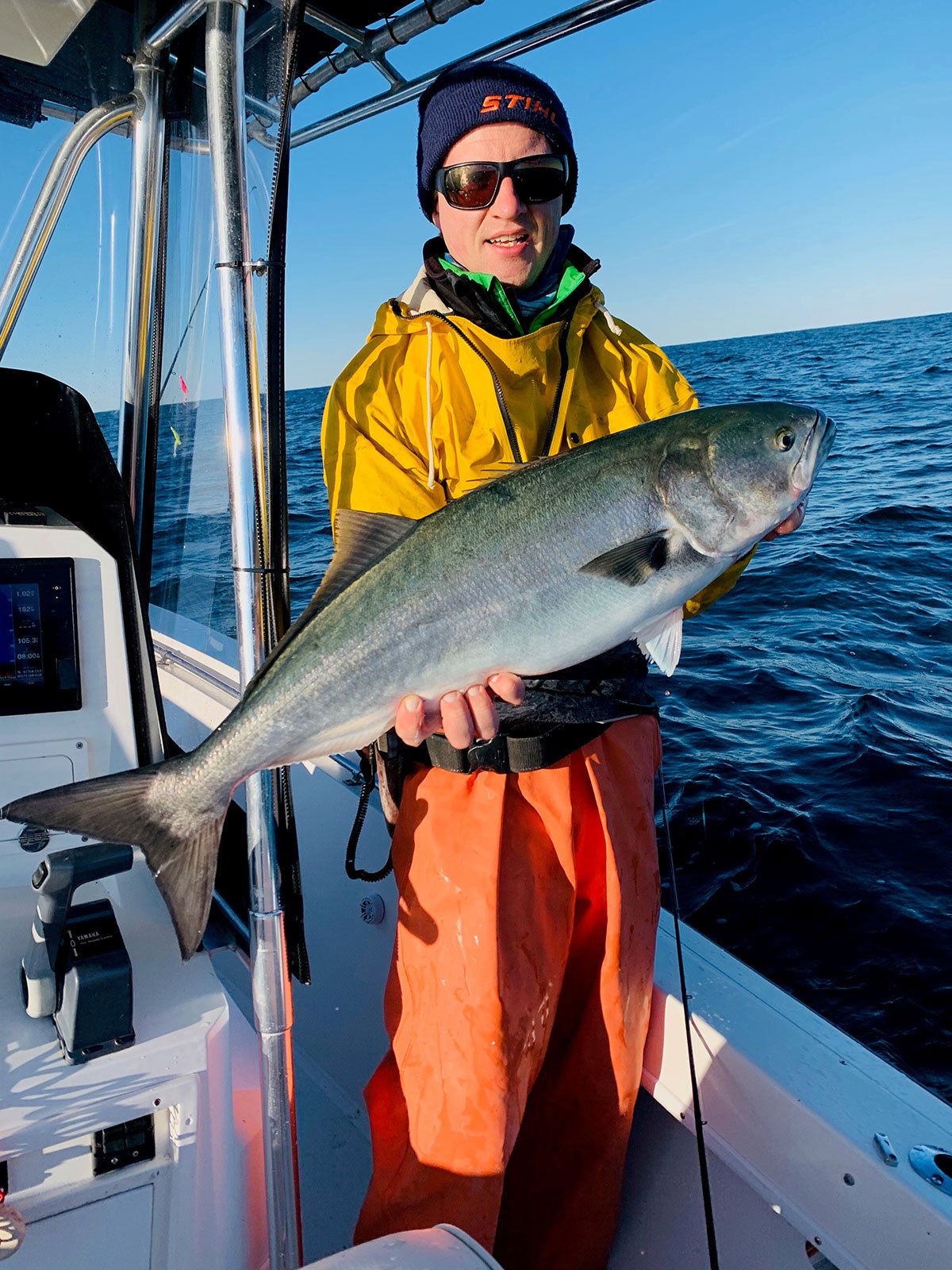
These days, it seems that big blues are more of bycatch for most, landed while targeting stripers, or chomped down on a hooked scup. Sometimes we hear from a friend that some big gators settled into a certain spot and we go out and give it a try. All of us have a big bluefish story. Every surfcaster I know has hooked a giant at night while crawling some piece of wood through the boulders and never forgot it. Any blue over 15 pounds is a good one; over 18 is a real good one; and one over 20 is a giant.

Bluefish also get a bad rap among certain segments of fishermen, they break off expensive lures, chase out bunker, chomp prime eels and can cause mayhem when landing. It seems to me that all of that is forgotten when someone hooks a big one, they don’t give up, they jump, they dive, they roll and tail-walk… and then when you finally grab the leader, they clamp down so hard on the hook or lure, daring you to pry open those razor-lined jaws. I have books that were written about blues in the 1970s and they were beloved, maybe we need to adjust our collective opinion of these amazing fish?
So far, I’ve had a good bluefish season in 2025. But I can’t speak to how anglers did other places; Long Island Sound or Nantucket. But around Block Island we had pulses of blues from June on. The fish would settle in for a few weeks, take off, come back, only to take off again. I had no real big fish. Nothing over 14 pounds. Those big ones, come now, in the fall. Last October and into November I had fish to 21 pounds.
Big Blues At Block
There are a few places around the Island that consistently hold gators in the fall. All the spots are deep or adjacent to deep water. You have the East Grounds off the east side of the Island. This rocky shoal can be very good but they aren’t a guarantee. In September into early October if the northern halfbeaks are present, you can often have great runs of big blues mixed with false albacore. Most of the fishing happens near the high spots in 55 to 65 feet.
From the East Grounds you can easily see the five windmills off the southeast side of Block Island. These often hold blues and there are big ones mixed in during the fall. Blues love the structure of the windmills and they also love the depth. It’s 70 to 80 feet at the windmills. This is structure fishing. You don’t need bait or birds for the blues to be here. Send a Diamond Jig or Flat-Fall down and see what comes out to greet it.
Outside the windmills is Sharks Ledge. This is traditional codfish bottom. It has depth and rocks. But in the late fall the big blues often pile up here. Most these fish are hooked while targeting sea bass or codfish. One of my biggest blues, was hooked this way, down deep in 110 feet of water, snapping a Flat-Fall Jig.
Or you can head for Southwest Ledge off the Southwest Corner of the island. This rock shoal with lots of tide is probably the most famous local piece of bluefish bottom. The blues can be anywhere on it. There are high spots and low valleys. There are deep spots nearby. This is the land of wire line fishing, but jigging works too. Often the blues don’t mark on the machine—but you should assume that a few are holding tight to bottom, and often in the fall, the blues we catch here are monsters that have that offshore, almost tuna-like, look.

Hunting Monsters
I use birds. But I really look for a specific kind of bird, the northern gannet. The smaller gulls, like the laughing gull are also good fish indicators but often herald smaller fish, like bonito, and smaller blues and bass. The gannets are on bigger bait. You don’t need a National Geographic type gannet show. Just a few birds flying in ‘search mode’ is enough to get my attention. Search mode with a gannet is flying maybe a 100 feet above the water with its head bent down toward the sea. If I see one plunge in, even better.
Then I troll, often with umbrella rigs. Blues love the spinning tubes. I set the wire fairly shallow. The blues will rise for an umbrella rig. So if the gannets are working over water that is 80-feet deep I will troll the wire so it gets down 25 feet, or so. This type of trolling is just searching to see if anything is there; seeing if I can raise a fish. It has nothing to do with fishing specific pieces of bottom. If I hook up I will then work the area with spinning rods. Either with metal jigs (Diamond, Flat-Fall, etc.) or trolling deep-diving swimmers, one I like is the Yo-Zuri Crystal Minnow Deep Diver.
More times than not there is not a classic feed going on. I get out there and all I see is empty ocean. The only gannets around are sitting on the water. If this is the scenario then I will structure fish for big blues, hitting my striper spots. The more prominent the piece the better. In the fall these pieces don’t get nearly the fishing pressure they see during the spring and summer months when the stripers draw in big crowds. I will troll around these spots trying to swing the boat up tide of the pinnacle so the lure crosses over the face of the rock. Often you get a big gator or two. I keep the trolling speed slow for big blues, sticking with striper speeds of around 3.5 knots. If a spot puts out more than one good fish, I’ll set up a drift and jig the spot, sending fluttering metal down into the deep. The hits are sharp and impressive, pulling a monster gator out of 85 feet of water is a true test of any angler’s stamina.
More Possibilities
Looking ahead to the future, love ‘em or hate ‘em, I think the new wind farms will hold big blues. Every mile a piece of massive structure juts out of the sea, life will congregate there and so too, will the blues. I bet they will love it there; deep ocean, concentrated bait and structure. This season the sand eels were around the wind mills, big sand eels, huge clouds of them. The bait drew the tuna and the whales. I think the blues will hang close to the wind turbines, seeking shelter from the predators, then making feeding missions. I’d bet we’ll see those ocean blues there, dark-backed fish with bright silver sides. It wouldn’t surprise me if these offshore structures produced some of the biggest ones we see.
Maybe that will be the subject of my next article on big bluefish. But a lot will have to happen before the pen hits paper. And that will have to begin with my speculations being correct. For now, I’ll look forward to my October runs to the island, dropping jigs and trolling for these late-season giants. It never gets old, watching a client on my boat who hasn’t caught a truly large bluefish struggling to maintain control over one of the toughest fish we have in our little corner of the Atlantic.