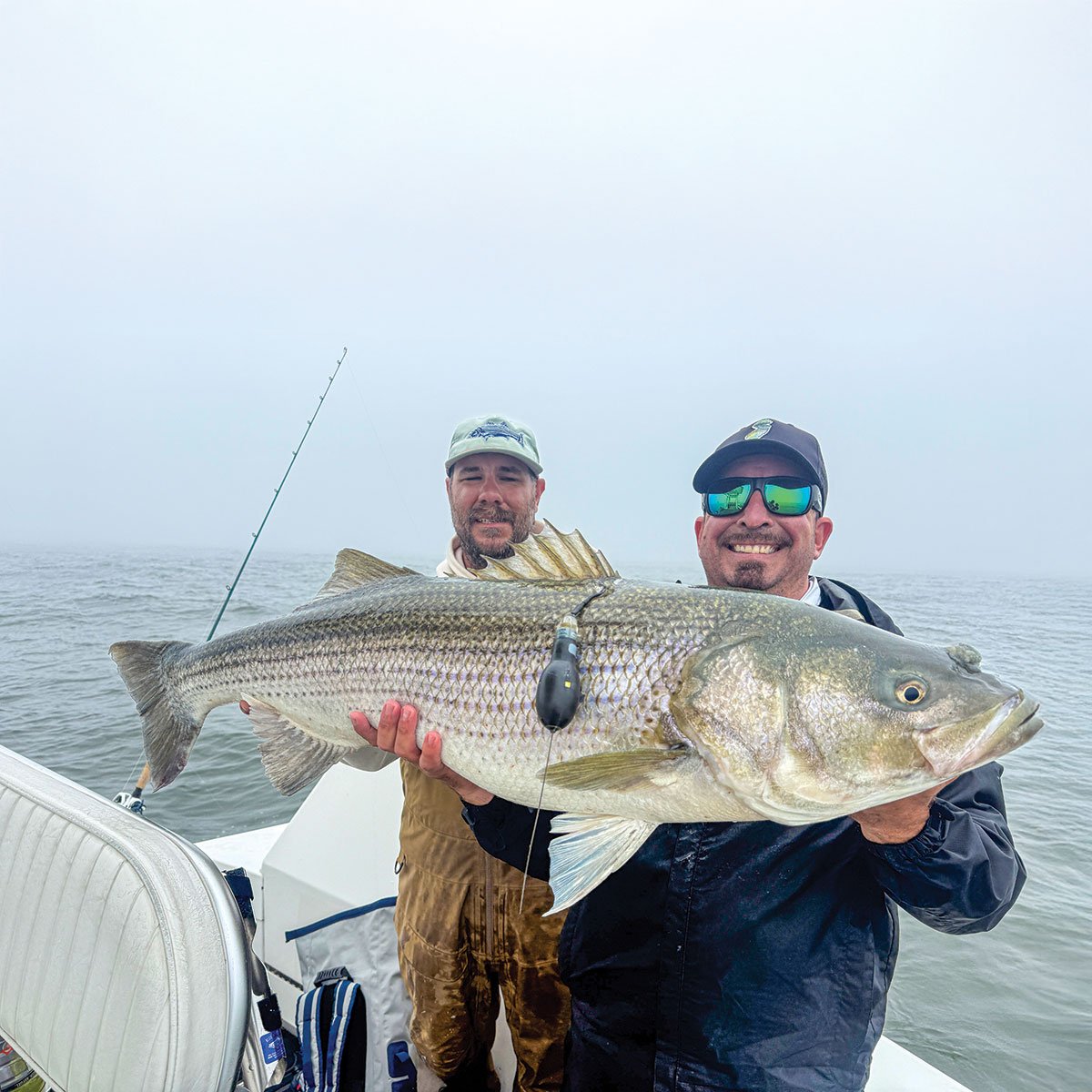
The quest for additional striped bass data continues with StriperQuest.
October is a busy month for striped bass, and not just from a fall run perspective.
This month, the Atlantic States Marine Fisheries Commission (ASMFC) is looking at public comment on a couple of major management fronts, first with an Atlantic Striped Bass Stock Assessment Data Workshop from October 6-9, 2025 in Arlington, VA, the first in a series of workshops to develop the next Atlantic striped bass benchmark stock assessment for 2026 and 2027.
The ASMFC and its Atlantic Striped Bass Management Board (Board) are also accepting public comment through October 3rd on Draft Addendum III to Amendment 7 to the Interstate Fishery Management Plan for Atlantic Striped Bass, which considers management measures to support rebuilding the stock by 2029.
On the latter, most Atlantic coastal states (Maine through Virginia) have already hosted meetings to collect input from the community on a proposed action intended to increase the probability of meeting the striped bass rebuilding target of 247 million pounds of spawning stock biomass by 2029. The official public comment period ends on October 3.

According to the ASMFC’s most recent stock projections, an increase in recreational fishing mortality in 2024 and 2025 puts the probability of reaching the 2029 deadline and target at less than 50%, prompting the Board to initiate the draft addendum to reduce striped bass fishery removals by 12% with management measures implemented in 2026. In the recreational fishery, the Draft Addendum considers season closures and/or size limit changes.
“The most recent stock projections estimate an increase in fishing mortality in 2025 due to the above average 2018 year-class entering the current recreational ocean slot limit,” ASMFC noted in an August 27th bulletin announcing the public hearing dates in September, adding “There is also concern about the lack of strong year-classes behind the 2018 year-class.”
For the commercial fishery, the draft addendum also proposes a similar commercial quota reduction. Input gathered through October 3rd will ultimately be considered at the ASMFC’s annual meeting being held in Dewey Beach, DE from October 27 through October 30.
As for the next benchmark stock assessment for striped bass, the Atlantic Striped Bass Stock Assessment Data Workshop will be reviewing all available data sources for Atlantic striped bass, and is expected to identify data sets to be incorporated in the assessment. In advance of the next full-scale assessment of striped bass being conducted next year – and then under peer-review in 2027 – ASMFC is openly soliciting data sources that will contribute to the goals of the assessment, including “data on landings and discards, catch per unit of effort, biological samples (length or age frequency), and life history information (growth, maturity, fecundity, natural mortality).”
More data is always a good thing.

Best Available
The ASMFC generally conducts two types of stock assessments, a “benchmark” stock assessment and a stock assessment “update.” A benchmark stock assessment is a full analysis and review of the stock condition that’s focused on consideration of new data sources and newer or improved assessment models. “This assessment is generally conducted every three to five years and undergoes a formal peer review by a panel of independent fisheries scientists,” the ASMFC website explains. On the other hand, a stock assessment update incorporates data from the most recent years into the peer-reviewed assessment model in order to determine current stock status.
The last benchmark assessment on striped bass was released in 2019 and used updated recreational catch estimates. Based in large part to those new findings from the Marine Recreational Information Program (MRIP), the 2019 benchmark assessment found the stock to be overfished because it was short of the target, and experiencing overfishing because the rate of removals was too high to reach the target. As a result, Addendum VI to Amendment 6 was initiated to end overfishing of striped bass, which ultimately resulted in all state commercial quotas by 18%, and a reduction in the total recreational removals by 18%, leading to the first ever ocean slot size on striped bass for the 2020 season.
One rather interesting finding from the 66th Northeast Regional Stock Assessment Workshop (SAW) Assessment Report completed in April of 2019 was this:
“Striped bass are not usually found more than 6 to 8 km offshore (Bain and Bain 1982), however, Kneebone et al. (2014), using acoustic telemetry, found that adult fish that aggregate on Stellwagen Bank, located in the U.S. Exclusive Economic Zone (EEZ) and beyond the 12-nautical mile territorial sea, move inshore as part of their normal migratory and feeding behavior.
Additionally, Fishery independent data collected by North Carolina DMF, ASMFC and USFWS (i.e., North Carolina Cooperative Winter Tagging Program) suggests striped bass distribution on their overwintering grounds during December through February has changed significantly since the mid-2000s. The migratory portion of the stocks has been well offshore in the EEZ (>3 miles), requiring travel as far as 25 nm offshore of Chesapeake Bay to locate fish to tag (ASMFC 2018).”
One month after the 2019 SAW report, The Fisherman Magazine and Gray Fishtag Research launched a striped bass tagging project on the lower Hudson River, deploying a pair of satellite tracking tags in two post-spawn Hudson River striped bass. These Wildlife Computer MiniPAT tags were designed to track the large-scale movements and behavior of fish, which in this case included a pair of stripers that we named Liberty and Freedom. These unique, high-tech tags store light, depth and temperature data while attached to the fish, and are programmed to release from the host after a pre-set time, which in Liberty and Freedom’s case was October 21.
The sat tag affixed to Liberty, a 34-inch striper, released earlier than planned and was found along a Massachusetts beach in early July that year. Once that MiniPAT was analyzed back at the Gray Fishtag Research headquarters in Florida – and with the help of Wildlife Computers – the data revealed that “Liberty left New York Harbor for the Jersey Shore in late May before traveling towards the South Shore of Long Island and ultimately spending much of June in parts of Ryan, Nantucket and Clipper canyons, a 300-mile trip in the span of 49 days.”
The second MiniPAT device from the 42-inch striper named Freedom washed up along the beaches of Asbury Park, NJ in October. From the light, depth and temperature data inside that device, it revealed that Freedom spent the better part of July and all of August covering ground on the shoals outside of Massachusetts state waters, before heading northwest into Rhode Island Sound. “For inshore fishermen and surfcasters in particular, Freedom didn’t make herself too available for capture for very long, ultimately sticking to the Exclusive Economic Zone (EEZ) for travel purposes,” is how I described it in a summary for the January, 2020 edition of The Fisherman.
Newly Available
From that first deployment in the spring of 2019, and into the fall of 2024, Gray Fishtag Research and The Fisherman, thanks to the generous support of our Northeast Striped Bass Study partners, deployed a total of 32 satellite tracking devices in 32 different striped bass from Virginia to the east end of New York, 15 of which were found and returned to Gray Fishtag Research. A simultaneous tagging effort with partners in the angling community has resulted in nearly 8,000 green streamer tags deployed along the Atlantic Coast, with hundreds of returns already registered.
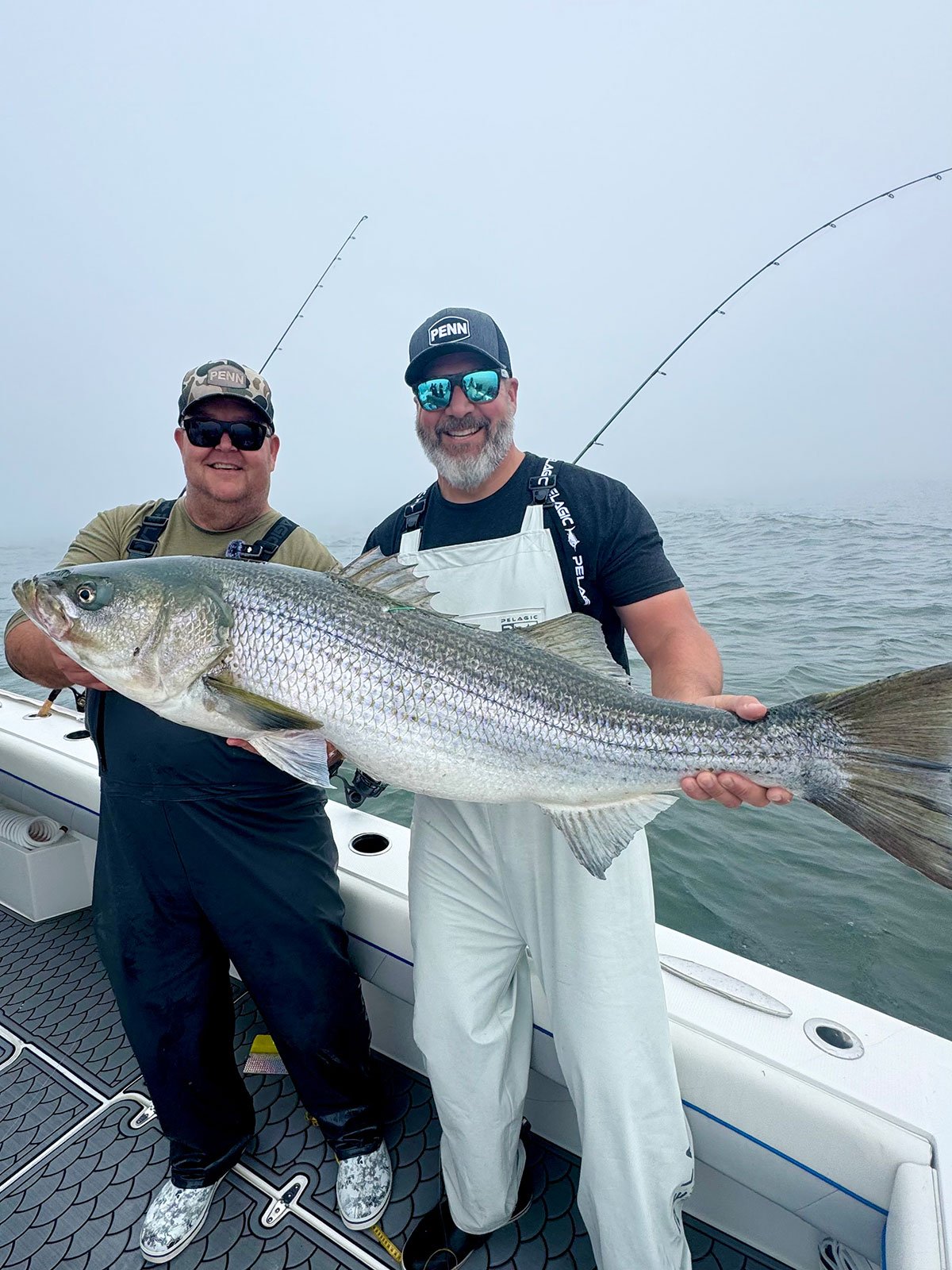
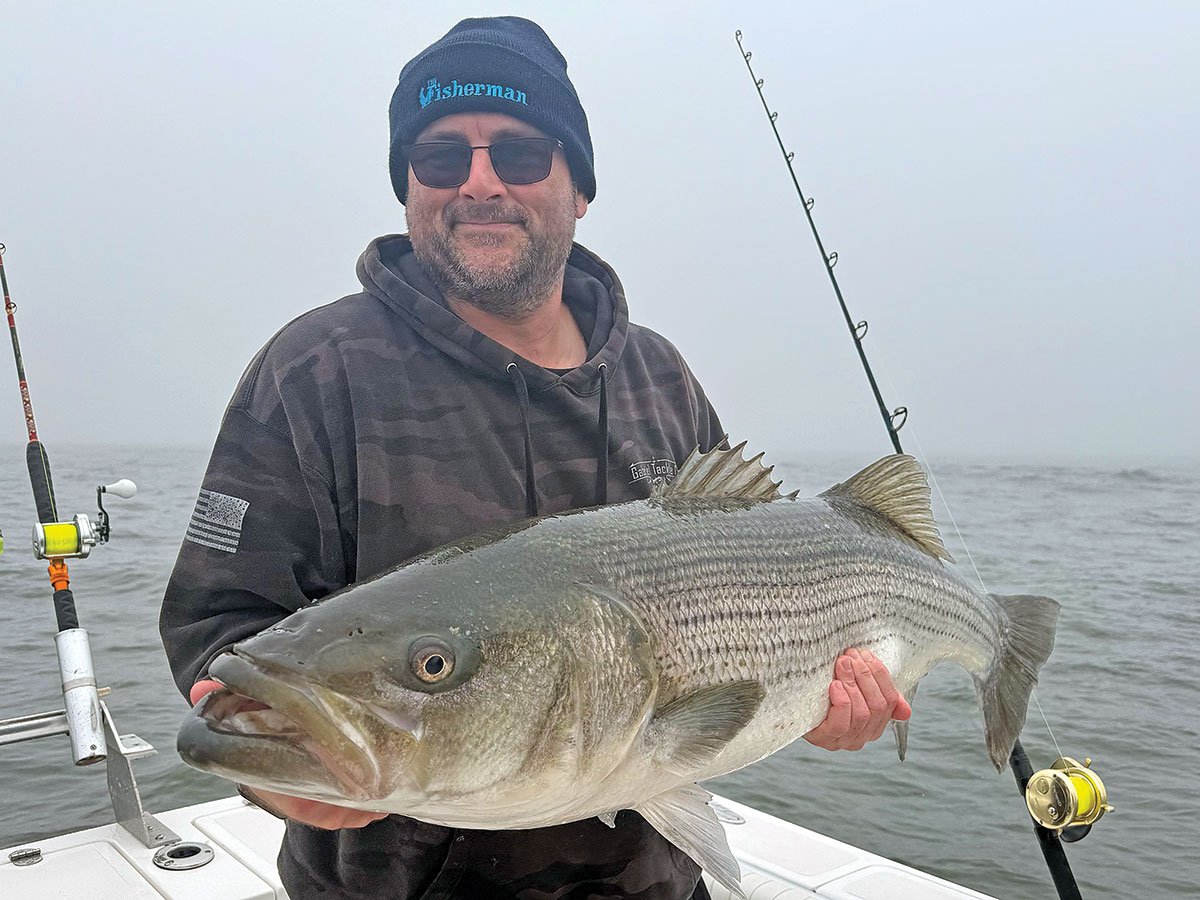
We have also opened up our Northeast Striped Bass Study to the public, with our annual spring StriperQuest event now bringing in study sponsors from around the country – and as far away as Costa Rica – to participate in a single day of sat tag deployments and streamer tagging. On May 14, 2025, our third annual StriperQuest event on the Raritan Bay saw 25 teams with 125 anglers, captains and mates coming together in the name of science for our third annual striped bass tagging competition. Together, we tagged and released over 300 striped bass and deployed three satellite tags, with two more to go this month.
The crew of Tom Streahle, Ryan Anderson, Michael Zedek and Missy Alcorn took top honors in this year’s public tagging competition, with the Ol Dirty Basser Crew limiting out on 25 Gray Fishtag Research tags which tied their team with teams from Rockfishsmartie and Fisher Price Sportfishing. Tom, Ryan, Michael and Missy caught and released the first fish of the day though to break the three-way tie for 25 catch, tag and releases, going on to win the day’s Calcutta for largest catch, tag and release of the day at 47-1/2 inches.

The 300 streamer tags and three sat tagged fish set a new benchmark for the Northeast Striped Bass Study in 2025. This year we also introduced a MicroPAT satellite tag from Wildlife Computers. This state-of-the-art tracking device is designed to study smaller class fish. Unlike previous years where we tagged larger class fish in the mid 30- to upper 40-inch range, this new technology allows us to attached a device to a 29-inch striped bass candidate to perhaps compare migration patterns to our past larger class fish.
All three tags deployed in mid-May were programmed for five months, which means we expect to hear more about the summer migration of these fish sometime this month. And of course we have another two tags to deploy at some point this fall to track the southern migration, five total for the 2025 season.
Over the course of the next several months here in The Fisherman – starting in the November edition – we’ll be sharing charts created using the light, depth and temperature data stored in those tags. Ideally, each of these satellite tracking devices, whether the MiniPAT for larger fish or the MicroPAT deployed on a 29-incher, will be physically retrieved. However, a battery enabled in each device allows the uploading of data stored inside the tag itself to the Argos satellite overhead, once that wet/dry sensor comes in contact with air at the ocean surface.

Citizen Science
What can we learn from taking a sneak peek at a 4- to 6-month migratory pattern for striped bass? Thus far we’ve seen what believe to be some staggering trends with large stripers – per the tracking info in those MiniPAT devices – traveling farther offshore in the EEZ for longer periods of time. As with the ASMFC’s own data revealed in the 2019 benchmark assessment, it appears as if the migratory portion of the striped bass stock has been well offshore in the EEZ, often as far as 25 nautical miles or more from shore.
| NORTHEAST STRIPED BASS STUDY |
| Over the next few months, The Fisherman will be working with Gray Fishtag Research on the release of data received from the four MiniPAT devices and one MicroPAT device deployed at StriperQuest back in May. While all five satellite tags were programmed to stay on the fish for 5 months, we did learn in August that one of those tags deployed on Chuck Many’s Tyman on May 14 released early after six weeks. According to Roxanne Willmer from Gray Fishtag Research, the MiniPAT released offshore of Rhode Island, and has since been retrieved with an initial analysis of the contents. “The migration track followed the similar route as many in the past making its way to the Nantucket Shoals,” Willmer said.
Beginning in the November edition of The Fisherman, we will begin publishing details of this and the other four fish carrying the high tech tags produced by Wildlife Computers over the course of this past summer. To learn more about the Northeast Striped Bass Study and findings thus far, point your cellphone camera at the QR code to A huge thanks to our continuing sponsors of the Gray Fishtag Research and the Northeast Striped Bass Study, including American Fishing Wire (AFW/HI-SEAS), Berkeley Striper Club, Fisheries Conservation Trust and the Manhattan Cup, Hudson River Fishermen’s Association, Penn, Seaguar, Yamaha, Yo-Zuri, and the Many, Glassberg and Nova families. |
Who’s to say what’s happening with the larger spawning class fish that make up the entire spawning stock biomass, and how can data collected from the Northeast Striped Bass Study be integrated into future assessments? What we do know is that back in June of this year NOAA Fisheries issued a news alert titled How Does Citizen Science Support Fisheries Stock Assessments? According to the bulletin, new research from NOAA Fisheries indicates potential to expand the use of citizen science data in stock assessments and provides recommendations for the integration of this type of data in the future.
According to NOAA Fisheries, a “citizen scientist” is a volunteer who participates in one or more aspects of the scientific process, such as data collection. In terms of stock assessments and the use of “citizen scientist” data, the federal fisheries agency noted how the authors of this new publication were interested in examining the role of citizen science in NOAA’s mission to produce stock assessments for management.
NOAA Fisheries said they’re looking to expand and improve the data available for the scientific analyses that they provide to managers, explaining in their June bulletin that it’s important to consider all the different ways they can collect data to improve the science while also working together with the stakeholders.
“The primary mechanism through which we’re seeing citizen science contribute to stock assessments is through the support of fish tagging efforts,” notes Jeffrey Vieser, co-author and data product manager for ECS in support of NOAA Fisheries. “But that’s challenging, because citizens’ contributions require that they land a tagged fish. It’s almost like asking them to win the lottery in order to contribute.”
Well Mr. Vieser, I’ve got some lotto numbers for you if you’re ready to play; try 844 824 8353. That’s the phone number for Gray Fishtag Research, where you can access the tagging data from 15 high-tech tracking devices and at least 300 returns from striped bass that citizens have tagged in the name of science, and sport, along the Atlantic Coast through our ongoing Northeast Striped Bass Study.
Tag, you’re it.